
TL;DR

Get kitchen staples and gadgets delivered free with Prime
- Fast, free delivery on millions of items
- Prime Video, Amazon Music and more included
- Member-only deals all year
Good Housekeeping’s Nutrition Lab director recommends canned pumpkin as a convenient pantry ingredient, citing its beta-carotene, fiber and potassium. The report advises choosing plain pumpkin puree rather than pumpkin pie filling, which can contain added sugar and other ingredients.
Good Housekeeping’s Nutrition Lab director is recommending canned pumpkin as a convenient source of nutrients and an ingredient for year-round meals, not just seasonal baking. The report says a half-cup serving provides 100% of the daily value for vitamin A, while advising shoppers to choose plain pumpkin puree rather than sweetened pie filling.
The report’s author, a registered dietitian and director of the Good Housekeeping Institute Nutrition Lab, says pumpkin is rich in beta-carotene, the pigment that gives it its orange color. The body converts beta-carotene into vitamin A, which the report says supports vision and immune function. It also identifies pumpkin as a source of fiber and potassium.
Those nutrients do not make every canned pumpkin product equivalent. The report advises checking the ingredient list for 100% pumpkin puree, whose only ingredient should be pumpkin. Pumpkin pie filling, also sold as pie mix, can include added sugar, sweeteners, fillers and spices; shoppers seeking plain pumpkin should not assume the products are interchangeable.
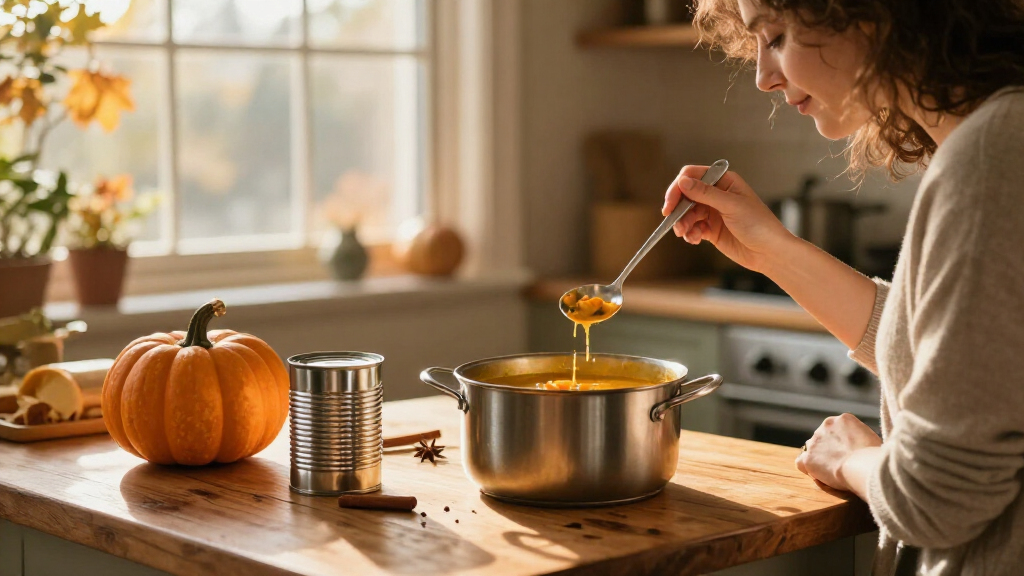
The dietitian suggests adding puree to smoothies, oatmeal, yogurt, soups and sauces, as well as baked goods. For leftovers, the report recommends transferring pumpkin to an airtight container and refrigerating it for three to four days, or freezing it in small portions. These are the source’s recommendations; the report does not provide a detailed nutrient comparison with fresh pumpkin or other produce.
A Pantry Ingredient Beyond Baking
The practical point is that canned pumpkin can be used in ordinary meals without requiring a whole pumpkin to be roasted and pureed. Its soft texture and mild flavor allow it to be stirred into both sweet and savory foods, giving readers a straightforward way to use a shelf-stable product across different recipes.
The distinction between puree and pie filling also matters for people checking ingredient labels or limiting added sugars. The report presents plain puree as the more flexible option because it contains pumpkin alone, while pie filling is formulated with additional ingredients. Its nutrition claims are useful guidance, but they do not establish that pumpkin alone can prevent illness or replace a varied diet.
Products Worth Considering

Cuisinart 14-Cup Food Processor, 720-Watt Motor, Stainless Steel, DFP-14BCNY

KitchenAid 13-Cup Food Processor, Contour Silver

Cuisinart Coffee Center Barista Bar 4-in-1 Coffee Maker
As an affiliate, we earn on qualifying purchases.
Why Plain Puree Matters
The report frames canned pumpkin as a year-round pantry staple that is especially easy to find in fall. It says the product is typically processed soon after harvest, which can preserve many of its nutrients. It does not provide processing data or a direct comparison showing how the nutrient content differs from fresh pumpkin.
In the report, “superfood” is a descriptive label rather than a formal nutrition category. The specific support offered is the stated vitamin A value for a half-cup serving and the presence of beta-carotene, fiber and potassium. The piece also emphasizes convenience and versatility, rather than presenting new clinical research or a change in dietary guidance.
“I consider canned pumpkin one of my favorite antioxidant-rich pantry staples.”
— The report’s author, a registered dietitian and director of the Good Housekeeping Institute Nutrition Lab
Limits of the Nutrition Claims
The source material does not identify the product or nutrition database behind the half-cup vitamin A figure, nor does it clarify whether the amount applies uniformly across brands. It also gives no head-to-head nutrient comparison between canned and fresh pumpkin, or between different canned products.
The report describes fiber and potassium as benefits but does not give their amounts per serving. It does not present clinical evidence that eating canned pumpkin produces a particular health outcome. The advice should be read as general food and shopping guidance, not individualized medical advice.
Check Labels and Store Leftovers
No follow-up study, product change or policy announcement is described in the source material. For readers applying the advice, the immediate next step is to check the can’s ingredient list and distinguish plain puree from pie filling before buying.
After opening a can, the report recommends refrigerating leftovers in an airtight container for three to four days or freezing small portions for later use. Readers with specific dietary needs can consult a qualified health professional for advice tailored to them.
Key Questions
Is canned pumpkin the same as pumpkin pie filling?
No. The report says plain pumpkin puree contains pumpkin, while pie filling may include added sugar, sweeteners, fillers and spices. Check the ingredient list rather than relying only on the front label.
What nutrients does the report identify in canned pumpkin?
It identifies beta-carotene, fiber and potassium, and says beta-carotene is converted by the body into vitamin A. The report states that a half-cup serving provides 100% of the daily value for vitamin A.
How can canned pumpkin be used besides pie?
The dietitian suggests stirring it into oatmeal, smoothies, yogurt, soups, sauces and baked goods. The report also lists energy bites and mac and cheese as possible uses.
How should leftover pumpkin puree be stored?
Transfer leftovers to an airtight container and refrigerate for three to four days, or freeze in small portions, according to the report.
Source: goodhousekeeping.com