
To get the best results from stainless steel cookware, you need to have patience with how you heat it. Stainless steel heats up slowly and unevenly if rushed, which can cause hot spots and uneven cooking. Taking your time guarantees heat distributes evenly, preventing warping and preserving its durability. This mindful approach not only improves your dishes but also extends the life of your cookware. Keep going to discover how mastering this technique enhances your cooking efficiency and results.
Key Takeaways
- Stainless steel heats slowly due to its poor thermal conductivity, requiring patience for even temperature distribution.
- Gradual heating prevents hot spots, reducing the risk of food burning or sticking.
- Steady, patient heating preserves the cookware’s structural integrity and corrosion resistance.
- Proper heat patience ensures optimal cooking results and prevents damage to the cookware over time.
- Mindful heating aligns with energy efficiency and extends the lifespan of stainless steel cookware.
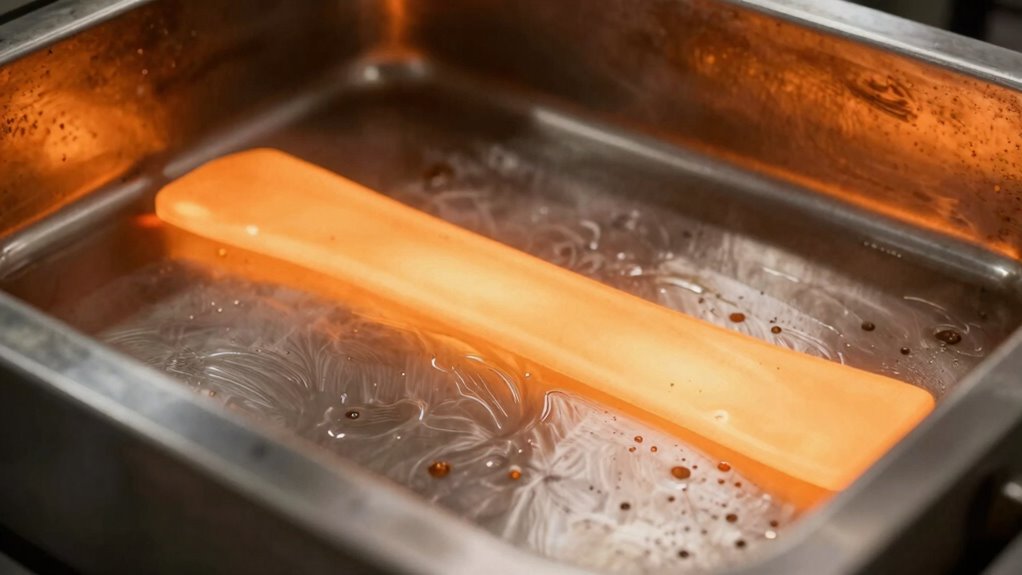
When it comes to cookware, stainless steel stands out for its durability and sleek appearance, but what truly sets it apart is its remarkable heat patience. This means that stainless steel can handle gradual temperature changes without warping or losing its integrity, which is essential for consistent cooking results. One reason stainless steel performs so well is its high corrosion resistance, allowing it to withstand moisture and acidic foods without rusting or degrading over time. This durability makes it a popular choice in busy kitchens where longevity matters. However, to maximize its advantages, you need to understand how heat interacts with stainless steel, especially in terms of thermal conductivity.
Unlike materials that heat up quickly, stainless steel has comparatively poor thermal conductivity. This means it doesn’t transfer heat evenly or rapidly across its surface. When you place stainless steel cookware on a burner, it takes a moment for the heat to distribute uniformly. This might seem like a drawback, but it’s actually a key reason why heat patience is important. With patience, you allow the heat to slowly and evenly permeate the entire pot or pan, reducing the risk of hot spots that can burn food or cause uneven cooking. Rushing this process can lead to frustration and inconsistent results. Instead, giving the cookware time to warm gradually ensures that heat is evenly spread, which is essential for delicate tasks like simmering sauces or caramelizing onions.
Allow stainless steel to warm gradually for even heat distribution and better cooking results.
The process of heat patience also helps you take advantage of stainless steel’s durability and corrosion resistance. As the heat gradually builds, the material remains stable, preventing warping or pitting that could compromise its corrosion resistance. This steady heating process means your cookware stays in top shape for years, maintaining its sleek appearance and functional integrity. Moreover, because stainless steel can withstand high temperatures without melting or releasing harmful substances, being patient with its heating allows you to cook at higher temperatures safely and effectively. Additionally, understanding the thermal properties of stainless steel can help you optimize your cooking techniques for better results. Recognizing the importance of heat distribution is essential for achieving consistent cooking outcomes and extending the lifespan of your cookware. Developing an awareness of metaphysical topics such as patience and energy flow can also enhance your overall approach to cooking as a mindful practice.
Furthermore, taking the time to learn about stainless steel’s heat patience can enhance your overall kitchen efficiency and reduce energy consumption, making your cooking practices more sustainable. Properly understanding these thermal characteristics allows you to plan your cooking process better and avoid unnecessary energy waste. In essence, understanding why stainless steel needs heat patience is about respecting its properties. Its corrosion resistance and thermal conductivity characteristics work together to give you a reliable, long-lasting cooking tool—if you’re willing to give it the time it needs to heat evenly. Patience isn’t just a virtue here; it’s a practical necessity for achieving the best results from your stainless steel cookware. With a little patience, you’ll enjoy perfectly cooked meals and a set of durable pots and pans that stand the test of time.
stainless steel cookware heat diffuser
As an affiliate, we earn on qualifying purchases.
As an affiliate, we earn on qualifying purchases.
Frequently Asked Questions
How Does Heat Treatment Affect Stainless Steel’s Corrosion Resistance?
Heat treatment enhances stainless steel’s corrosion resistance by refining its surface finish and improving mechanical properties. When you heat and cool the steel properly, it develops a uniform, smooth surface that reduces corrosion spots. Additionally, heat treatment strengthens the steel’s internal structure, making it less prone to cracks and rust. As a result, you get a more durable, corrosion-resistant stainless steel that performs better in harsh environments.
What Temperature Ranges Are Ideal for Heat-Treating Stainless Steel?
Imagine you’re in a medieval forge—crucial heat ranges for heat-treating stainless steel are typically between 1,600°F and 1,800°F (870°C to 980°C). Staying within this range promotes grain refinement, which enhances strength and toughness, while maintaining alloy stability. Temperatures outside this spectrum risk grain growth or alloy degradation, so precise control guarantees your stainless steel’s ideal performance and durability.
Can Improper Heating Cause Stainless Steel to Crack or Warp?
Improper heating can definitely cause stainless steel to crack or warp. When you heat it unevenly, thermal expansion creates stress within the metal, leading to distortions or cracks. To prevent this, make sure you follow proper heat treatments for stress relief, gradually heating and cooling the steel. This careful process helps avoid internal stresses that can cause warping or cracking, keeping your stainless steel components safe and durable.
How Long Should Stainless Steel Be Held at High Temperatures?
Waiting for stainless steel to reach the right temperature is like watching a sunrise—patience reveals its true beauty. You should hold it at high temperatures for about 15-30 minutes, depending on thickness. This allows heat penetration and guarantees temperature uniformity, preventing warping or cracking. Keep the heat steady, and check the temperature regularly to maintain consistent results. Rushing this process can compromise the metal’s integrity and finish.
Does Heat Treatment Change the Stainless Steel’s Color or Appearance?
Yes, heat treatment can change the stainless steel’s color and visual appearance. As you heat it, you’ll notice a color transformation—usually shades of blue, purple, or gold—due to oxidation layers forming on the surface. These changes indicate temperature levels and can affect the metal’s aesthetic appeal. If you want a consistent look, you’ll need to control the heating process carefully to manage the visual appearance during treatment.
induction compatible stainless steel pots and pans
As an affiliate, we earn on qualifying purchases.
As an affiliate, we earn on qualifying purchases.
Conclusion
Just like a gardener tending delicate plants, working with stainless steel requires patience and a gentle touch. Rushing the process can lead to mistakes or weak spots, but with steady heat and careful handling, you’ll shape it into something strong and beautiful. Remember, patience isn’t just a virtue here—it’s the secret ingredient that transforms raw metal into a masterpiece. Stick with it, and you’ll find that the results are worth every moment of waiting.
stainless steel cookware set with even heat distribution
As an affiliate, we earn on qualifying purchases.
As an affiliate, we earn on qualifying purchases.
heat resistant stainless steel cooking utensils
As an affiliate, we earn on qualifying purchases.
As an affiliate, we earn on qualifying purchases.