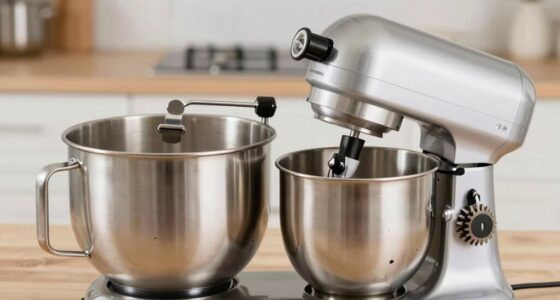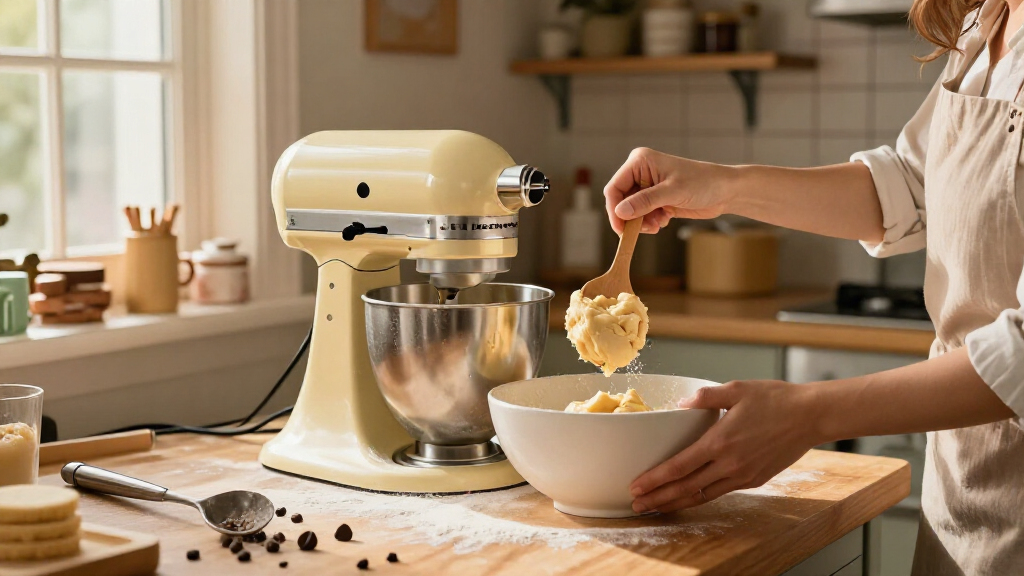

The KitchenAid Artisan 5-Quart Tilt-Head Stand Mixer is a versatile mid-range mixer for regular home baking, with a roomy stainless steel bowl, 10 speeds, and the core tools for mixing, kneading, and whipping. Its strongest case is the balance of useful capacity and everyday flexibility; its main drawback is that it is a heavy appliance to move and does not include KitchenAid’s optional hub-powered attachments. For households that bake in batches but do not need a high-capacity bowl-lift machine, it is worth buying when the tilt-head format and 5-quart size fit the work.

Get kitchen staples and gadgets delivered free with Prime
- Fast, free delivery on millions of items
- Prime Video, Amazon Music and more included
- Member-only deals all year
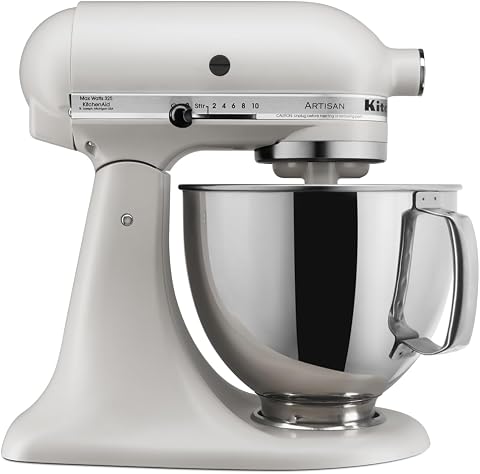
KitchenAid Artisan 5-Quart Tilt-Head Stand Mixer
- ✔ Brand: KitchenAid
- ✔ Model: KSM150PSMH
- ✔ Capacity: 5 quarts
Why This Product Stands Out
The Artisan’s appeal is its middle-ground capacity and flexible format. A 5-quart bowl is large enough for many family-sized baking jobs, with product information citing batches of up to nine dozen cookies, yet the tilt-head layout stays more approachable than a larger bowl-lift mixer for routine access. It occupies a useful position between compact mixers meant for lighter workloads and bigger machines intended for especially large batches.
That makes it a strong fit for a home kitchen where the mixer will handle several kinds of work rather than one narrow task. The 10 speeds and three core mixing tools cover common needs: a flat beater for general batters and mixtures, a dough hook for kneading, and a wire whip for aerating. These are not unusual extras in this class; their value is that the mixer arrives ready for the main jobs most home bakers actually do.
The tradeoff is less compelling for buyers at either end of the workload range. If frequent large dough batches are routine, the KitchenAid 7 Quart Bowl-Lift Stand Mixer is the more relevant comparison because its larger capacity is better aligned with that demand. If countertop space and easy handling matter more than bowl volume, the Artisan Mini’s 3.5-quart bowl and smaller format may be a better match. The Artisan 5-Quart is most convincing for the broad middle: regular baking, varied recipes, and batches that outgrow a compact machine.
Key Features and What They Mean
The 5-quart stainless steel bowl provides meaningful room for cookie dough, cake batter, and other household batches. Its cited capacity of up to nine dozen cookies gives a useful sense of scale, although real capacity depends on the recipe and mixture. For someone who bakes for family gatherings or prepares several portions at once, a larger bowl can save time by cutting down on separate mixing rounds. Occasional bakers making small portions may not use all that space.
Ten speeds allow the mixer to move from gentler combining to faster beating and whipping. This matters because different mixtures respond better to different levels of agitation: starting gently can reduce splashes, while higher speeds help incorporate air into suitable mixtures. The range is a practical everyday feature, not a substitute for choosing the right attachment or following recipe instructions. Most buyers will value the control, but a person who only makes simple batters may rarely use every setting.
The tilt-head design lifts away from the bowl area so ingredients are easier to add and the bowl and attachment are easier to access. That convenience is particularly noticeable during recipes that call for adding ingredients in stages or checking the mixture partway through. It is a familiar format for countertop home mixers, and it avoids the separate bowl-lifting mechanism found on larger models. Buyers who routinely work with heavy, high-volume mixtures may prefer comparing it with a bowl-lift model rather than assuming the tilt-head is right for every workload.
The included flat beater, dough hook, six-wire whip, and pouring shield give the machine a credible starting toolkit. The beater handles general mixing, the hook is intended for kneading, and the whip serves tasks where incorporating air matters. The shield can help manage splatter when adding ingredients, though it does not make every messy recipe effortless. These pieces are useful for a varied baking routine; hub-powered attachments are optional extras, so specialty uses depend on additional purchases.
At 14.1 × 8.7 × 13.9 inches and 22 pounds, the Artisan needs a stable countertop spot and is better treated as a resident appliance than something to carry around casually. The weight can support a steady setup, but it limits convenience if cabinet storage is the only option. The 1-year limited warranty is a defined coverage period, not a reason to assume trouble; still, buyers who prioritize longer included protection may want to weigh that policy against competing options.
Performance and Real-World Use
For routine home-baking work, the Artisan’s setup is straightforward: place the bowl, fit the appropriate attachment, and select one of its 10 speeds. The tilt-back access and familiar attachment set should make it practical for switching between a batter, a whipped mixture, and dough without requiring a specialized machine for each job. The pouring shield can help contain some mess while ingredients are added, although careful speed selection and sensible filling remain important.
Its likely day-to-day advantage is having enough bowl room for larger household recipes without stepping up to the bulk and format of a 7-quart bowl-lift model. A 5-quart bowl can still feel undersized if the plan is repeated large batches, dense dough, or production-style baking. For those workloads, the larger KitchenAid bowl-lift alternative is the more suitable direction. The Artisan is better understood as a capable home mixer, not a guarantee that every recipe can be doubled or tripled in one go.
The main practical inconvenience is moving and storing a 22-pound appliance. Buyers with permanent counter space are less likely to mind; anyone who must lift it from a high shelf or carry it between rooms should treat the weight as a serious fit issue. The listed 325-watt power figure alone does not establish how well it will handle every heavy mixture, so frequent intensive kneading is a reason to compare larger models and check their intended workload. Routine upkeep is relatively uncomplicated: the bowl and included accessories need cleaning after use, and the attachment choice should match the task.
Who Should Buy This
Buy the Artisan if you are a regular home baker who makes cookies, cakes, frosting, whipped mixtures, or occasional dough and wants one countertop appliance for those jobs. It suits households that value a 5-quart bowl for family-sized batches, want tilt-head access while adding ingredients, and have room to leave a 22-pound mixer on the counter. It is particularly sensible for someone moving up from hand mixing or a smaller mixer who will use the extra capacity and the included beater, hook, and whip. The purchase makes less sense if the larger bowl is only a rarely needed reserve or if specialty hub accessories are the main attraction.
Who Should Skip This
Skip this model if you regularly bake very large batches or heavy dough and would benefit more from a 7-quart bowl-lift mixer. The KitchenAid 7 Quart Bowl-Lift Stand Mixer with Accessories is the stronger comparison when capacity and higher-volume work take priority over the Artisan’s tilt-head format. Choose the Artisan Mini instead if you usually make small batches, have limited counter or cabinet space, or place more importance on a lighter, smaller machine than on a 5-quart bowl. Also look elsewhere if you need a mixer that is easy to lift in and out of storage or expect powered specialty attachments to be included.
Value for Money
The Artisan’s value rests on being ready for several common baking jobs in one machine, not on including every possible accessory or offering the largest bowl in the range. The stainless steel bowl, three principal attachments, shield, tilt-head access, and 10 speeds make a useful package for a household that will use it regularly. Its mid-range position is easiest to justify when the capacity replaces repeated hand mixing or multiple small batches. Value weakens if you bake only now and then, because the weight and countertop footprint remain even when the mixer sits idle.
It is also worth comparing the intended workload before choosing a KitchenAid model. The 7-quart bowl-lift option is a better use of money for someone who often needs extra capacity; the Artisan Mini makes more sense when compact storage and smaller recipes are the priority. The optional attachment hub can extend the Artisan’s usefulness, but those tools cost extra and should not be counted as part of the included package. For frequent, varied household baking, the Artisan is a sensible mid-range buy; for occasional or unusually heavy use, a smaller or larger alternative may offer better fit.
KitchenAid Artisan 5-Quart Tilt-Head Stand Mixer
The Artisan’s appeal is its middle-ground capacity and flexible format . A 5-quart bowl is large enough for many family-sized baking jobs, with product information citing batches of up to nine dozen cookies, yet the tilt-head layout stays more approachable than a larger bowl-lift mixer for routine access.
Pros:
- The 5-quart bowl can handle substantial home-baking batches, including up to nine dozen cookies according to the product information, reducing the need to mix in rounds.
- Ten speed settings give cooks finer control across tasks such as gently combining ingredients, beating mixtures, and whipping.
- The tilt-head opens access to the bowl, making it easier to add ingredients and remove the bowl than on a bowl-lift design.
- A flat beater, dough hook, wire whip, and pouring shield cover the main mixing jobs without requiring a separate purchase for basic use.
- The optional powered attachment hub can expand what the mixer does, giving owners a possible upgrade path if their cooking habits change.
Cons:
- Its 22-pound weight makes it a poor choice for someone who must lift the mixer in and out of a cupboard after every use.
- The 5-quart capacity is generous for everyday baking but may be limiting for frequent oversized batches or intensive production.
- Hub-powered accessories are sold separately, so buyers should not assume the mixer includes specialty food-preparation tools.
- The 1-year limited warranty is a relatively short coverage period for a substantial countertop appliance.
Best for: Home bakers who regularly make cookies, cakes, frosting, or occasional dough and want a versatile 5-quart mixer.
Not ideal for: People who bake very large or frequent heavy dough batches, need a lighter mixer to store after each use, or expect hub-powered accessories to come in the box.
Bottom line: The KitchenAid Artisan 5-Quart Tilt-Head Stand Mixer is worth buying for regular home bakers who want a flexible machine for family-sized batches and have a stable place to keep it.
Frequently Asked Questions
Is the 5-quart bowl large enough for family baking?
For many household recipes, yes. Product information cites capacity for up to nine dozen cookies in one batch, making it suitable for substantial cookie and baking projects. Recipe size and mixture type affect what fits comfortably, so frequent very large batches point toward a 7-quart bowl-lift model.
Can this mixer knead bread dough?
It includes a dough hook intended for kneading, so it can handle dough as part of a general home-baking routine. Buyers who regularly knead large or particularly demanding batches should compare it with a larger model and check guidance for their recipes; the 5-quart capacity may be the limiting factor.
Are KitchenAid hub-powered attachments included?
No. The mixer includes a flat beater, dough hook, wire whip, bowl, and pouring shield, but hub-powered accessories are sold separately. Treat those tools as optional additions rather than part of the purchase package.
Is the Artisan easy to store in a cabinet?
Its listed weight is 22 pounds, so it is not especially convenient to lift in and out of storage. It suits a permanent countertop spot better. If cabinet storage is necessary or you want a smaller appliance, the Artisan Mini is a more fitting comparison.
Should I choose this or the 7-quart bowl-lift model?
Choose the Artisan for regular, varied home baking where tilt-head access and a 5-quart bowl are enough. Choose the 7-quart bowl-lift model if you frequently prepare larger batches or prioritize extra bowl capacity. The larger alternative is not automatically better if its extra size and format go unused.
Final Thoughts
The KitchenAid Artisan 5-Quart Tilt-Head Stand Mixer is worth buying for regular home bakers who want a flexible machine for family-sized batches and have a stable place to keep it. Its bowl capacity, useful speed range, tilt-head access, and included attachments make a balanced package for everyday mixing, kneading, and whipping. It is not the best choice for frequent oversized or heavy dough batches, for buyers who need a compact appliance, or for anyone who expects the optional hub attachments in the box. Choose the 7-quart bowl-lift model for capacity; choose the Artisan Mini for smaller batches and easier space management. If neither extreme applies, the Artisan’s middle-ground size is its clearest reason to buy.
Halloween Picks
halloween
As an affiliate, we earn on qualifying purchases.