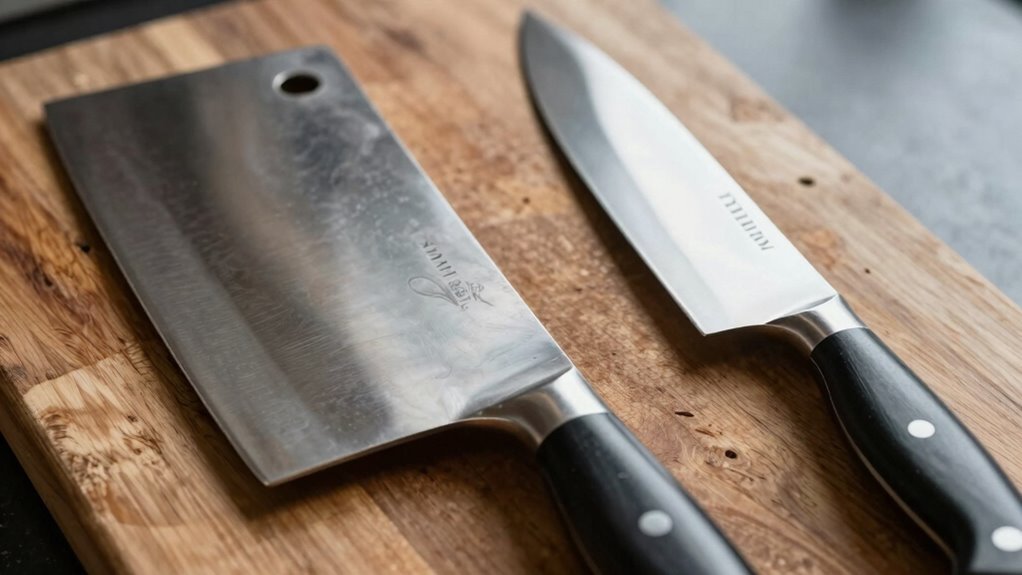

A heavy cleaver is ideal when you need to cut through tough, dense ingredients like bone-in meat, thick vegetables, or large poultry, where a standard chef knife might struggle. Its broad, weighted blade provides more force and control for heavy-duty tasks, making your cuts safer and more efficient. If you’re curious about how to choose the right knife for different tasks and guarantee safe handling, there’s more valuable information ahead.

Get kitchen staples and gadgets delivered free — and shop member deals
- Fast, free delivery on millions of items
- Access to Prime Big Deal Days deals on October 6–7
- Prime Video, Amazon Music and more included
Key Takeaways
- Use a cleaver for heavy-duty tasks like chopping bones, dense vegetables, and large poultry where force and power are needed.
- A heavy blade helps exert more control and safety when cutting through tough, dense ingredients.
- Cleavers excel in tasks requiring force, such as breaking down large cuts or crushing garlic, where a standard chef knife may struggle.
- For delicate slicing and precise cuts, a lighter chef knife is more appropriate; heavy blades are less suited for finesse.
- Properly maintained heavy blades enhance safety, efficiency, and durability during demanding kitchen tasks.
As an affiliate, we earn on qualifying purchases.
When Should You Use a Cleaver Instead of a Chef Knife?
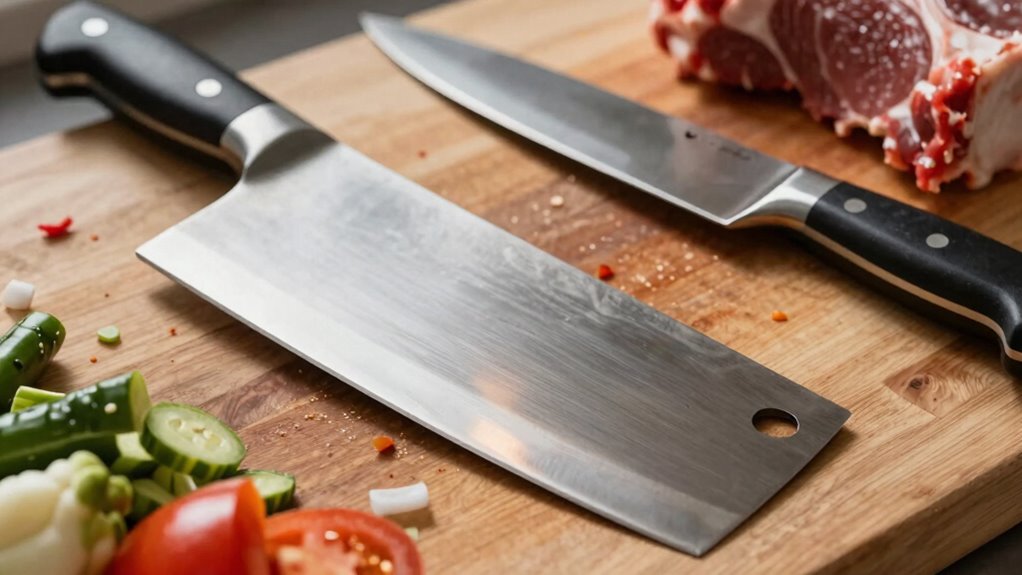
You should reach for a cleaver instead of a chef knife when you’re tackling tough, dense ingredients like bone-in meat, large poultry, or thick vegetable stems. The cleaver’s heavy, broad blade provides the power needed for precision slicing through these stubborn items. It allows you to exert more control and force, making it easier to cut through bone or cartilage without damaging the blade. While chef knives excel at delicate garnishing and thinner slices, a cleaver is better suited for heavy-duty tasks. Its weight helps you make clean cuts with less effort. Use a cleaver when you need strength and accuracy in handling dense ingredients, ensuring safe, efficient, and precise results every time. Additionally, understanding the design features of a cleaver can enhance your cutting efficiency and safety, especially when dealing with heavy-duty tasks. Recognizing the importance of proper blade geometry can also make a significant difference in your cutting performance. Moreover, selecting a cleaver with the right balance and weight distribution can further improve control and reduce fatigue during demanding cuts. Developing an understanding of ergonomic handle design can also help prevent fatigue and improve safety during prolonged use.
As an affiliate, we earn on qualifying purchases.
What Are the Main Strengths and Limitations of Cleavers and Chef Knives?
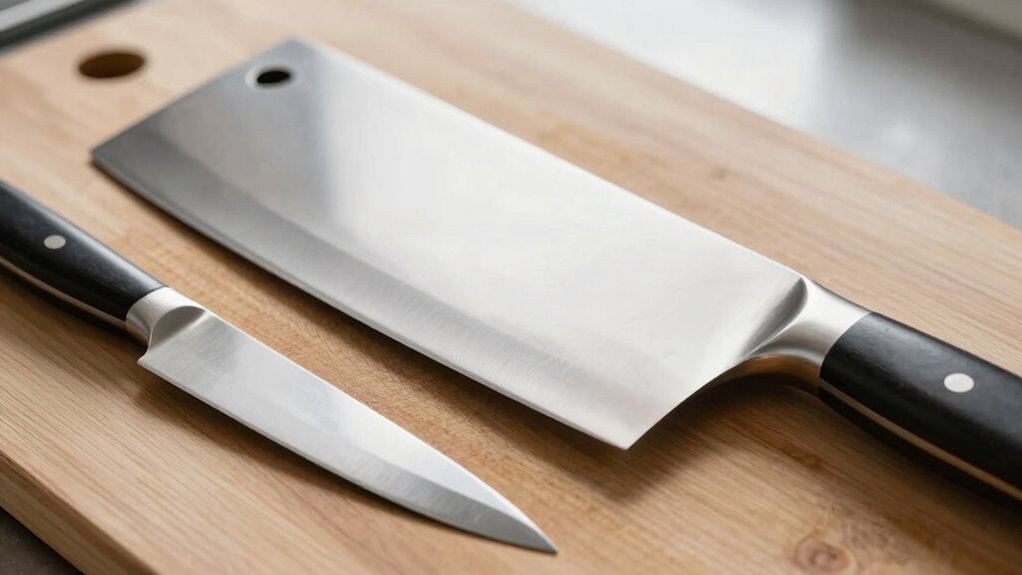
Your choice between a cleaver and a chef knife depends on their strengths and limitations for different tasks. Cleavers excel at chopping through bones and heavy-duty work, but they can be less precise for intricate cuts. Free floating techniques can aid in mastering delicate slicing and carving tasks, enhancing efficiency. Chef knives are versatile for various kitchen tasks, yet they may struggle with tough bones or heavy-duty chopping. Additionally, cultural significance influences how each tool is used in traditional Italian cuisine, highlighting their unique roles in different culinary contexts. Understanding auditory processing can also inform how chefs develop their skills with each tool, especially when multitasking in busy kitchens. Recognizing the importance of water-based techniques in some cuisines can further expand a chef’s versatility with different knives. Moreover, ergonomic design plays a crucial role in reducing fatigue during prolonged use, improving overall safety and precision.
Versatility in Tasks
When it comes to versatility in the kitchen, cleavers and chef knives each excel in different areas due to their unique designs. A chef knife handles slicing, dicing, and mincing with precision, making it ideal for tasks like scaling fruits or slicing vegetables. Its sharp, curved blade offers control and speed. Meanwhile, a cleaver’s broad, heavy blade is perfect for crushing garlic or breaking down tougher ingredients. It can also handle chopping bones or large cuts of meat. Additionally, research on sound vibrations suggests that the vibrations produced by some kitchen tools can influence food textures and preparation techniques. The material and measurements of the knives influence their efficiency and safety during use. However, each has limitations; a chef knife isn’t well-suited for crushing or heavy-duty tasks, while a cleaver may lack the finesse needed for delicate slicing. Overall, your choice depends on the task—each knife’s design enhances specific functions, but neither covers all tasks perfectly.
Strengths and Limitations
What makes cleavers and chef knives stand out are their distinct strengths and limitations, which directly relate to their designs. Cleavers excel in blade durability thanks to their sturdy construction and thick blades, making them ideal for heavy-duty tasks like chopping bones or dense vegetables. However, their material differences can make them less precise for intricate cuts. Chef knives offer exceptional control and precision, especially with their sharper, thinner blades, but they may lack the robustness needed for very tough materials. While chef knives are versatile in slicing and dicing, they can chip or dull faster if made from softer materials. Understanding these strengths and limitations helps you choose the right tool based on your specific cooking needs.
As an affiliate, we earn on qualifying purchases.
How to Decide Which Knife Is Right for Your Kitchen Tasks?
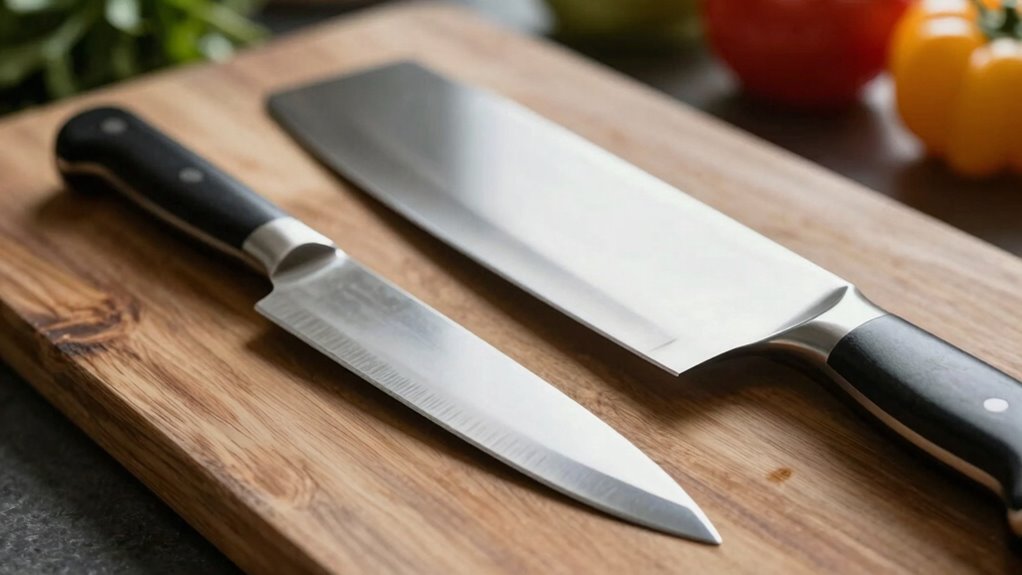
Deciding which knife to use depends on understanding the specific tasks you’ll tackle in the kitchen. For precision chopping and delicate slicing, a chef’s knife offers control and versatility. If you’re preparing large cuts of meat or heavy-duty tasks, a cleaver’s weight and broad blade make the job easier. Consider how you store your knives; proper knife storage protects blades and maintains sharpness, reducing the need for frequent knife sharpening. A well-sharpened knife performs better and is safer to use, so choose a knife that suits your maintenance routine. If you mainly handle vegetables and light tasks, a smaller paring knife might suffice. Assess your typical tasks, storage options, and sharpening habits to pick the right tool for your kitchen. Additionally, understanding deep-sky imaging concepts can help you better appreciate the importance of proper maintenance and care, whether for your knives or optical equipment. Regularly reviewing your sharpening techniques can also extend the lifespan of your blades and improve overall cutting performance. Considering knife ergonomics can further enhance comfort and reduce fatigue during extended use.
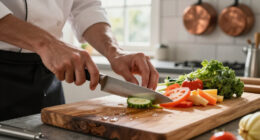
kitchen chef knife for precision slicing
As an affiliate, we earn on qualifying purchases.
As an affiliate, we earn on qualifying purchases.
Techniques for Safely Handling and Using a Heavy Cleaver?
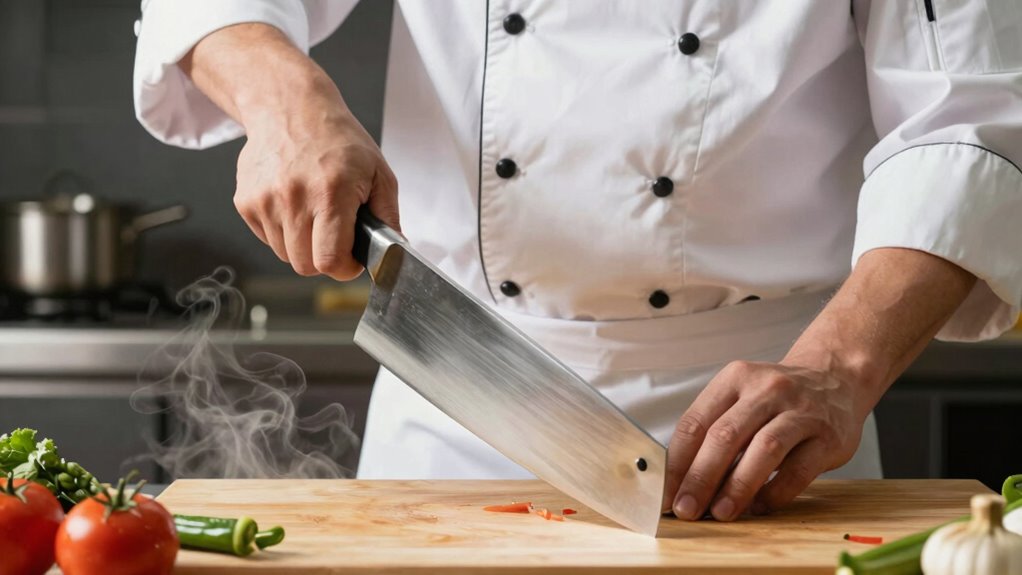
To handle a heavy cleaver safely, you need to maintain a proper grip and posture. Keep your hands firm but relaxed, and stand with a stable stance to control the tool. Use controlled cutting motions to prevent slips and reduce fatigue during prolonged use. Incorporating ergonomic design features can also improve safety and comfort during extended chopping sessions. Additionally, being aware of your technique and practicing proper handling can significantly reduce the risk of injury. Developing good cutting habits and understanding blade maintenance can extend the life of your cleaver and ensure safer operation. Paying attention to proper storage can also prevent accidental injuries and keep the blade in optimal condition. Utilizing thermal behavior knowledge can help you anticipate how the blade reacts to different materials, enhancing both safety and efficiency.
Proper Grip and Posture
When handling a heavy cleaver, maintaining proper grip and posture is essential for safety and efficiency. You should adopt an ergonomic grip, holding the handle firmly but without excessive tension, which reduces fatigue and enhances control. Keep your hand relaxed and ensure your fingers wrap securely around the handle. Your proper stance involves standing with your feet shoulder-width apart, knees slightly bent, and weight evenly distributed. Keep your back straight and your shoulders relaxed to prevent strain. Position your body so that your chopping motion flows naturally from your core, not just your arms. This alignment ensures better leverage and stability, minimizing the risk of slips or injuries. Prioritizing a good grip and stance helps you cut confidently and safely, especially when working with a heavy blade. Additionally, incorporating cultural awareness of proper technique can improve your confidence and safety when using traditional tools. Developing an understanding of proper technique can also help prevent accidents and increase your efficiency during cutting tasks. Practicing technique consistency ensures you develop muscle memory, making your cuts more precise and controlled over time. Being mindful of body mechanics can further enhance your safety and effectiveness during heavy cutting tasks.
Controlled Cutting Techniques
Using controlled cutting techniques with a heavy cleaver involves deliberate, steady movements that prioritize safety and precision. You should focus on maintaining a firm grip and applying consistent pressure to avoid slips. When performing precision slicing, use a smooth, downward motion, letting the weight of the cleaver do the work. For delicate carving, adopt a gentle, controlled approach, keeping your fingers away from the blade’s path. Keep your wrist steady and use your entire arm for leverage, rather than relying solely on wrist movement. Always cut on a stable surface, and take your time to ensure accuracy. These techniques reduce the risk of accidents and help you achieve clean, professional results—whether you’re slicing thin vegetables or carving tender meat.
Comparing Cutting Performance: Cleaver vs. Chef Knife in Everyday Cooking?
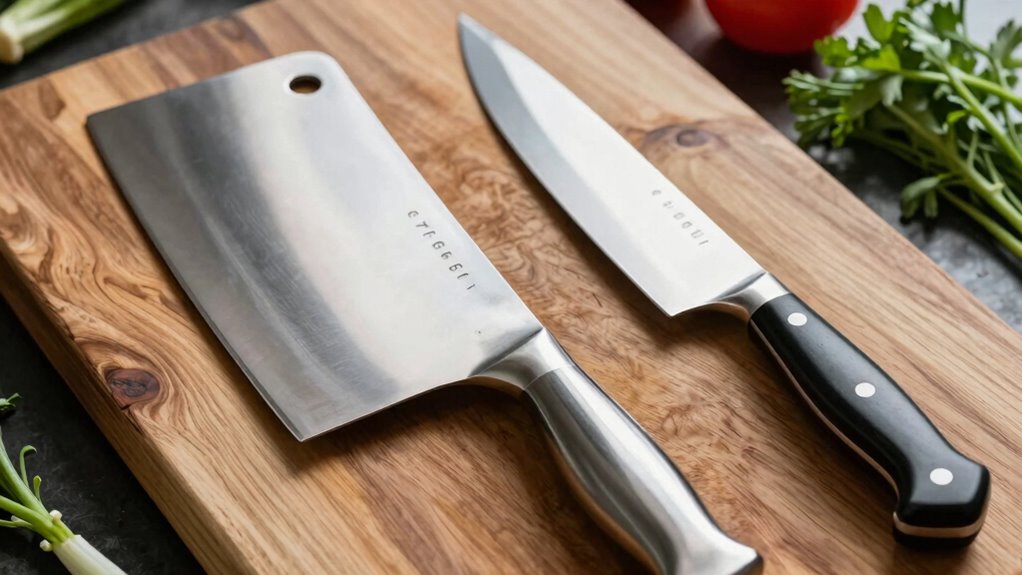
While both cleavers and chef knives are essential tools in the kitchen, their cutting performance varies considerably depending on the task. A chef knife excels at precise slicing, thanks to its sharp, thin blade made from high-quality knife material like stainless steel or carbon steel, which offers excellent edge retention. Its handle design typically promotes balance and control, making it ideal for delicate tasks. In contrast, a cleaver’s heavy, broad blade is better suited for chopping through bones or dense vegetables, providing power and durability. The handle design on cleavers often emphasizes grip strength and stability, allowing you to apply force effortlessly. Overall, your choice depends on whether you prioritize finesse for everyday slicing or robustness for heavy-duty chopping.
How to Maintain and Care for Your Heavy-Duty Kitchen Blades?
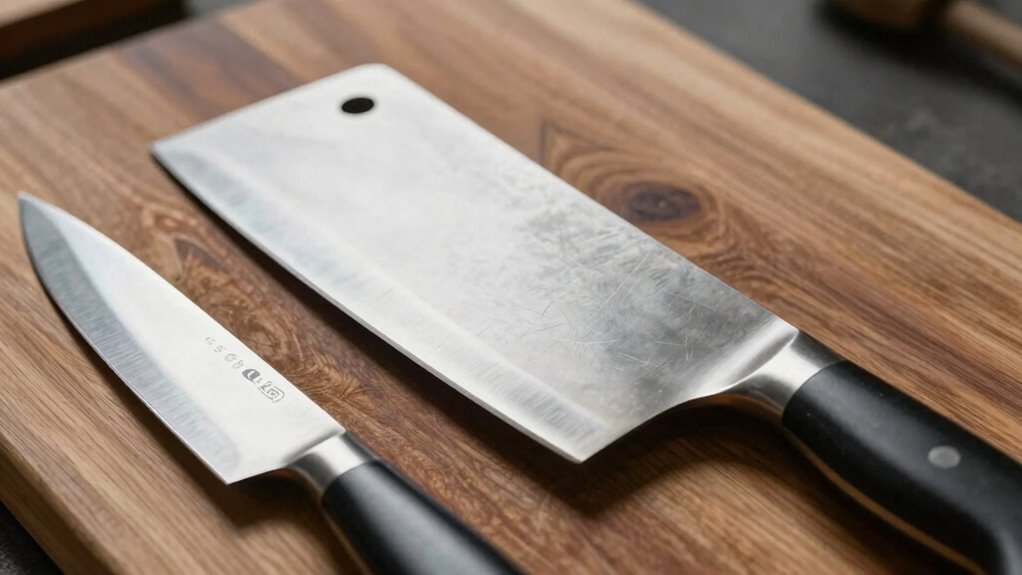
Proper maintenance is essential to keep your heavy-duty kitchen blades like cleavers in top condition, ensuring they perform effectively and last for years. To do this, focus on proper knife storage—use a magnetic strip or a knife block to prevent damage and corrosion. Regular blade sharpening is vital; use a whetstone or a quality sharpening tool to maintain a keen edge. Avoid dishwasher cleaning, which can dull or rust your blades. Instead, hand wash with warm water and dry immediately. Keep your blades oiled occasionally to prevent rust and corrosion, especially if you store them long-term.
Proper care extends the life and effectiveness of heavy-duty kitchen blades like cleavers.
- Feel confident knowing your blades stay sharp and ready to tackle tough ingredients
- Preserve the integrity of your heavy-duty blades through proper care
- Enjoy safe, efficient cooking with well-maintained knives
Frequently Asked Questions
Can a Cleaver Replace a Chef Knife in All Kitchen Tasks?
A cleaver can’t replace a chef knife in all kitchen tasks because it lacks the versatility needed for detailed cutting techniques. While a cleaver excels at chopping through bone and dense ingredients, a chef knife is better suited for slicing, dicing, and precise work. For overall kitchen versatility, it’s best to have both; each tool complements the other depending on the task at hand.
What Materials Are Best for Maintaining a Heavy Cleaver’s Edge?
Think of your heavy cleaver’s edge as a dancer needing the right shoes to perform perfectly. To keep it sharp, use sharpening materials like whetstones or diamond sharpeners—these are your reliable tools for blade maintenance. They gently hone the edge, restoring its keen performance. Regularly maintaining with quality sharpening materials guarantees your cleaver slices smoothly, keeping it a powerful partner in your kitchen adventures.
How Does the Weight of a Cleaver Affect Its Precision?
The weight of a cleaver directly impacts your precision by enhancing blade stability, allowing you to make powerful, controlled cuts. A heavier blade helps you maintain cutting control, especially through tough ingredients like bones or dense vegetables. However, if it’s too heavy, it might reduce finesse and cause fatigue. Finding the right weight balances stability and control, ensuring you can execute accurate, confident cuts with ease.
Are There Specific Dishes That Benefit Most From a Cleaver?
You’ll find that dishes involving traditional butchery or Asian cuisine benefit most from a cleaver. Its heavy blade makes chopping through bones, thick cuts, and tough vegetables easier and more efficient. Don’t worry about precision—its strength is perfect for breaking down whole animals or preparing large, hearty ingredients. If you want authentic results and effortless cuts, a cleaver is your go-to tool for these specific dishes.
What Safety Gear Is Recommended When Using a Heavy Cleaver?
When using a heavy cleaver, you should wear protective gloves to prevent cuts and safety goggles to shield your eyes from flying debris. Make certain your workspace is stable and well-lit, and keep your hands dry to avoid slips. Always use proper technique, gripping the cleaver firmly and cutting away from your body. These safety measures help you handle the heavy blade confidently and reduce the risk of injury.
Conclusion
Choosing between a cleaver and a chef knife is like selecting the right brush for your masterpiece—each has its own rhythm and purpose. When you wield your knife wisely, it becomes an extension of your hand, slicing through ingredients like a hot knife through butter. Trust your instincts, respect the tool’s strength, and let your kitchen become a stage where your skills shine. With the right blade, every meal transforms into a work of art.
Fall Picks
fall essentials
As an affiliate, we earn on qualifying purchases.