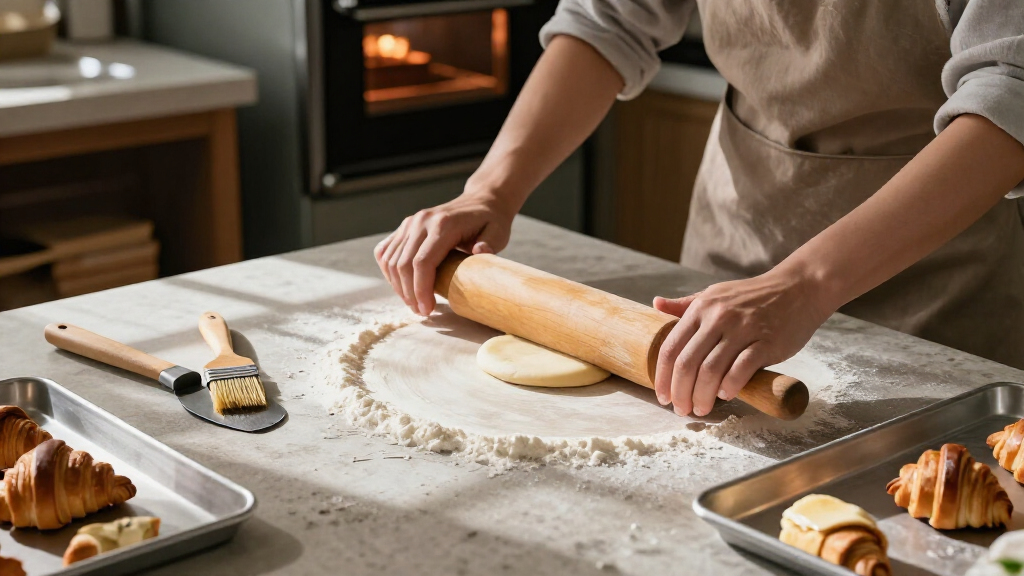
The best croissant baking tools depend on whether you need more consistent dough thickness, faster shaping, or a reliable surface for rolling and baking. My best overall pick is the Japan Kneader RS301 Manual Dough Sheeter and Laminator for its focused role in rolling laminated dough evenly, while the Geesta Adjustable Teak Wood Rolling Pin stands out for guided thickness and the O’Creme Revolving Croissant Cutter for continuous cutting. The main tradeoff is between specialized tools that can improve consistency and simpler, lower-commitment tools that suit occasional batches. Cutter style, counter space, cleanup, and how much dough you make all affect the right choice. Read on for the full breakdown and a guide to building a croissant setup that fits your routine.

Get kitchen staples and gadgets delivered free with Prime
- Fast, free delivery on millions of items
- Prime Video, Amazon Music and more included
- Member-only deals all year
Key Takeaways
- The RS301 earns the overall lead because sheeting and lamination are central to croissant dough consistency; its manual operation and dedicated footprint make it a bigger commitment than a rolling pin.
- The Geesta rolling pin bridges precision and flexibility with thickness rings, while the Aisoso and Ultra Cuisine pins are simpler choices for bakers who prefer direct control.
- Cutting tools serve different workflows: the O’Creme revolving cutter suits repeated cuts, the Ateco roller offers a straightforward specialty option, and the foldable Kopida mold favors repeatable shapes.
- Silicone mats are surface tools, not lamination shortcuts. Mimekitchen and DANIA & DEAN mats help define a work area, but neither replaces chilled dough handling or suitable counter space.
- A small core kit can be more useful than buying every specialty tool. A dependable rolling option, a straight scraper, and a cutter suited to your batch size cover more everyday tasks than several overlapping cutters.
| Mimekitchen Silicone Baking Mat, 26 x 16 Inch |  | Best for Rolling and Work-Surface Protection | Brand: Mimekitchen | Material: Silicone and fiberglass | Size: 26 x 16 inches | VIEW LATEST PRICE | See Our Full Breakdown |
| Japan Kneader RS301 Manual Dough Sheeter and Laminator |  | Best for Precise Home Lamination | Model: RS301 | Operation: Manual hand crank | Thickness settings: 65 settings from 0 to 32 mm | VIEW LATEST PRICE | See Our Full Breakdown |
| Stainless Steel Dough Wheel Cutter with Wooden Handle |  | Best Simple Handheld Cutter | Brand: YongXiangPeng | Model: YongXiangPeng-0012 | Blade material: Stainless steel | VIEW LATEST PRICE | See Our Full Breakdown |
| Kopida Foldable Plastic Croissant Cutter Mold |  | Best for Guided Triangle Cutting | Brand: Kopida | Material: Plastic, polycarbonate (PC) | Dimensions: 23 x 14 x 2 cm | VIEW LATEST PRICE | See Our Full Breakdown |
| Stainless Steel Pastry Scraper and Dough Cutter with Measuring Scale |  | Best Multipurpose Bench Tool | Brand: MS WGO | Material: Stainless steel | Dimensions: 5.75 x 5.74 inches | VIEW LATEST PRICE | See Our Full Breakdown |
| Ultra Cuisine French Stainless Steel Rolling Pin, 15.75-Inch |  | Best for Keeping Laminated Dough Cool | Material: Stainless steel | Length: 15.75 inches | Diameter: 1.5 inches | VIEW LATEST PRICE | See Our Full Breakdown |
| DANIA & DEAN Extra-Thick Silicone Baking Mat, 26 x 16 Inches |  | Best Large Work Surface | Dimensions: 26 x 16 inches | Thickness: 0.7 mm | Material: Food-grade silicone with fiberglass reinforcement | VIEW LATEST PRICE | See Our Full Breakdown |
| Aisoso French Wooden Rolling Pin, 17.7 Inches |  | Best Traditional Wooden Pin | Material: Natural solid wood | Length: 17.7 inches | Diameter: 1.38 inches | VIEW LATEST PRICE | See Our Full Breakdown |
| Geesta Adjustable Teak Wood Rolling Pin with Thickness Rings and Measurement Guide |  | Best for Consistent Dough Thickness | Material: Teak wood | Thickness rings: 5 food-grade PP rings | Measurement guide: Inches and centimeters | VIEW LATEST PRICE | See Our Full Breakdown |
| O’Creme Revolving Croissant Cutter with Stainless Steel Blades |  | Best for Cutting Uniform Croissant Triangles | Brand: O’Creme | Material: Stainless steel blades, plastic handles | Dimensions: 3-3/4 x 8-1/2 inches | VIEW LATEST PRICE | See Our Full Breakdown |
| Ateco Stainless Steel Croissant Roller Cutter |  | Best for Consistent Croissant Shapes | Cutting area material: Stainless steel | Handle material: Polypropylene | Dimensions: 15 in L × 5 in W | VIEW LATEST PRICE | See Our Full Breakdown |
| croissant baking tool | Material | Dimensions |
|---|---|---|
| Mimekitchen Silicone Baking Ma | Silicone and fiberglass | — |
| Japan Kneader RS301 Manual Dou | — | — |
| Stainless Steel Dough Wheel Cu | — | — |
| Kopida Foldable Plastic Croiss | Plastic, polycarbonate (PC) | 23 x 14 x 2 cm |
| Stainless Steel Pastry Scraper | Stainless steel | 5.75 x 5.74 inches |
| Ultra Cuisine French Stainless | Stainless steel | — |
| DANIA & DEAN Extra-Thick Silic | Food-grade silicone with fiberglass reinforcement | 26 x 16 inches |
| Aisoso French Wooden Rolling P | Natural solid wood | — |
| Geesta Adjustable Teak Wood Ro | Teak wood | 23 × 0.5 inches (as listed) |
| O’Creme Revolving Croissant Cu | Stainless steel blades, plastic handles | 3-3/4 x 8-1/2 inches |
| Ateco Stainless Steel Croissan | — | 15 in L × 5 in W |
More Details on Our Top Picks
Mimekitchen Silicone Baking Mat, 26 x 16 Inch
For croissant dough that needs rolling and shaping without flouring the counter repeatedly, the Mimekitchen Silicone Baking Mat provides a broad, reusable nonstick surface. Its nonslip backing helps keep the mat in place as you roll, while the 26 x 16-inch area gives more working room than a small pastry board. Compared with the Japan Kneader RS301, it is far simpler and lighter: it protects a counter but does not adjust or control dough thickness mechanically. The temperature range also lets it serve as a baking liner, though its large footprint may be awkward on compact counters and in crowded drawers. I’d choose it as a flexible work surface, not as a replacement for a sheeter when uniform lamination is the priority.
Pros:- Nonstick surface helps with rolling and shaping laminated dough
- Nonslip backing helps the mat stay put during work
- Can be used for both dough preparation and baking
- Reusable, rinse-clean design folds for storage
Cons:- Its 26 x 16-inch footprint needs ample counter space
- Does not provide the thickness control of the Japan Kneader RS301
- Folded storage may be less convenient than a small rigid tool
Best for: Home bakers who roll croissant dough on a large counter and want one reusable surface for preparation and baking
Not ideal for: Bakers with limited counter or storage space, or anyone seeking machine-assisted, repeatable dough thickness
- Brand:Mimekitchen
- Material:Silicone and fiberglass
- Size:26 x 16 inches
- Weight:6.38 ounces
- Temperature range:-40°F to 450°F
- Shape:Rectangular
- Color:Red
- Warranty:120 days
Our verdict“Choose this mat if you want a roomy, reusable surface for rolling and baking, but skip it if counter space or precise sheeting is your main concern.”
Japan Kneader RS301 Manual Dough Sheeter and Laminator
When consistent dough thickness is the sticking point in croissant making, the Japan Kneader RS301 offers a level of control that mats and handheld cutters cannot. Its 65 thickness settings cover 0 to 32 mm, and its stated capacity of up to 2 kg suits substantial batches. The double-sided board supports rolling and cutting, so the machine is useful beyond croissants. Compared with the Mimekitchen Silicone Baking Mat, it is far more capable for repeatable sheeting but also weighs 37 pounds and requires hand-crank operation. The foldable case helps reduce the machine’s footprint, yet the board stores separately, so it is not a fully self-contained storage solution. I’d rank it for committed bakers who value control over quick setup and easy portability.
Pros:- 65 settings provide fine adjustment for consistent sheets
- Handles up to 2 kg of dough per batch
- Double-sided board supports both rolling and cutting
- Five-year warranty is specified for home or commercial use
Cons:- Manual hand-crank operation takes effort during repeated passes
- The 37-pound unit is heavy to move and set up
- Board must be stored separately when the machine is folded
Best for: Frequent home or small commercial bakers making large batches who want finely adjustable dough thickness without a powered machine
Not ideal for: Occasional croissant makers, people who need a lightweight countertop tool, or kitchens without room to store the separate board
- Model:RS301
- Operation:Manual hand crank
- Thickness settings:65 settings from 0 to 32 mm
- Dough capacity:Up to 2 kg (4.4 lbs)
- Board dimensions:21.6 x 43 inches
- Folded dimensions:28 x 10 x 16 inches; board stores separately
- Item weight:37 pounds
- Board design:Double-sided multilayer construction
- Warranty:5 years, home or commercial
Our verdict“Pick the RS301 if you make croissants often and want precise manual sheeting; choose a mat or rolling pin for simpler, lighter-duty work.”
Stainless Steel Dough Wheel Cutter with Wooden Handle
The Stainless Steel Dough Wheel Cutter is a straightforward choice for bakers who want to divide dough by hand rather than use a fixed-shape mold. Its rolling wheel can follow a marked line or cut custom strips and shapes, giving it more flexibility than the Kopida Foldable Plastic Croissant Cutter Mold, which is designed around triangular portions. The stainless steel blade is intended for repeated use, while the wooden handle gives you a separate grip for guiding the cut. This is a small supporting tool, not a shortcut to evenly sized croissants: unlike the Japan Kneader RS301, it does nothing to standardize dough thickness, and the product information provides no dimensions or handle-care details. I’d favor it for simple, adaptable cutting, with the caveat that exact fit and storage needs are hard to judge from the listed specs.
Pros:- Stainless steel wheel is designed for repeated use
- Rolling cutter can follow custom cutting paths
- Wooden handle provides a distinct grip
- More adaptable to different shapes than the fixed-triangle Kopida mold
Cons:- Does not guide triangle size or produce uniform croissant portions by itself
- Product dimensions are not provided
- No handle-care instructions are specified
Best for: Bakers who already roll dough evenly and want a reusable handheld wheel for custom cuts and shaping
Not ideal for: Beginners who want a guide for uniform croissant triangles or buyers who need clearly stated dimensions before purchasing
- Brand:YongXiangPeng
- Model:YongXiangPeng-0012
- Blade material:Stainless steel
- Handle material:Wood
- Items included:1 dough wheel cutter
- Product dimensions:Not provided
Our verdict“Choose this wheel for flexible, hands-on dough cutting, but select a croissant mold if consistent triangle shapes matter more than versatility.”
Kopida Foldable Plastic Croissant Cutter Mold
The Kopida Foldable Plastic Croissant Cutter Mold is the more guided option for home bakers who want to cut pastry into triangles without measuring each piece individually. That makes it a better fit for repeatable shapes than the Stainless Steel Dough Wheel Cutter, which lets you choose the cut but offers no built-in pattern. Its foldable design is also easier to store than a large work surface such as the Mimekitchen Silicone Baking Mat. The tradeoff is material and care: this mold is plastic and must be hand washed, while the stainless steel scraper in this lineup is dishwasher safe. The listed dimensions are compact, but the mold’s fixed triangular purpose is less flexible for other dough shapes. I’d pick it for guided croissant cutting, not as a general-purpose pastry cutter.
Pros:- Guides cutting into triangles for croissant shaping
- Foldable design helps limit storage bulk
- Compact listed dimensions suit home kitchens
- Plastic construction is intended for repeated pastry use
Cons:- Hand washing is required
- Plastic may be less durable than the stainless steel dough wheel
- Fixed triangular use is less versatile for other dough cuts
Best for: Newer home bakers who want a repeatable triangular cutting guide for homemade croissants and pastries
Not ideal for: Bakers who need a versatile cutter for varied shapes or prefer dishwasher-safe metal tools
- Brand:Kopida
- Material:Plastic, polycarbonate (PC)
- Dimensions:23 x 14 x 2 cm
- Quantity:1 piece
- Care instructions:Hand wash only
- Shape:Triangular
- Color:Yellow
Our verdict“Choose the Kopida mold if guided, repeatable triangles matter most; pick a wheel cutter for more freedom to make different shapes.”
Stainless Steel Pastry Scraper and Dough Cutter with Measuring Scale
For the practical jobs that surround croissant shaping—dividing dough, lifting portions, and clearing the work surface—the MS WGO Stainless Steel Pastry Scraper is the most versatile small tool in this group. Its built-in measuring scale helps portion strips or dough pieces more consistently, unlike the YongXiangPeng Dough Wheel Cutter, which is better suited to rolling cuts along a line. The scraper’s broad 5.75-inch dimensions also make it useful for moving dough and cleaning flour from a bench. It cannot replace a croissant triangle mold or the adjustable sheeting of the Japan Kneader RS301; its role is preparation and portioning, not lamination or patterned cutting. Dishwasher-safe construction eases cleanup, though the care notes still call for drying it after washing.
Pros:- Built-in scale helps portion dough more evenly
- Useful for cutting, dividing, scraping, and lifting dough
- Stainless steel construction suits repeated kitchen work
- Dishwasher safe for convenient cleanup
Cons:- Does not cut repeated croissant triangles as a mold can
- Care guidance recommends wiping dry after washing
- No handle details are provided
Best for: Home bakers who want one durable bench tool for dividing dough, measuring portions, and clearing flour from a work surface
Not ideal for: Bakers seeking a dedicated croissant triangle guide, a rolling cutter, or a tool that controls dough thickness
- Brand:MS WGO
- Material:Stainless steel
- Dimensions:5.75 x 5.74 inches
- Weight:5.44 ounces
- Features:Built-in measuring scale
- Care:Dishwasher safe; rinse and dry after use
Our verdict“Choose this scraper as an everyday dough-prep companion, but pair it with a dedicated cutter if uniform croissant triangles are your goal.”
Ultra Cuisine French Stainless Steel Rolling Pin, 15.75-Inch
For croissant dough, a rolling pin that can be chilled offers a practical advantage: it helps limit warming as you roll and shape the butter layers. The stainless steel body can go in the freezer, and its tapered, handle-free form gives you direct control over pressure, useful when easing dough into an even sheet. Compared with the longer Aisoso French Wooden Rolling Pin, this model is shorter and easier to chill, while the wooden pin offers a more familiar feel for bakers who prefer wood. The tradeoff is that French-style pins take practice if you are accustomed to handles, and the narrow 1.5-inch diameter may require more passes over a large sheet. Dishwasher-safe construction makes cleanup simple, but it is a focused rolling tool rather than a guide to consistent thickness.
Pros:- Freezer-safe stainless steel can help keep dough cool during rolling
- Tapered shape gives the baker direct control over pressure
- Dishwasher-safe construction simplifies cleanup
- Lighter than many solid wood rolling pins at 10.08 ounces
Cons:- Handle-free design may feel unfamiliar to bakers used to handles
- Narrow 1.5-inch diameter can mean more passes over broad dough sheets
Best for: Croissant bakers who already prefer French-style pins and want a freezer-ready tool for rolling cool laminated dough
Not ideal for: Bakers who prefer handled rolling pins or need a wider tool to cover large dough sheets in fewer passes
- Material:Stainless steel
- Length:15.75 inches
- Diameter:1.5 inches
- Weight:10.08 ounces
- Design:Handle-free, tapered French style
- Care:Dishwasher safe
- Quantity:1
Our verdict“Choose this pin if you want a chillable, easy-clean option for controlled croissant-dough rolling and are comfortable with a handle-free design.”
DANIA & DEAN Extra-Thick Silicone Baking Mat, 26 x 16 Inches
This mat earns its place as a large, nonslip surface for rolling and shaping croissant dough, especially when a bare counter makes cleanup or sticking a concern. Its 26 x 16-inch footprint and measurement guides help with sizing dough, while the reinforced 0.7 mm construction is designed to stay put as you work. Unlike the Geesta Adjustable Teak Wood Rolling Pin, which helps standardize thickness through rings, this mat supports measuring and surface control but does not set the dough’s thickness for you. It also moves from freezer to oven across a broad temperature range, giving it uses beyond shaping. The size can be awkward to store or fit in a small sink, and a mat is not a substitute for a board or a dedicated dough sheeter when precise lamination is the goal.
Pros:- Large 26 x 16-inch area accommodates rolling and shaping
- Nonslip bottom helps the work surface stay steady
- Measurement guides aid dough sizing
- Temperature range supports freezer, microwave, and oven use
Cons:- Large format may be cumbersome to store and wash in a small sink
- Measurement guides do not control dough thickness
- Silicone work surface does not replace a dedicated sheeter for repeated, precise lamination
Best for: Home bakers who roll croissant dough on the counter and want a generous, marked surface that can also go in the freezer and oven
Not ideal for: Bakers with limited counter or storage space, or anyone seeking a tool that mechanically controls dough thickness
- Dimensions:26 x 16 inches
- Thickness:0.7 mm
- Material:Food-grade silicone with fiberglass reinforcement
- Temperature range:-45°F to 450°F
- Features:Nonstick surface, nonslip bottom, measurement guides
- Care:Dishwasher safe
- Included components:1 baking mat
- Model number:DDMT2616
Our verdict“Pick this mat if you need a roomy, stable surface for hand-rolling croissant dough and have space to store it flat.”
Aisoso French Wooden Rolling Pin, 17.7 Inches
The Aisoso is a straightforward choice for bakers who want a traditional wooden French pin for rolling croissant dough without handles getting in the way. At 17.7 inches, it is longer than the Ultra Cuisine stainless steel pin, giving you a broader tool for working across a sheet, though it cannot be chilled in the freezer as a metal pin can. Its polished, unfinished wood offers a direct grip and can handle other doughs, so it is more versatile than the O’Creme Revolving Croissant Cutter, which only cuts triangles. That simplicity is also the limitation: there are no thickness rings or measurement guides, so even sheets depend on the baker’s technique. Wood needs hand washing and thorough drying, adding care that the stainless steel alternative avoids.
Pros:- Long 17.7-inch body suits rolling broader dough sheets
- Handle-free shape allows direct control over pressure
- Works with pastry, pizza, noodles, and other doughs
- Polished, unfinished wood provides a natural handhold
Cons:- Requires hand washing and prompt, thorough drying
- Lacks thickness rings or measurement guides for repeatable sizing
- Cannot be chilled like the Ultra Cuisine stainless steel pin
Best for: Bakers who prefer the feel of a simple wooden French pin and want one tool for croissant dough and other rolling tasks
Not ideal for: Bakers who want dishwasher-safe cleanup, freezer-chilled rolling, or built-in thickness guides
- Material:Natural solid wood
- Length:17.7 inches
- Diameter:1.38 inches
- Color:Brown
- Care:Hand wash, wipe with a damp cloth, and dry promptly
- Included components:Wooden rolling pin
Our verdict“Choose this wooden pin if you value a simple, versatile French-style tool and do not mind hand-washing it.”
Geesta Adjustable Teak Wood Rolling Pin with Thickness Rings and Measurement Guide
The Geesta is the most measurement-focused rolling pin here: its five thickness rings are designed to keep dough at a chosen height, while etched inch and centimeter guides help track width. That combination can help newer croissant bakers produce more consistent sheets than they might with the Aisoso French Wooden Rolling Pin, which relies entirely on hand pressure and visual judgment. The tradeoff is less freedom to roll by feel; rings may also need to come off when working with uneven or unusually shaped dough. Its teak body and holder add storage and can support a phone or tablet, but the listed dimensions include a 0.5-inch width that appears unclear, and care instructions for the wooden pin are not specified. I’d favor it for repeatable sizing, not the simplest cleanup routine.
Pros:- Five rings provide a way to roll dough to consistent thicknesses
- Etched inch and centimeter guides support measuring dough
- Teak construction is intended for a range of dough-preparation tasks
- Included holder provides storage and can support a phone or tablet
Cons:- Thickness rings can limit flexibility when rolling irregular dough
- Listed dimensions of 23 × 0.5 inches leave the width unclear
- Care instructions for the wooden pin are not specified
Best for: Bakers who want repeatable dough thickness and measurements for croissant sheets and other pastry projects
Not ideal for: Experienced bakers who prefer unrestricted rolling by feel, or buyers who need clear wooden-tool care instructions and unambiguous dimensions
- Material:Teak wood
- Thickness rings:5 food-grade PP rings
- Measurement guide:Inches and centimeters
- Dimensions:23 × 0.5 inches (as listed)
- Weight:2.6 lb
- Color:Western
- Model:GETA057
- Included accessory:Wooden holder
Our verdict“Choose the Geesta if repeatable thickness matters more to you than a free-rolling feel or clearly documented care.”
O’Creme Revolving Croissant Cutter with Stainless Steel Blades
Once croissant dough is rolled, cutting consistently shaped triangles is the O’Creme’s specific job. Its independently rolling stainless steel blades make multiple cuts in one pass, helping speed up batch preparation compared with a single dough wheel, which requires repeated individual cuts. That efficiency comes with less versatility: unlike the DANIA & DEAN baking mat, which supports a range of rolling and shaping tasks, this cutter is made for triangles for croissants and crescent bread. Its 3-3/4 x 8-1/2-inch format is a dedicated bench tool, so it only makes sense if that cut pattern fits your workflow. The plastic handles are non-porous and the cutter is dishwasher safe, but the provided details do not specify adjustable triangle dimensions.
Pros:- Cuts multiple dough triangles in one pass
- Independently rolling blades support a rolling cut action
- Stainless steel blades resist rust and bending
- Dishwasher-safe design and non-porous handles simplify cleanup
Cons:- Designed specifically for cutting dough triangles
- No adjustable triangle dimensions are specified
- Adds limited value if croissant-style dough is made only occasionally
Best for: Home bakers who regularly shape batches of croissants or crescent bread and want to cut multiple triangles in one pass
Not ideal for: Bakers who make croissants only occasionally or need a general-purpose pastry cutter with adjustable cut sizes
- Brand:O’Creme
- Material:Stainless steel blades, plastic handles
- Dimensions:3-3/4 x 8-1/2 inches
- Use:Cutting dough into triangles for croissants and crescent bread
- Dishwasher safe:Yes
- Model number:OCCRCT
- UPC:810175411279
- Included components:1 croissant cutter
Our verdict“Choose this cutter if you regularly make batches of croissants and its fixed triangle-cutting format suits your dough size.”
Ateco Stainless Steel Croissant Roller Cutter
The Ateco earns its place for bakers who want repeatable croissant triangles without cutting each one by hand. Its rotating stainless steel cutting area makes six triangles per revolution, each measuring 3.75 inches across the base and 8.25 inches high. That repeatability can help a batch bake and roll more evenly than triangles cut with the Stainless Steel Dough Wheel Cutter with Wooden Handle, which leaves sizing to the baker. The tradeoff is less flexibility: the Ateco is made for a specific croissant shape and size, while a dough wheel can handle varied cuts. Its 15-inch length also calls for counter space, and the suggested hand washing adds cleanup work. Choose it for consistent shaping, not for an all-purpose pastry cutter.
Pros:- Cuts six croissant triangles per revolution to speed up batch prep.
- Produces consistent triangles measuring 3.75 inches at the base and 8.25 inches high.
- Rotating stainless steel cutting area moves independently of the polypropylene handle.
- More repeatable for croissant shapes than a general-purpose dough wheel.
Cons:- Manual operation requires the baker to guide each pass.
- Designed around one triangle size, limiting flexibility for other pastries or croissant formats.
- Hand washing is suggested, adding cleanup effort.
Best for: Home bakers who make batches of similarly sized croissants and want a repeatable triangle shape.
Not ideal for: Bakers who make varied pastry shapes, need a compact tool, or prefer dishwasher-friendly cleanup.
- Cutting area material:Stainless steel
- Handle material:Polypropylene
- Dimensions:15 in L × 5 in W
- Item weight:15.84 oz
- Cuts per revolution:6
- Triangle dimensions:3.75 in base × 8.25 in height
- Model number:18405
- Care:Hand wash suggested
Our verdict“Pick the Ateco for repeatable batches of standard-size croissant triangles; choose a dough wheel if you need more cutting flexibility.”
How We Picked
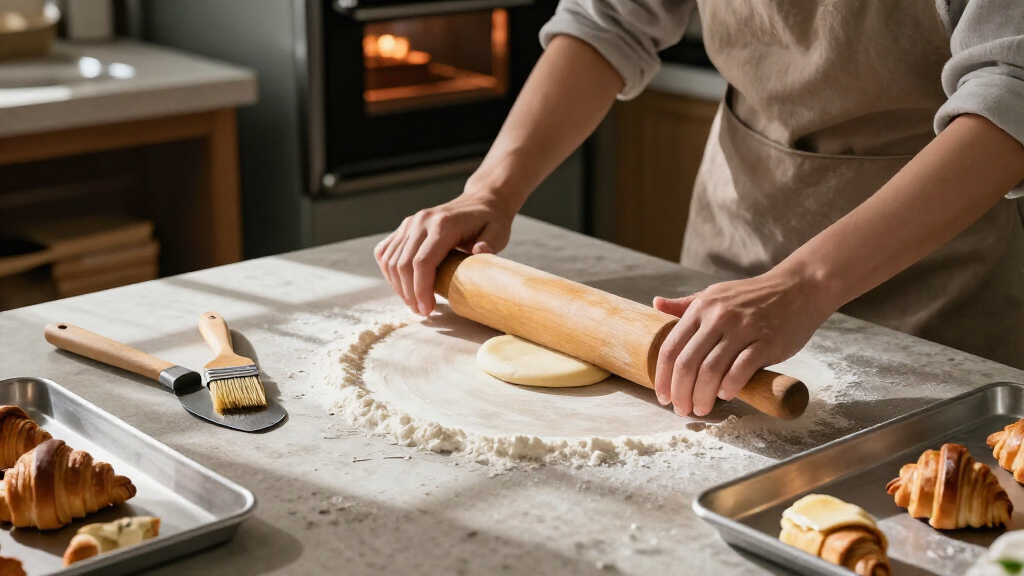
I ranked these 11 products by how directly they support the steps that make croissant baking demanding: controlling dough thickness, laminating, cutting consistent triangles, handling dough cleanly, and managing the work surface. I also weighed usability, storage needs, material and cleanup demands, and how many tasks each tool can handle. A specialized tool could rank highly when it addresses a difficult croissant-specific task, but its learning curve and footprint count against it.
The ranking favors tools with a clear job and a practical role in a home baking setup, rather than treating every cutter or rolling pin as interchangeable. That is why the RS301 leads for process control, while more accessible options like the Geesta pin and stainless steel scraper serve buyers who want useful precision without committing to a dedicated sheeter. Mats and cutters rank according to their fit for particular workflows; they cannot replace the dough temperature control and technique that croissants still require.
Factors to Consider When Choosing Best Croissant Baking Tools
Choosing croissant tools is less about assembling a large kit and more about finding where your process loses consistency. I would match each purchase to a specific bottleneck, then check how the tool will fit your counter, storage, and batch size.
Choose Sheeting Control Before Adding More Cutters
Croissants depend on even layers of dough and butter, so uneven rolling can affect the whole batch before shaping begins. A manual sheeter is a specialized purchase: it can offer more repeatable rolling, but it takes space and adds setup and cleaning. A rolling pin costs less commitment in counter space and handles other doughs, though consistent thickness relies more on your technique. Avoid buying several cutting tools to solve a thickness problem; a cleaner triangle cannot correct uneven lamination. If you bake occasionally, start with a versatile pin and learn to gauge thickness. Regular batch bakers may value dedicated sheeting control more than another shaping accessory.
Match Cutter Design to Batch Size and Shape
Single or guided cutters, revolving cutters, and croissant molds approach shaping differently, so choose based on how you like to work. A revolving cutter can suit repeated cuts across a sheet, while a mold or template may help keep dimensions consistent from one triangle to the next. Check whether the cutter width matches the dough sheets you typically roll; an awkward size can create offcuts or force you to change your layout. More blades or a specialty profile do not automatically mean faster work if the tool is difficult to clean or store. Before buying, think about whether you value speed, repeatability, or easy adjustment most. Small home batches often benefit more from a simple cutter that is easy to handle than from a production-oriented design.
Treat Work-Surface Size and Temperature as Separate Needs
A silicone mat can mark out a rolling area and make cleanup easier, but it does not keep butter cold or replace a cool, stable counter. Large mats need enough surrounding space to sit flat; if they bunch or overhang, rolling can become less controlled. Thickness and flexibility affect how a mat feels under pressure and how easily it can be stored, so consider drawer or cabinet space as well as dimensions. A common mistake is assuming any baking mat is suitable for every oven or dough task. Check the product’s stated use and care guidance before putting it under high heat or using sharp tools on it. For croissants, the surface should support clean rolling without encouraging prolonged warm handling.
Pick a Rolling Pin for the Control You Prefer
A straight French-style pin gives direct feedback and suits bakers comfortable judging dough thickness by eye. A pin with thickness rings can guide more repeatable rolling, especially when you are still learning to apply even pressure. Stainless steel and wood feel different in the hand and call for different care habits; the right choice depends on your comfort and cleaning preferences. Rings can help set a target, but they do not fix uneven pressure or dough that has softened. Confirm the pin’s length against your counter and dough-sheet size before choosing. If you make varied pastries, a versatile pin may serve more often than a croissant-specific cutter.
Use a Scraper as a Work-Flow Tool, Not Just a Cutter
A pastry scraper can lift sticky dough, divide portions, clear flour, and help keep a work area tidy, making it useful beyond croissants. A measurement scale can support more consistent portions, but markings only help when the tool is easy to read and sized for your work surface. A scraper with a rigid edge offers control, yet it may not replace a dedicated wheel when you want long, continuous cuts through a dough sheet. Consider the handle and edge shape if you expect to use it frequently; comfort matters during repetitive handling. Wash and dry it promptly if the material or markings need particular care. For a minimal setup, this kind of multitasker often earns its place before a second specialty cutter.
Frequently Asked Questions
Do I need a dough sheeter to make croissants at home?
No, a rolling pin can work for home batches, especially if you are comfortable rolling evenly and chilling the dough between steps. A sheeter is most useful when uneven thickness repeatedly gets in the way or when you make larger, regular batches. It also asks for dedicated storage and a little more setup than a pin. I would learn the lamination process with a versatile pin before investing in a machine unless repeatability is your main frustration. Whichever method you use, keep the dough and butter at workable temperatures.
Which cutter makes the most sense if I bake only a few croissants at a time?
For small batches, prioritize a cutter that is easy to position, clean, and store rather than one designed mainly for repeated production cuts. A simple roller or a mold can help repeat triangle shapes, but the best fit depends on your preferred sheet layout and desired croissant size. Check the cutter’s width against your rolling area before buying. A large or specialized cutter may leave awkward offcuts when the batch is small. A sharp knife and ruler can also work if you want to postpone buying a dedicated cutter.
Can I use a silicone baking mat as my main croissant work surface?
A mat can provide a defined, easy-to-clean surface, but it is not automatically a substitute for a large, cool counter. It needs to lie flat and have enough room for the dough sheet and your rolling motion. Silicone also does not solve temperature problems, so limit warm handling and chill the dough when needed. Check the mat’s care and intended-use instructions, especially before using it in the oven or cutting on it. If it shifts, curls, or restricts your working area, a bare suitable counter may give you better control.
Are thickness rings worth choosing over a traditional French rolling pin?
Thickness rings can help newer bakers repeat a target thickness, which is useful when inconsistent rolling leads to uneven dough sheets. A traditional French pin offers more direct control and can feel less constrained when rolling irregular shapes. Neither style guarantees even dough: pressure, dough temperature, and rolling direction still matter. If you bake several kinds of pastry, consider whether the rings suit those other tasks too. Choose guided thickness for repeatability, or a plain pin if flexibility and tactile control matter more.
What should I buy first for a basic croissant tool setup?
Start with a rolling tool you can control, a scraper for moving and dividing dough, and a cutter or straight edge that fits your preferred triangle layout. These cover the core handling and shaping steps without filling storage with overlapping specialty tools. Add a work mat if cleanup or marking out a rolling area is a recurring problem. A dedicated sheeter makes more sense once you know that rolling consistency or batch size is limiting your process. Spend time on chilling and lamination technique alongside tool choices, since equipment alone cannot produce even layers.
Conclusion
For most committed home bakers, I recommend the Japan Kneader RS301 as the best overall pick because it addresses dough sheeting directly, though it is a more specialized choice than a rolling pin. The Geesta adjustable teak rolling pin is my best value-style choice for bakers who want thickness guidance in a tool that remains versatile. For beginners, I would start with a rolling pin and stainless steel scraper before adding a dedicated sheeter; the scraper is also the practical pick for buyers who want one tool for several dough-handling tasks. Choose the O’Creme revolving cutter if repeated cutting is your specific bottleneck, or a silicone mat if you need a defined work surface and easier cleanup. Buy for the step that causes you the most trouble, rather than trying to assemble a complete professional kit at once.
Halloween Picks
halloween
As an affiliate, we earn on qualifying purchases.