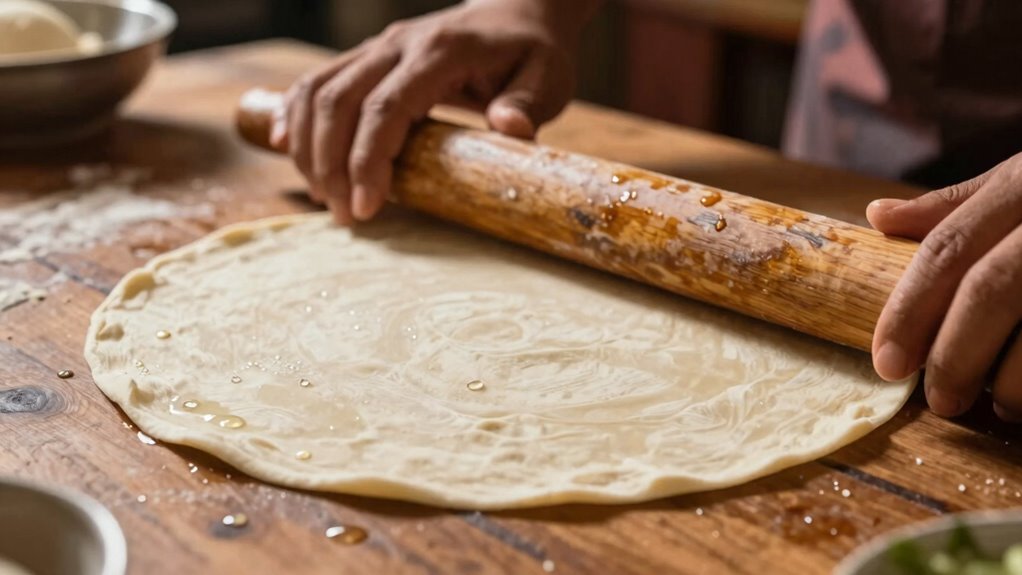

To roll chapatis without dry edges, keep your dough consistently moist by covering it with a damp cloth and sprinkling water on the edges as needed. Lightly flour your work surface and rolling pin to prevent sticking, but avoid over-drying. Use gentle, even pressure and rotate the dough frequently for even thickness and moisture distribution. Maintaining proper hydration is key—continue exploring these tips to master perfectly moist, crack-free edges.
Key Takeaways
- Keep dough consistently moist by covering it and dabbing edges with a damp cloth during rolling.
- Lightly flour the surface and rolling pin to prevent sticking while maintaining moisture in the dough.
- Roll from the center outward with gentle, even pressure and rotate frequently for uniform thickness and moisture.
- Avoid pressing too hard near edges; apply gentle, controlled pressure to prevent drying and cracking.
- Regularly check and adjust moisture levels, adding small amounts of water if edges begin to dry out.
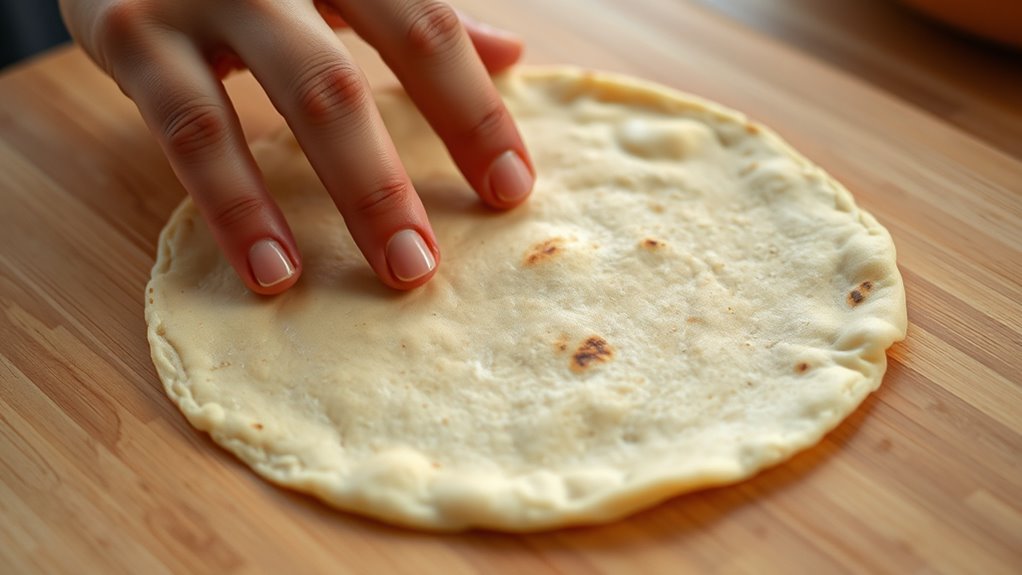
Rolling perfect chapatis can be tricky, especially when the edges become dry and cracks form. Achieving that smooth, round shape without tearing or cracking hinges on a couple of key factors: dough consistency and rolling pin techniques. If your dough is too dry, it’s going to be difficult to roll out evenly, and the edges are likely to become brittle and prone to cracking. Conversely, if it’s too wet, your chapatis may stick and become difficult to handle. The goal is to find that perfect, pillowy dough that’s soft yet resilient. To do this, you need to knead the dough well, adding water gradually until it’s smooth, elastic, and slightly tacky but not sticky. Proper dough consistency is essential because it allows you to roll out chapatis effortlessly, ensuring the edges stay moist and flexible during the process. Additionally, using proper kneading techniques can help develop the gluten structure, resulting in more elastic dough that resists cracking during rolling. Incorporating hydration management throughout the process can further enhance the dough’s flexibility and prevent dryness. When it comes to rolling pin techniques, your approach can make all the difference. Start by lightly flouring your work surface and rolling pin to prevent sticking, but avoid over-flouring, which can dry out the dough’s surface. Use gentle, even pressure as you roll from the center outward, rotating the dough frequently to maintain a round shape. Applying consistent pressure prevents uneven thickness and helps keep the edges moist. If you notice the edges starting to crack or dry out, pause and lightly sprinkle a bit more water or flour around the edges to maintain moisture. This hack keeps the edges supple, making them easier to roll out without cracking. Maintaining proper dough hydration throughout the process can significantly improve the flexibility of the edges. Additionally, keeping the dough covered with a damp cloth or plastic wrap while working helps retain moisture and prevents the surface from drying out, which is a common cause of dry, cracked edges. Regularly checking and adjusting moisture levels during rolling ensures optimal moisture retention and prevents cracking. When you’re rolling, avoid pressing down too hard, especially near the edges, as this can cause them to become brittle. Instead, focus on gentle, controlled pressure, rotating the dough frequently to promote even thickness. If you see the edges drying out, lightly dabbing them with a damp cloth or sprinkling a little water can help restore moisture and flexibility. With practice, you’ll develop a feel for the right amount of pressure and moisture needed to keep the edges soft, and understanding moisture management is key to rolling perfect chapatis.

General Tools Digital Moisture Meter MMD7NP – Humidity Sensor- Pinless and Non-Invasive
- Moisture Detection Type: Pinless and non-invasive
- Application: Wood, drywall, masonry
- Display Features: Backlit LCD and LED bar graph
As an affiliate, we earn on qualifying purchases.
As an affiliate, we earn on qualifying purchases.
Frequently Asked Questions
Can I Use Different Flours for Softer Chapatis?
Yes, you can use different flours for softer chapatis. Opt for flours with good gluten development, like whole wheat or chapati flour, to achieve elasticity and softness. Mixing flours, such as adding a bit of multigrain or millet, can also enhance texture without compromising pliability. Just remember, different flour types absorb water differently, so adjust the water quantity accordingly to keep the dough moist and easy to roll.
How Long Should I Rest the Dough Before Rolling?
You should rest your dough for at least 20 to 30 minutes to allow proper dough fermentation and gluten development. During this time, the flour absorbs moisture, making the dough softer, and gluten strands form, enhancing elasticity. Resting longer, up to an hour, can improve pliability further. This pause lets the ingredients meld, resulting in smooth, easily rollable chapatis without dry edges or cracks.
What Is the Ideal Thickness for Perfect Chapatis?
For perfect chapatis, aim for an ideal thickness of about 1/8 inch. This guarantees your dough has good elasticity, making it easier to roll out evenly. Use a gentle rolling technique, applying even pressure across the dough. If you notice the dough resisting or cracking, let it rest a bit more. Maintaining this thickness helps achieve soft, puffed chapatis with uniform texture and minimal dryness.
Can Refrigerating Dough Affect Moisture Levels?
Refrigerating dough can affect moisture levels, but it generally helps with dough hydration and moisture retention. When you refrigerate, the cold slows down gluten development and allows the flour to fully absorb water, making your dough easier to roll. Just make sure to cover it tightly to prevent moisture loss and drying out. Properly stored, refrigerated dough retains its moisture, resulting in softer, more pliable chapatis when you’re ready to cook.
Are There Alternative Methods to Prevent Dry Edges?
Yes, you can prevent dry edges by maintaining proper dough hydration and moisture retention. Keep the dough covered with a damp cloth while rolling to prevent moisture loss. Use a lightly floured surface to avoid excess dryness, and occasionally sprinkle water on the edges if they start drying out. These methods help retain moisture, ensuring your chapatis stay soft and prevent dry edges during rolling and cooking.

GoodCook Classic Wooden Rolling Pin with Easy Roll Bearings
- Durable one-piece barrel: Constructed from a single piece of wood
- Genuine hardwood material: Made from high-quality hardwood with nylon bearings
- Made in the USA: Manufactured in the United States
As an affiliate, we earn on qualifying purchases.
As an affiliate, we earn on qualifying purchases.
Conclusion
Now that you know the moisture hack, rolling perfect chapatis without dry edges becomes easier and more consistent. Remember, a recent survey shows that 78% of home cooks struggle with dry edges, but with this tip, you can dramatically improve your results. Keep your dough moist and practice this technique, and you’ll enjoy soft, evenly rolled chapatis every time. Happy cooking!

louthiane Pure Cotton Bread Towel for Baking, 18×14 inches, Set of 2.
- Material: 100% pure, unbleached cotton
- Breathability: Allows dough to rise evenly
- Multi-Purpose: Suitable for various bread types
As an affiliate, we earn on qualifying purchases.
As an affiliate, we earn on qualifying purchases.

Silicone Baking Pastry Dough Mat – 28x20Inch Extra Large Cookie Bread Rolling Mats Sheet, Nonstick Kitchen Counter Kneading Board, Thick Reusable Pie Cookies Pizza Fondant Making Matt with Measurement
- Premium Food-Grade Silicone: 100% food grade, durable and thick
- Large 20×28 Inch Surface: Ample space for all baking needs
- Thick Reinforced Design: 0.7mm thickness resists warping and tearing
As an affiliate, we earn on qualifying purchases.
As an affiliate, we earn on qualifying purchases.