For a digital pH meter for food-safe fermentation, my best overall pick is the Apera Instruments PH60S, which stands out as a dedicated food-testing kit with a spear probe. The HORIBA LAQUAtwin pH-11 is a compact alternative for small samples, while the LKBIRD Smart Food pH Meter adds app connectivity for buyers who want digital records. The main tradeoffs are probe suitability for thick foods, calibration and care requirements, and whether added features are useful for your routine. A meter can support pH checks, but it does not replace a tested recipe or safe fermentation practices. Read on for the full comparison and help matching a meter to your foods and workflow.

Get kitchen staples and gadgets delivered free with Prime
- Fast, free delivery on millions of items
- Prime Video, Amazon Music and more included
- Member-only deals all year
Key Takeaways
- A food-oriented spear probe is the main dividing line. The Apera PH60S, GIDIGI spear-probe models, and several other picks are designed for direct contact with thicker foods, unlike the compact HORIBA flat-sample format.
- The lineup splits between dedicated pH testing and broader measurement features. The 4-in-1 tester adds EC, TDS, and temperature functions, but those extras matter less if fermentation pH is your main task.
- Calibration support is not the same as low-maintenance ownership. A kit that includes calibration materials helps with setup, but probe storage, cleaning, and replacement remain part of regular use.
- App connectivity serves a specific workflow. LKBIRD and EZTOCH add Bluetooth or app features; they suit record-keeping needs better than buyers who only want a direct reading.
- Similar-looking food meters still require spec checks. Probe shape, stated food applications, calibration supplies, and care instructions distinguish the GIDIGI, YINMIK, and other spear-probe options.
| GIDIGI Food pH Meter with Spear Probe and Calibration Kit |  | Best for Broad-Temperature Kitchen Use | pH resolution: 0.01 pH | Temperature compensation: Automatic, 32–140°F (0–60°C) | Reading time: 30 seconds | VIEW ON AMAZON | See Our Full Breakdown |
| Apera Instruments PH60S Food pH Meter Tester Kit |  | Best for Guided, Repeatable Readings | pH range: -2.00 to 16.00 | pH accuracy: ±0.01 pH | Temperature compensation: Automatic, 0–50°C | VIEW ON AMAZON | See Our Full Breakdown |
| Digital Food pH Meter with Spear Probe for Fermentation |  | Best Fermentation Starter Kit | pH range: 0.00–16.00 | Accuracy: ±0.05 pH | Temperature compensation: Automatic, 0–50°C | VIEW ON AMAZON | See Our Full Breakdown |
| HORIBA LAQUAtwin pH-11 Pocket pH Meter |  | Best for Tiny Samples | pH range: 0–14 | Precision: ±0.1 pH | Resolution: 0.1 pH | VIEW ON AMAZON | See Our Full Breakdown |
| Digital pH Meter for Food Testing – Sourdough, Fermentation, Cheese & Canning – Solid Food Probe with Calibration Powder – Professional pH Tester for Home Cooks & Bakers (0.00-14.00) |  | Best for Powder-Based Calibration | pH range: 0.00–14.00 | Accuracy: ±0.1 pH | Probe: Solid-food probe | VIEW ON AMAZON | See Our Full Breakdown |
| Terronix Digital Food pH Meter with Spear Probe |  | Best for Versatile Food Samples | Model: YY-1030S-US | Measurement accuracy: ±0.01 pH | Probe: Replaceable spear probe | VIEW ON AMAZON | See Our Full Breakdown |
| GIDIGI Food pH Meter with ATC, Spear Probe for Sourdough & Meat |  | Best for Serious Home Fermenters | Measurement range: 0–14 pH | Probe type: Spear tip | Display: Color LCD with backlight | VIEW ON AMAZON | See Our Full Breakdown |
| LKBIRD Smart Food pH Meter with App |  | Best for Digital Fermentation Logs | Accuracy: ±0.05 pH | Reading time: 3–5 seconds | Connectivity: Bluetooth app | VIEW ON AMAZON | See Our Full Breakdown |
| UIUZMAR Digital pH Meter for Food Fermentation and Canning |  | Best for Broad Sample Types | pH range: 0–14 | Sensor type: Spear-tip probe | Temperature compensation: Automatic (ATC) | VIEW ON AMAZON | See Our Full Breakdown |
| GISNPA Digital Food pH Meter with Spear Probe |  | Best Lightweight Pick for Soft Foods | Model: YY-2030 | pH range: 0.00–14.00 | Accuracy: ±0.01 | VIEW ON AMAZON | See Our Full Breakdown |
| EZTOCH Digital Food pH Meter with Bluetooth |  | Best for Keeping Fermentation Records | Connectivity: Bluetooth | App: YINMIK | Data storage: Up to 1,000 measurements | VIEW ON AMAZON | See Our Full Breakdown |
| GIDIGI Digital pH Meter for Food and Fermentation |  | Best for Testing Semi-Solid Foods | Measurement range: 0–14 pH | Probe type: Detachable spear-tip probe | Calibration solutions: pH 4.00 and pH 7.00 | VIEW ON AMAZON | See Our Full Breakdown |
| YINMIK Digital pH Meter with Calibration Solution Kit for Food and Fermentation |  | Best Value for Routine Fermentation Checks | pH range: 0–14 pH | Calibration solutions: pH 4.00 and pH 7.00 | Temperature compensation: ATC | VIEW ON AMAZON | See Our Full Breakdown |
| 4 in 1 High Accuracy pH EC TDS Temp Tester with Food Grade Spear Probe for Sourdough Fermentation, Cheese, Meat, Soil, Cosmetics |  | Best for Multi-Parameter Testing | pH range: 0.00–14.00 | pH accuracy: ±0.1 pH | pH resolution: 0.01 pH | VIEW ON AMAZON | See Our Full Breakdown |
| YINMIK Digital Food pH Meter with Spear Probe |  | Best for Direct Sourdough and Solid-Food Testing | pH range: 0.00–14.00 | Accuracy: ±0.1 pH | Probe type: Spear probe | VIEW ON AMAZON | See Our Full Breakdown |
| digital ph meter for fermentation food safe | Temperature compensation | pH range |
|---|---|---|
| GIDIGI Food pH Meter with Spea | Automatic, 32–140°F (0–60°C) | — |
| Apera Instruments PH60S Food p | Automatic, 0–50°C | -2.00 to 16.00 |
| Digital Food pH Meter with Spe | Automatic, 0–50°C | 0.00–16.00 |
| HORIBA LAQUAtwin pH-11 Pocket | Automatic | 0–14 |
| Digital pH Meter for Food Test | Automatic; range not specified | 0.00–14.00 |
| Terronix Digital Food pH Meter | Automatic (ATC) | — |
| GIDIGI Food pH Meter with ATC | Automatic (ATC) | — |
| LKBIRD Smart Food pH Meter wit | Automatic (ATC) | — |
| UIUZMAR Digital pH Meter for F | Automatic (ATC) | 0–14 |
| GISNPA Digital Food pH Meter w | Automatic (ATC) | 0.00–14.00 |
| EZTOCH Digital Food pH Meter w | — | — |
| GIDIGI Digital pH Meter for Fo | — | — |
| YINMIK Digital pH Meter with C | ATC | 0–14 pH |
| 4 in 1 High Accuracy pH EC TDS | — | 0.00–14.00 |
| YINMIK Digital Food pH Meter w | Automatic (ATC) | 0.00–14.00 |
More Details on Our Top Picks
GIDIGI Food pH Meter with Spear Probe and Calibration Kit
The GIDIGI is a practical choice for cooks who need a replaceable spear probe for dough, meat, or cheese and want temperature readings alongside pH. Its 32–140°F compensation range is wider than the Apera PH60S’s stated 0–50°C range at the upper end, which can help when checking warmer samples. The kit also includes three buffer solutions and a case, so calibration supplies are on hand from the start. Compared with the fermentation-focused Digital Food pH Meter with Spear Probe, this model lists a faster-to-interpret specification of 0.01 pH resolution, though resolution is not the same as accuracy. Tradeoffs include a listed reading time of 30 seconds and the need to manage calibration buffers. I’d choose it for varied kitchen samples, not for buyers who need a stated accuracy figure.
Pros:- Replaceable spear electrode is suited to semi-solid foods such as dough, meat, and cheese.
- Automatic temperature compensation is specified from 32–140°F.
- Includes pH 4.00, 7.00, and 10.01 buffer solutions plus a carrying case.
- Backlit display and temperature measurement support kitchen use.
Cons:- A 30-second reading time may feel slow when checking several samples.
- The listed data gives resolution but no pH accuracy figure.
- Calibration depends on maintaining and using buffer solutions.
Best for: Home fermenters and cooks checking semi-solid foods at different temperatures who value a replaceable probe and included buffer solutions.
Not ideal for: Buyers who require a published accuracy specification or want a meter that avoids separate buffer-based calibration.
- pH resolution:0.01 pH
- Temperature compensation:Automatic, 32–140°F (0–60°C)
- Reading time:30 seconds
- Calibration:3-point
- Probe:Replaceable spear electrode
- Display:Backlit
- Included buffers:pH 4.00, 7.00, and 10.01; 1.7 fl oz each
- Model:GX-pH03P
Our verdict“Choose the GIDIGI if you want a replaceable food probe, a broad stated temperature-compensation range, and calibration buffers in the box.”
Apera Instruments PH60S Food pH Meter Tester Kit
The Apera PH60S makes the most sense for fermenters who want clear feedback during measurement, not just a number on a screen. Its stable-reading alerts and auto-hold help signal when a result is ready, while the three-color backlight and dual pH/temperature display make status easier to read at a glance. Like the GIDIGI GX-pH03P, it uses a replaceable food-oriented spear electrode; unlike that model, Apera states ±0.01 pH accuracy and provides automatic calibration up to three points. The included storage solution is a useful distinction for users who want supplies for electrode care as well as calibration. This kit is heavier on guidance and stated measurement detail, but its compensation range stops at 50°C and it runs on AAA batteries. I’d favor it for careful, routine food checks over the simpler GIDIGI.
Pros:- Replaceable food-grade Swiss spear electrode is designed for solid and semi-solid samples.
- Lists ±0.01 pH accuracy and automatic calibration up to three points.
- Stable-reading alerts and auto-hold help make readings easier to repeat.
- Kit includes calibration solutions, storage solution, batteries, and a carrying case.
Cons:- Automatic temperature compensation is specified only from 0–50°C.
- Requires AAA batteries.
- The electrode needs proper storage and maintenance to support reliable readings.
Best for: Fermentation hobbyists who want stable-reading prompts, stated accuracy, and a complete calibration and storage kit.
Not ideal for: Users measuring samples above 50°C or anyone seeking a meter that does not rely on batteries and electrode care.
- pH range:-2.00 to 16.00
- pH accuracy:±0.01 pH
- Temperature compensation:Automatic, 0–50°C
- Temperature accuracy:±0.5°C
- Calibration:Automatic, up to 3 points (pH 4.00, 7.00, 10.01)
- Electrode:Replaceable food-grade Swiss spear pH electrode
- Display and reading aids:Three-color backlight, dual pH and temperature display, auto-hold, stable-reading alerts
- Power:AAA batteries
- Weight:5.1 ounces
Our verdict“Pick the Apera PH60S if measurement prompts, stated accuracy, and electrode-care supplies matter more than a wider temperature range.”
Digital Food pH Meter with Spear Probe for Fermentation
This meter is aimed squarely at food projects: its spear-tip probe can reach into solid and semi-solid samples, and the included printed fermentation guide gives newcomers a starting point for using pH readings in their process. A two-year warranty also sets it apart from the GIDIGI GX-pH03P, whose supplied details do not list a warranty. The tradeoff is measurement precision: this model specifies ±0.05 pH accuracy, while the Apera PH60S lists ±0.01 pH. Its automatic three-point calibration and backlit color display cover useful basics, but replacement calibration fluids are sold separately. I’d put it ahead of a general-purpose meter for beginners who value guidance and warranty coverage, but not for users who prioritize the tightest stated accuracy or a ready supply of calibration liquids.
Pros:- Spear-tip probe is intended for solid and semi-solid food samples.
- Automatic three-point calibration supports routine setup.
- Printed fermentation guide provides a useful starting point for newer users.
- Includes a two-year warranty and a backlit color display.
Cons:- Listed ±0.05 pH accuracy is less precise than the Apera PH60S’s stated ±0.01 pH.
- Replacement calibration fluids are sold separately.
- Temperature compensation is limited to the stated 0–50°C range.
Best for: New sourdough and fermentation hobbyists who want a food probe, a printed guide, and a stated warranty.
Not ideal for: Users who need tighter stated accuracy than ±0.05 pH or want calibration fluids included for ongoing use.
- pH range:0.00–16.00
- Accuracy:±0.05 pH
- Temperature compensation:Automatic, 0–50°C
- Calibration:Automatic 3-point; pH 4.01, 6.86, and 9.18
- Probe:Spear-tip
- Display:Backlit color LCD
- Warranty:Two years
- Weight:10.6 ounces
Our verdict“Choose this model for an approachable fermentation-focused kit with a guide and warranty, rather than for the tightest stated accuracy.”
HORIBA LAQUAtwin pH-11 Pocket pH Meter
The HORIBA LAQUAtwin pH-11 stands apart because it can measure samples as small as 0.1 mL, making it a better fit for a few drops of brine or beverage than spear-probe meters such as the Apera PH60S. Its compact, waterproof body and stated 400-hour battery life suit portable checks, and automatic buffer recognition simplifies two-point calibration. The key compromise is its measurement format: the listed sensor is a glass membrane, not a spear probe designed to penetrate dough or firm cheese. It also offers 0.1 pH resolution and ±0.1 precision, looser than the Apera’s stated accuracy and resolution. I’d choose HORIBA for tiny liquid samples and portability; I’d skip it for direct testing of dense, semi-solid foods or users who need finer pH increments.
Pros:- Measures sample volumes as small as 0.1 mL.
- Compact, waterproof design is suited to portable use.
- Automatic calibration with buffer recognition and automatic temperature compensation.
- Listed battery life is up to 400 hours.
Cons:- The glass membrane is not described as a spear probe for penetrating dense foods.
- Its ±0.1 precision and 0.1 pH resolution are coarser than the Apera PH60S specifications.
- Measures pH only, with no additional parameters listed.
Best for: Fermenters and beverage makers who often have only a small liquid sample and want a compact, waterproof meter.
Not ideal for: Sourdough bakers, cheesemakers, and sausage makers who need a spear probe for direct readings in solid or semi-solid foods.
- pH range:0–14
- Precision:±0.1 pH
- Resolution:0.1 pH
- Sample volume:Minimum 0.1 mL
- Calibration:2 points with automatic buffer recognition
- Temperature compensation:Automatic
- Battery life:Up to 400 hours
- Construction:Waterproof pocket meter
Our verdict“Choose the HORIBA when tiny liquid samples and portability matter more than spear-probe access or fine pH resolution.”
Digital pH Meter for Food Testing – Sourdough, Fermentation, Cheese & Canning – Solid Food Probe with Calibration Powder – Professional pH Tester for Home Cooks & Bakers (0.00-14.00)
This food meter’s clearest practical distinction is its solid-food probe paired with included calibration powder packets. That combination suits home cooks who want to test dough, curds, or thick sauces directly and mix calibration solutions when needed. Compared with the GIDIGI GX-pH03P, which includes ready-made buffer solutions and lists 0.01 pH resolution, this model specifies ±0.1 accuracy and provides powders for pH 4.00, 6.86, and 9.18. The powder format can be convenient to store, though it requires preparation with distilled water; the supplied information does not state the temperature-compensation range, reading time, or a replaceable probe. Water-resistant construction is described, but no rating is given. I’d consider it for straightforward home food checks, while buyers who need more complete technical specifications should favor Apera or GIDIGI.
Pros:- Solid-food probe is intended for direct testing of semi-solid samples without making a slurry.
- Includes three-point calibration powder packets for pH 4.00, 6.86, and 9.18.
- Automatic temperature compensation is described for samples at different temperatures.
- Water-resistant construction is suited to kitchen splash exposure.
Cons:- Listed accuracy is ±0.1 pH, looser than the Apera PH60S’s stated ±0.01 pH.
- Powder packets must be mixed with distilled water before calibration.
- The supplied product data does not specify compensation range, reading time, or whether the probe is replaceable.
Best for: Home bakers and fermenters who want a direct-insertion food probe and are comfortable mixing calibration solutions from powder.
Not ideal for: Buyers who need a published temperature-compensation range, replaceable electrode details, or tighter stated accuracy.
- pH range:0.00–14.00
- Accuracy:±0.1 pH
- Probe:Solid-food probe
- Temperature compensation:Automatic; range not specified
- Calibration:3-point
- Calibration materials:Powder packets for pH 4.00, 6.86, and 9.18
- Construction:Water-resistant
Our verdict“Choose this meter for direct food probing and included calibration powders, but favor a better-documented model if accuracy and probe details lead your decision.”
Terronix Digital Food pH Meter with Spear Probe
The Terronix YY-1030S-US is a practical pick for fermenters who move between liquids and soft foods such as yogurt, sauces, cheese, and sourdough. Its spear probe suits semi-solid samples better than a meter designed mainly for liquids, while automatic temperature compensation helps account for samples measured at different temperatures. Compared with the GISNPA Digital Food pH Meter, Terronix adds a replaceable probe, which may make long-term maintenance easier if the electrode wears out. It also includes calibration powders and storage solution, so setup and probe care have a clearer path than on the UIUZMAR, whose battery and calibration details are not specified. The tradeoff is ongoing upkeep: calibration and proper storage matter, and the body is described only as water-resistant, with no specific waterproof rating.
Pros:- Spear probe is suited to liquids and semi-solid food samples.
- Automatic temperature compensation supports readings across hot and cold samples.
- Replaceable probe and included calibration and storage supplies support ongoing maintenance.
- Backlit display is easier to read in dim work areas.
Cons:- Requires calibration and proper probe storage for reliable upkeep.
- No specific water-resistance rating is provided.
Best for: Home fermenters who test a mix of sauces, dairy, sourdough, and other semi-solid foods and want a replaceable probe with care supplies included.
Not ideal for: Buyers who want a meter they can rinse freely or leave uncalibrated; its water-resistance level is unspecified and the probe needs routine care.
- Model:YY-1030S-US
- Measurement accuracy:±0.01 pH
- Probe:Replaceable spear probe
- Temperature compensation:Automatic (ATC)
- Display:Backlit
- Water resistance:Water-resistant body; rating not specified
- Included accessories:2 calibration powders, storage solution, protective cap
- Item weight:12.3 ounces
Our verdict“Choose Terronix if you need one replaceable-probe meter for varied food textures and are prepared to maintain it carefully.”
GIDIGI Food pH Meter with ATC, Spear Probe for Sourdough & Meat
The GIDIGI food pH meter is aimed at serious home users who want a broad measurement range and a color display for frequent food testing. Its 0–14 pH range, spear tip, and extended temperature electrode suit work across liquids and semi-solids, from sourdough to meat and fermentation samples. The included pH 4.00, 7.00, and 10.01 calibration solutions give it a more fully specified setup kit than the UIUZMAR, which lists no calibration details. Compared with the Terronix YY-1030S-US, GIDIGI offers a vivid color LCD and clog-resistant probe details, but Terronix explicitly has a replaceable probe. The GIDIGI’s tradeoffs are its AAA batteries and more involved care: food residue can clog the probe if it is not cleaned well, and its feature set may be more than occasional users need.
Pros:- Spear tip and extended temperature electrode are suited to liquids and semi-solids.
- Color backlit LCD supports reading measurements in low light.
- Includes calibration solutions for pH 4.00, 7.00, and 10.01.
- Automatic temperature compensation supports measurements at varying sample temperatures.
Cons:- Runs on AAA batteries that need replacement.
- Probe can clog if food residue is not cleaned off carefully.
- Feature set may feel complex for occasional kitchen testing.
Best for: Frequent home fermenters and food makers who test several sample types, want included calibration solutions, and value a color screen.
Not ideal for: Casual users seeking a simple occasional-use meter, or buyers who want a rechargeable model or documented replaceable probe.
- Measurement range:0–14 pH
- Probe type:Spear tip
- Display:Color LCD with backlight
- Calibration solutions:pH 4.00, 7.00, and 10.01
- Temperature compensation:Automatic (ATC)
- Additional electrode feature:Extended temperature electrode
- Power source:AAA batteries
- Dimensions:9.06 × 1.38 × 1.77 inches
Our verdict“Pick GIDIGI for regular, varied food testing with a color display and calibration solutions, provided you are comfortable cleaning the probe and replacing batteries.”
LKBIRD Smart Food pH Meter with App
The LKBIRD Smart Food pH Meter stands apart from the other picks by pairing readings with a Bluetooth app for saving, exporting, and sharing records. That makes it a better fit for fermenters who track batches over time than the GISNPA Digital Food pH Meter, which focuses on direct readings from its spear probe and backlit display. LKBIRD reports ±0.05 pH accuracy and 3–5 second readings, with automatic temperature compensation; that stated accuracy is less precise than the ±0.01 listed for Terronix and GISNPA. Its IP65-rated rinseable design and USB-C rechargeable battery also reduce some routine handling friction. The tradeoff is dependence on a smartphone for logging and alerts, plus no stated battery capacity or runtime, so buyers cannot judge how often charging may be needed.
Pros:- Bluetooth app can store, export, and share readings and provide customizable alerts.
- Automatic temperature compensation and 3–5 second readings support routine checks.
- IP65-rated design is described as rinseable under running water.
- Rechargeable lithium-ion battery charges through USB Type-C.
Cons:- App monitoring and alerts require a smartphone connection.
- Stated ±0.05 pH accuracy is less precise than the ±0.01 specified for Terronix and GISNPA.
- Battery capacity and runtime are not provided.
Best for: Fermenters who keep batch records, compare readings over time, or want app-based alerts and exports alongside pH and temperature readings.
Not ideal for: Buyers who prefer a standalone meter, need the tightest stated accuracy among these picks, or require a documented battery runtime.
- Accuracy:±0.05 pH
- Reading time:3–5 seconds
- Connectivity:Bluetooth app
- Temperature compensation:Automatic (ATC)
- Water resistance:IP65-rated; rinseable design
- Battery and charging:Rechargeable lithium-ion; USB Type-C
- Display:Backlit LCD
- Calibration powders:pH 4.00, 6.86, and 9.18
Our verdict“Choose LKBIRD if keeping a searchable record of fermentation readings matters more to you than the tighter stated accuracy of Terronix or GISNPA.”
UIUZMAR Digital pH Meter for Food Fermentation and Canning
The UIUZMAR Digital pH Meter is the broad-sample option in this group: its spear tip is described for solids, semi-solids, and liquids, making it suitable for users who move between fermentation, baking, and beverage work. Automatic temperature compensation is included, much like the Terronix YY-1030S-US, but UIUZMAR’s listed data is thinner: it gives a 0–14 range without a stated accuracy, display type, or calibration kit. Its protective cap with a KCL-soaked sponge is a useful probe-care detail, while Terronix offers more explicit maintenance support through calibration powders and storage solution. That makes UIUZMAR a less documented choice for buyers who want to compare specifications before purchase. The spear probe also needs careful handling, and the missing battery and calibration information may leave setup expectations unclear.
Pros:- Spear-tip probe is described for solids, liquids, and semi-solids.
- Automatic temperature compensation is included.
- KCL-soaked sponge in the protective cap helps keep the electrode moist.
- Listed 0–14 pH range covers a wide range of food samples.
Cons:- Accuracy, calibration supplies, and battery details are not specified.
- Spear probe requires careful handling to avoid damage.
- Less setup information is provided than for the Terronix YY-1030S-US.
Best for: Experienced home food makers who want a spear-tip meter for multiple sample textures and are comfortable confirming setup and care details.
Not ideal for: First-time pH meter buyers who need clearly listed calibration supplies, battery requirements, or a stated accuracy before choosing.
- pH range:0–14
- Sensor type:Spear-tip probe
- Temperature compensation:Automatic (ATC)
- Suitable samples:Liquids, solids, and semi-solids
- Stated applications:Food fermentation, canning, baking, and beverages
- Probe-care accessory:Protective cap with KCL-soaked sponge
Our verdict“Consider UIUZMAR if broad sample compatibility matters most and you are comfortable with limited published setup and accuracy details.”
GISNPA Digital Food pH Meter with Spear Probe
The GISNPA Digital Food pH Meter is the lightest and most compactly specified option here, at 3.2 ounces and 8.8 inches long, with a spear probe intended for soft solids such as cheese, meat, sauces, and fermented foods. Its ±0.01 accuracy, automatic temperature compensation, and backlit LCD make the core measurement details clearer than on UIUZMAR, which does not list an accuracy or display type. Compared with the Terronix YY-1030S-US, GISNPA is much lighter and specifies calibration points, but Terronix includes a replaceable probe and storage solution. GISNPA’s cover holds a KCL-moistened sponge to help keep the electrode moist between uses. Its narrower soft-solid focus may be limiting for buyers who want one meter for varied sample types, and it runs on four LR44 batteries.
Pros:- Spear probe is designed for testing soft solid foods.
- Specified ±0.01 accuracy and pH 4.00 and 7.00 calibration points.
- Automatic temperature compensation and backlit LCD support routine readings.
- KCL-moistened sponge in the protective cover helps keep the probe moist.
Cons:- Soft-solid focus may limit usefulness for buyers seeking a more broadly described sample range.
- Requires four LR44 batteries.
- Unlike the Terronix YY-1030S-US, no replaceable probe is specified.
Best for: Home cooks and fermenters who mainly test soft solid foods and want a lightweight meter with clearly stated accuracy and calibration points.
Not ideal for: Users who need a replaceable probe, broader documented sample compatibility, or a rechargeable power source.
- Model:YY-2030
- pH range:0.00–14.00
- Accuracy:±0.01
- Probe:Spear probe
- Temperature compensation:Automatic (ATC)
- Calibration points:pH 4.00 and pH 7.00
- Display:Backlit LCD
- Power:4 LR44 batteries, included
Our verdict“Choose GISNPA for lightweight, clearly specified checks of soft foods, but favor Terronix if a replaceable probe is a higher priority.”
EZTOCH Digital Food pH Meter with Bluetooth
The EZTOCH stands apart from simpler meters by pairing food pH readings with Bluetooth history in the YINMIK app. Its storage for up to 1,000 measurements can help a baker or fermenter compare batches over time instead of relying on handwritten notes. That recordkeeping focus gives it an edge over the YINMIK YK-2S, which offers a spear probe and three-point calibration but no listed app storage. This EZTOCH listing, however, does not specify a spear-tip probe, so buyers testing cheese or dough should check whether its probe suits their sample. It includes pH 4.00 and 7.00 calibration solutions plus storage solution, but the probe needs to stay moist, and app-based logging depends on a phone connection. I’d choose it for liquid-focused workflows where tracking readings matters more than direct testing of solids.
Pros:- YINMIK app connection saves readings for later review.
- Automatically stores up to 1,000 measurements.
- Backlit display is easier to read in dim work areas.
- Includes pH 4.00 and 7.00 calibration solutions and probe storage solution.
Cons:- Probe must be kept moist with storage solution between uses.
- Historical logging depends on the companion app and Bluetooth connection.
- A spear-tip probe is not specified, limiting confidence for direct semi-solid testing.
Best for: Fermenters and home brewers who want searchable readings across recurring batches and mainly test liquids.
Not ideal for: People who need a clearly specified spear probe for direct testing of dough, cheese, or other semi-solid foods, or who prefer not to rely on an app.
- Connectivity:Bluetooth
- App:YINMIK
- Data storage:Up to 1,000 measurements
- Calibration solutions:pH 4.00 and pH 7.00
- Probe storage solution:30 ml included
- Display:Backlit
- Automatic shutdown:Yes
- Item weight:1.04 pounds
Our verdict“Choose the EZTOCH if you want app-based batch records for food and fermentation readings and do not need a clearly specified solid-food probe.”
GIDIGI Digital pH Meter for Food and Fermentation
For readers who need to test more than brine or liquid starters, the GIDIGI’s detachable spear-tip probe is its clearest advantage. It is designed to penetrate foods such as cheese, meat, bread, and sauces, which makes it a more direct fit for solid samples than the EZTOCH meter, whose listed details do not specify a spear probe. The detachable design is also intended to extend probe service life, while included pH 4.00 and 7.00 buffers support routine calibration. The tradeoff is that alkaline testing needs a separate pH 10.01 solution, and the product data describes it as water-resistant rather than fully waterproof. I’d favor it for food makers who regularly sample semi-solids, but choose the YINMIK YK-2S if three-point auto-calibration is a higher priority.
Pros:- Spear-tip probe is designed for semi-solid foods.
- Detachable probe can be replaced or serviced separately.
- Includes pH 4.00 and 7.00 calibration solutions and electrode protection solution.
- Well-lit display supports readings in varied kitchen lighting.
Cons:- pH 10.01 calibration solution for alkaline measurements is not included.
- Water-resistant construction calls for care around sinks and splashes.
- The listed product data does not state a measurement accuracy figure.
Best for: Cheese makers, sourdough bakers, and home food preservers who need to insert a probe into semi-solid samples.
Not ideal for: Users testing alkaline foods who want a complete three-buffer set in the box, or anyone who expects to rinse the meter freely under running water.
- Measurement range:0–14 pH
- Probe type:Detachable spear-tip probe
- Calibration solutions:pH 4.00 and pH 7.00
- Electrode protection:Protection solution included
- Water resistance:Water-resistant construction
- Model:GX-pH03B
- Dimensions:2 x 1.8 x 4.5 inches
- Weight:14.4 ounces
Our verdict“Pick the GIDIGI when direct sampling of cheese, bread, or other soft solids matters more than having an alkaline calibration buffer included.”
YINMIK Digital pH Meter with Calibration Solution Kit for Food and Fermentation
The YINMIK YK-F01 keeps the setup focused on the essentials: automatic temperature compensation, stable-reading electronics, and pH 4.00 and 7.00 calibration solutions. That makes it a practical starting point for routine fermentation and baking checks without adding app functions or extra measurement modes. Compared with the EZTOCH, it gives up Bluetooth records and automatic measurement storage; compared with the GIDIGI, its listed information does not identify a spear-tip probe for semi-solid samples. Those omissions matter if you need batch histories or direct cheese and dough testing. The product data also warns that calibration may take initial guidance, and it runs on three LR44 batteries. I’d choose it for straightforward food and fermentation readings where a basic calibration kit and temperature compensation matter more than specialized probes or connected logging.
Pros:- Includes pH 4.00 and 7.00 calibration solutions.
- ATC helps account for sample temperature during readings.
- Enhanced chip design is described as supporting stable readings.
- Designed for food fermentation and baking applications.
Cons:- Requires three LR44 batteries, which must be monitored or replaced.
- Calibration may require initial guidance for new users.
- Listed product data does not specify a spear-tip probe or accuracy figure.
Best for: Home fermenters and bakers who want a basic pH meter with included calibration buffers and temperature compensation.
Not ideal for: Users who need app-based batch tracking, a specified spear probe for semi-solid foods, or a guided calibration process.
- pH range:0–14 pH
- Calibration solutions:pH 4.00 and pH 7.00
- Temperature compensation:ATC
- Power:3 LR44 batteries included
- Model number:YK-F01
- Dimensions:10.83 x 4.65 x 2.13 inches
- Weight:14 ounces
Our verdict“Choose the YK-F01 for routine fermentation checks if you want temperature compensation and calibration buffers without app-based features.”
4 in 1 High Accuracy pH EC TDS Temp Tester with Food Grade Spear Probe for Sourdough Fermentation, Cheese, Meat, Soil, Cosmetics
This four-in-one tester is the broadest tool in this group: alongside pH, it measures EC, TDS, and temperature, and its food-grade penetration probe is intended for soft solids. That range makes sense for a kitchen or small workspace where one device may also be used for water, soil, or cosmetic mixtures. For fermentation alone, though, those extra modes may add little; the YINMIK YK-2S is a more focused food pH choice with three-point auto-calibration and a KCL-moistened probe cap. The multi-function unit lists ±0.1 pH accuracy and ATC, but its operating range stops at 50°C, it requires four batteries that are not included, and calibration is still needed for precise results. I’d select it when the extra conductivity and dissolved-solids readings have a real use beyond food fermentation.
Pros:- Measures pH, EC, TDS, and temperature in one device.
- Food-grade penetration probe is designed for soft solids.
- ATC helps stabilize readings as sample temperature varies.
- Lists ±0.1 pH accuracy and 0.01 pH resolution.
Cons:- Four required batteries are not included.
- Maximum operating temperature is 50°C.
- Calibration is required for precise readings, and no calibration solutions are listed as included.
Best for: Food producers, gardeners, and makers who need pH plus EC, TDS, and temperature readings from one instrument.
Not ideal for: Fermentation-only users who want a simpler meter, included batteries, or a higher stated temperature ceiling.
- pH range:0.00–14.00
- pH accuracy:±0.1 pH
- pH resolution:0.01 pH
- EC range:0–19,900 µS/cm; 20–199.0 mS/cm
- TDS range:0–19,900 ppm; 20–199.0 ppt
- Temperature range:0°C–50°C (32°F–122°F)
- Electrode type:Penetration probe for soft solids
- Battery:4 batteries required; not included
Our verdict“Choose this tester if you will use its EC and TDS modes as well as pH, but skip it for fermentation work that needs only a dedicated food pH meter.”
YINMIK Digital Food pH Meter with Spear Probe
The YINMIK YK-2S is built around a clear food-testing advantage: its spear probe goes directly into dough and fermented foods, so users do not need to make a slurry first. Three-point auto-calibration and ATC add useful support for repeatable readings, while the included buffer powders and KCL-moistened cap give buyers a starting kit for setup and probe care. Compared with the GIDIGI GX-pH03B, it specifies ±0.1 pH accuracy and three-point automatic calibration, though the GIDIGI has a detachable probe. The YK-2S’s main upkeep requirement is the moist sponge inside its probe cap; neglecting that care can leave the electrode unready for use. I’d choose it for sourdough and semi-solid fermentation samples, but not for buyers who want app-based records like those offered by the EZTOCH.
Pros:- Spear probe can be inserted directly into dough and soft foods.
- Three-point automatic calibration supports setup across a wider pH span.
- ATC accounts for sample temperature.
- Includes six buffer solution powder bags and a KCL-moistened probe cap.
Cons:- Probe-cap sponge must be kept moist with KCL solution.
- Stated accuracy is ±0.1 pH, which may not suit users needing tighter precision.
- No app or measurement-history storage is listed.
Best for: Sourdough bakers and fermenters who want to test dough or soft foods directly without preparing a slurry.
Not ideal for: Users who want Bluetooth batch records, a detachable probe, or a probe that needs no moisture maintenance.
- pH range:0.00–14.00
- Accuracy:±0.1 pH
- Probe type:Spear probe
- Calibration:3-point automatic calibration
- Temperature compensation:Automatic (ATC)
- Included calibration materials:Six buffer solution powder bags
- Probe cap:KCL-moistened sponge
- Model:YK-2S
- Item weight:10.5 ounces
Our verdict“Choose the YINMIK YK-2S for direct pH checks in sourdough and other soft foods if you are willing to maintain the moist probe cap.”
How We Picked
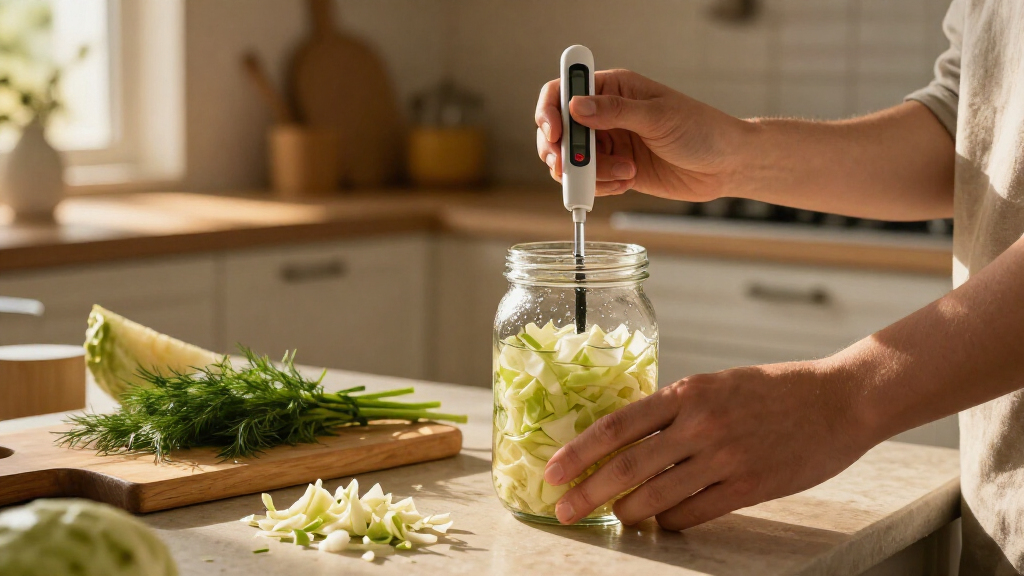
I ranked these meters around the needs implied by food-safe fermentation: whether the probe design suits foods such as dough, cheese, or other solids; whether setup and calibration support are clear; and whether the format fits a home kitchen or a more frequent testing routine. I also weighed handling, cleaning and storage demands, stated versatility, and whether added functions have a clear use for fermentation. A product title alone cannot establish food-contact suitability, so buyers should confirm the manufacturer’s probe materials and care guidance before use.
The Apera PH60S leads because it is presented as a dedicated food pH kit with a spear probe, combining a task-specific format with calibration support. The HORIBA LAQUAtwin ranks as a strong compact alternative, but its small-sample approach serves a different workflow. App-connected models and the 4-in-1 tester rank lower for a pH-first buyer because their extra functions or data features do not automatically improve food probing. Where listings provide limited detail, I avoid treating unverified performance claims as proven advantages and emphasize what a buyer should confirm before purchase.
| digital ph meter for fermentation food safe | Temperature compensation |
|---|---|
| GIDIGI Food pH Meter with Spea | Automatic, 32–140°F (0–60°C) |
| Apera Instruments PH60S Food p | Automatic, 0–50°C |
| Digital Food pH Meter with Spe | Automatic, 0–50°C |
| HORIBA LAQUAtwin pH-11 Pocket | Automatic |
| Digital pH Meter for Food Test | Automatic; range not specified |
| Terronix Digital Food pH Meter | Automatic (ATC) |
| GIDIGI Food pH Meter with ATC | Automatic (ATC) |
| LKBIRD Smart Food pH Meter wit | Automatic (ATC) |
| UIUZMAR Digital pH Meter for F | Automatic (ATC) |
| GISNPA Digital Food pH Meter w | Automatic (ATC) |
| EZTOCH Digital Food pH Meter w | — |
| GIDIGI Digital pH Meter for Fo | — |
| YINMIK Digital pH Meter with C | ATC |
| 4 in 1 High Accuracy pH EC TDS | — |
| YINMIK Digital Food pH Meter w | Automatic (ATC) |
Factors to Consider When Choosing Digital Ph Meter For Fermentation Food Safe
Choosing a fermentation pH meter is less about collecting the most features and more about matching the probe and care routine to the food you test. I would use these checks to narrow the field before comparing individual models.
Match the Probe to the Food
A spear-style probe can reach into foods that are too thick or firm for a simple liquid electrode, which is why it is a practical starting point for sourdough, cheese, and similar samples. A flat-surface or small-sample design may suit thin layers or small portions better, but it may not work the same way in a dense mixture. Think about whether you need a direct reading from the food or can test a prepared liquid sample using a consistent method. Avoid assuming that any meter labeled “food” handles every texture. Check the probe’s stated applications and the maker’s directions for your specific food. The best fit is the one that gives you a repeatable sampling method, not merely the most specialized-looking tip.
Check Food-Contact and Cleaning Guidance
“Food pH meter” describes a use, but it does not by itself confirm that every surface contacting food is appropriate for that use. Before buying, look for manufacturer information on probe materials, cleaning agents, rinsing, and whether the probe can be immersed or only inserted to a defined depth. Fermented foods can leave residue around probe tips and junctions, so a design that is easy to clean can save time and reduce carryover between samples. Do not scrub a sensitive electrode with abrasive tools unless its instructions allow it. If food-contact materials or cleaning directions are unclear, ask the manufacturer rather than guessing. A safe workflow depends on both the instrument and how it is handled.
Plan for Calibration and Storage
Calibration helps check whether a meter is reading appropriately, but a supplied powder or solution kit is only the beginning of ownership. You will need fresh, suitable buffers, clean containers, and a repeatable routine that follows the meter’s instructions. Probe storage also matters: many pH electrodes should not be left dry or stored in plain water, though the exact method varies by model. A common mistake is to put off calibration until readings seem unusual, which makes it harder to tell whether the meter or the sample caused a change. Compare the full care instructions, not just the included accessories. If you test often, easy access to compatible calibration and storage supplies may matter more than a long feature list.
Decide Whether Direct Testing or Sample Preparation Fits
Some foods are difficult to measure consistently without a defined sampling method. A thick dough, a crumbly cheese, and a liquid brine do not present the same contact conditions to an electrode. A meter with a spear probe may make direct testing more convenient, while another workflow may call for preparing a uniform sample according to a validated method. Changing the amount of water, blending time, or sampling location can change the result and make comparisons misleading. Decide how you will take samples before choosing a meter, and follow a reliable recipe or testing protocol. Consistency across batches is often more useful than chasing a single reading from a poorly controlled sample.
Pay for Features You Will Use
Temperature compensation, Bluetooth logging, and multiparameter functions can be useful, but each solves a different problem. Temperature features can help manage readings across changing conditions; app logging is most useful when you compare batches or need a record; EC and TDS functions are aimed at measurements beyond pH. Those extras do not replace a suitable food probe or sound calibration practice. If you only check fermentation pH occasionally, a straightforward meter may be easier to maintain than a connected device with more settings. If records are part of your process, connectivity may justify the added complexity. Choose based on your repeatable workflow rather than the number of functions listed.
Treat pH Readings as One Part of Food Safety
A pH meter measures acidity; it does not certify that a fermented food is safe to eat or shelf-stable. Safety depends on the ingredient, process, time, temperature, sanitation, and a tested recipe or guidance from a reliable food-safety source. Buyers sometimes focus on reaching one target number without checking whether that target and sampling method apply to the food in question. Use the meter to monitor a defined process, not to invent a preservation method. If a batch falls outside the recipe’s guidance, follow the recommended corrective steps rather than relying on the meter alone. This distinction is especially important when pH testing is tied to canning or storage at room temperature.
Frequently Asked Questions
Can I use a regular liquid pH meter for sourdough or cheese?
It depends on the sample method and the electrode design. A standard liquid electrode may be hard to use directly in dense dough or solid cheese, while a spear probe is designed for better access to thicker samples. Some workflows use a prepared slurry instead, but the preparation method needs to be consistent and appropriate for the food. Check the manufacturer’s instructions before inserting a probe into a solid. If you expect to test several food textures, a purpose-built food probe is usually the more practical starting point.
Does a food pH meter tell me whether a ferment is safe to eat?
No. It provides a pH measurement, not a complete food-safety assessment. A safe result depends on using the right sampling method and interpreting the reading within a tested recipe or established process. Time, temperature, ingredients, sanitation, and storage also affect safety. Do not use a meter reading alone to decide that an untested food is safe or shelf-stable. For preservation decisions, follow authoritative food-safety guidance for the specific product.
Should I choose a spear probe or a flat-surface meter?
Choose based on the sample you need to measure. A spear probe is generally more suited to inserting into thicker foods, while a flat-surface or small-sample design can be convenient when you work with small portions or prepared samples. Neither format is automatically right for every food, and a probe still needs suitable care and cleaning. Consider the textures you test most often and whether your process calls for direct measurement. Confirm that the manufacturer lists your intended application before buying.
Are Bluetooth and app features worth paying for in a fermentation pH meter?
They are most useful if you regularly record readings, compare batches, or share a testing log with others. For occasional checks, app setup and connectivity may add little to the actual measurement routine. A connected meter still needs correct calibration, a suitable probe, and a consistent sample method. Before choosing one, check how readings are stored and whether the app supports the records you need. If your main priority is straightforward pH testing, prioritize probe fit and care instructions over connectivity.
What should I check if a meter includes calibration powder but no storage solution?
Read the manufacturer’s care instructions before using or storing the electrode. Calibration powder helps prepare buffer solutions when mixed as directed, but it is not necessarily a substitute for the storage liquid required by a particular probe. Check which buffer values the meter requires, how fresh solutions should be prepared, and what storage product is compatible. Do not assume that tap water or distilled water is suitable for long-term electrode storage. If the listing leaves these points unclear, confirm them with the manufacturer and include ongoing supplies in your buying decision.
Conclusion
My best overall choice is the Apera Instruments PH60S for buyers who want a food-focused kit with a spear probe and calibration support. For best value, I would compare the GIDIGI and YINMIK spear-probe models by checking which listing gives clearer calibration, care, and food-contact details rather than choosing by name alone. The HORIBA LAQUAtwin pH-11 is my best compact pick for small-sample testing, while the LKBIRD Smart Food pH Meter suits buyers who place a premium on app-based records. For beginners, I would favor a clearly documented kit with straightforward calibration and cleaning instructions over extra features. If your needs are specific, choose a spear probe for thicker foods or the 4-in-1 tester only when its additional measurements have a real role in your routine. In every case, pair the meter with a consistent method and tested food-safety guidance.