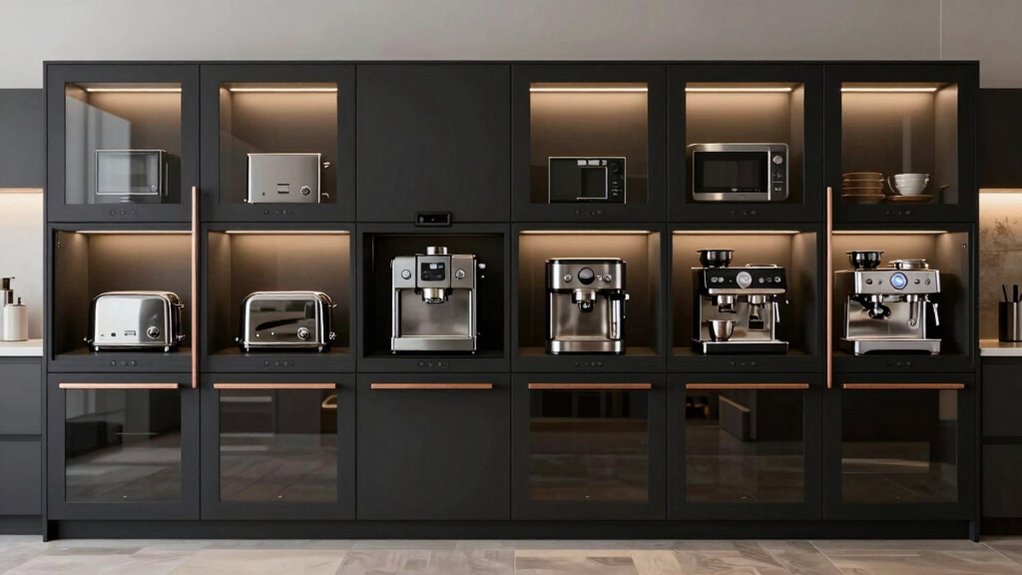

For a large, premium countertop appliance garage, the decision is less about hiding appliances in any box and more about fitting the right footprint, door style, and wood finish into your kitchen. I rank the 24-inch Omega National Hickory first for its wide opening and solid-wood tambour face, while the 24-inch Red Oak is my strongest alternative if you prefer oak. The Maple Corner Appliance Garage suits kitchens where a corner is more useful than a broad countertop run.

Get kitchen staples and gadgets delivered free with Prime
- Fast, free delivery on millions of items
- Prime Video, Amazon Music and more included
- Member-only deals all year
These are all unfinished wood options, so none is a ready-to-install match for every kitchen. The main tradeoffs are width versus countertop space, straight versus corner placement, and solid-wood visible components versus veneer-faced MDF end panels. I also weigh usable opening height: each straight model provides about 14⅝ inches, which can rule out taller appliances even when the exterior looks spacious.
Key Takeaways
Best broad-counter choice: The 24-inch Hickory combines a wide footprint with a solid wood tambour door and face frame, but its usable opening is only 14⅝ inches high.
Best oak alternative: The 24-inch Red Oak shares the Hickory model’s width, depth, and spring-tension track, so choose it when oak better fits your cabinetry plan.
Best for corner placement: The Maple Corner model uses a compact corner-oriented footprint and adjustable shelf, rather than the long straight profile of the 24-inch units.
Best for narrower counters: The 18-inch Hickory keeps the same listed 18.5-inch exterior height and 11.875-inch depth while giving up six inches of width.
Plan for finishing and fit: Every option is unfinished, and the straight models’ 14⅝-inch opening height deserves a measurement check against your tallest appliance.
| Omega National Hickory Appliance Garage, 24 in. W x 18.5 in. H |  | Best Overall — wide straight storage with a solid-wood tambour face | Width: 24 in. | Exterior height: 18.5 in. | Depth: 11.875 in. | VIEW ON AMAZON | See Our Full Breakdown |
| Omega National Straight Appliance Garage, 24-Inch, Unfinished Red Oak | | Best for an oak cabinetry plan — full width without changing the core layout | Width: 24 in. | Height: 18.5 in. | Depth: 11.875 in. | VIEW ON AMAZON | See Our Full Breakdown |
| Omega National Hickory Appliance Garage, 18 in. W x 18.5 in. H | | Best for narrower counters — the hickory tambour format in a smaller span | Width: 18 in. | Height: 18.5 in. | Depth: 11.875 in. | VIEW ON AMAZON | See Our Full Breakdown |
| National Products Maple Corner Appliance Garage |  | Best Corner Fit — use a compact corner instead of a long counter run | Material: Maple wood | Listed dimensions: 12 × 17 × 18.5 in.; description also cites 12 × 12 × 12 in. | Shelf: One adjustable shelf | VIEW ON AMAZON | See Our Full Breakdown |
| countertop appliance garage large premium | Width | Depth | Usable opening height | Door and face frame |
|---|---|---|---|---|
| Omega National Hickory Applian | 24 in. | 11.875 in. | 14.625 in. | Solid wood |
| Omega National Straight Applia | 24 in. | 11.875 in. | 14.625 in. | — |
| Omega National Hickory Applian | 18 in. | 11.875 in. | 14⅝ in. | Solid wood |
| National Products Maple Corner | — | — | — | — |
More Details on Our Top Picks
Omega National Hickory Appliance Garage, 24 in. W x 18.5 in. H
This is my leading pick for buyers who mean large in countertop capacity: its 24-inch width gives it the broadest straight storage footprint in this group, while the 11.875-inch depth keeps the cabinet profile consistent with the 24-inch Red Oak. The solid wood tambour door and face frame give the front a more substantial wood presence than a basic cabinet box, and the spring-tension track is designed to resist binding during use.
Compared with the Red Oak version, the practical distinction is mostly the hickory species, not a larger opening or different stated dimensions. The unfinished surface also gives the buyer control over staining or painting, but that flexibility means extra work before it can coordinate with finished cabinetry. I would not mistake the 18.5-inch exterior height for appliance clearance: usable opening height is 14.625 inches. End panels are veneer-faced and backed MDF, rather than solid hickory, a meaningful construction distinction for a premium purchase.
Pros:- 24-inch width offers the broadest straight footprint in this lineup.
- Solid wood tambour door and face frame.
- Spring-tension track is designed for smooth, nonbinding movement.
- Unfinished surface and doweled joints allow a tailored finish and considered assembly.
Cons:- Usable opening height is 14.625 inches, which may exclude taller appliances.
- End panels are veneer-faced and backed MDF rather than solid wood.
- Unfinished wood requires finishing to suit the kitchen.
Best for: Buyers with a wide countertop section who want a 24-inch straight garage, a solid-wood tambour front, and the option to finish it in a chosen hickory-compatible color.
Not ideal for: Shoppers who need more than 14.625 inches of appliance clearance, want solid wood on every panel, or need a finished unit without a separate staining or painting step.
- Width:24 in.
- Exterior height:18.5 in.
- Depth:11.875 in.
- Usable opening height:14.625 in.
- Door and face frame:Solid wood
- End panels:Veneer-faced and backed 3/8 in. MDF
- Track:Spring tension
- Finish and placement:Unfinished; freestanding, floor mount
Our verdict“I’d choose this as the strongest all-around large option when a 24-inch hickory front and a custom finish matter more than all-solid-wood panels or extra interior height.”
Omega National Straight Appliance Garage, 24-Inch, Unfinished Red Oak
If your kitchen leans toward oak, this model delivers the same key spatial advantage as the 24-inch Hickory: a wide straight footprint with a 14.625-inch usable opening height and 11.875-inch depth. Its solid wood tambour door and face frame, paired with a spring-tension track, make it a close functional match to the Hickory model. That makes wood species and finishing plans the clearest reasons to choose between the two.
The Red Oak is listed at 20 pounds and is described as designed for easy installation, but it still arrives unfinished. I would plan for staining or another finish rather than assume “ready to finish” means ready to use out of the box. Like the wider Hickory, it cannot solve a height problem: both offer the same stated clearance, so a taller appliance calls for another storage approach. Compared with the 18-inch Hickory, the Red Oak takes more counter width in exchange for six extra inches of span; compared with the corner Maple, it is better for a continuous run, not a tucked-away corner.
Pros:- 24-inch width matches the largest straight option in this roundup.
- Solid wood tambour door and face frame.
- Spring-tension track is designed for smooth, nonbinding operation.
- Ready-to-finish surface offers room to coordinate with oak cabinetry.
Cons:- Unfinished surface needs a separate finishing step.
- 14.625-inch usable height limits appliance fit.
- Uses a substantial straight countertop span rather than a corner footprint.
Best for: Buyers who want a 24-inch straight appliance garage with a solid-wood oak front and can finish the unit to coordinate with existing cabinetry.
Not ideal for: Anyone looking for a ready-finished cabinet, a compact corner solution, or additional clearance for tall appliances.
- Width:24 in.
- Height:18.5 in.
- Depth:11.875 in.
- Usable opening height:14.625 in.
- Door:Solid wood tambour
- Face frame:Solid wood
- Track:Spring tension
- Weight and finish:20 lb; unfinished, ready to finish
Our verdict“I’d pick the Red Oak over the Hickory when oak is the better design match, since the two share the same principal dimensions and door-track approach.”
Omega National Hickory Appliance Garage, 18 in. W x 18.5 in. H
The 18-inch Hickory is the sensible choice when a 24-inch garage would crowd the work surface. It keeps the same 18.5-inch exterior height and 11.875-inch depth as the wider Hickory, with a solid wood tambour door and face frame, spring-tension track, doweled joints, and an included shelf. In other words, the reduced width does not change the basic style or the stated vertical clearance.
That shorter span is also the main compromise. Buyers seeking a large garage for several appliances or a wide machine should favor either 24-inch straight model, while this one makes more sense for a single compact appliance and limited counter room. Its usable opening is still only 14⅝ inches high, so it does not solve the tall-appliance limitation shared by the larger straight units. The end panels are veneer-faced MDF, as with the 24-inch Hickory, and the unfinished finish calls for a separate customization step.
Pros:- Narrower 18-inch width takes less countertop span than the 24-inch straight models.
- Solid wood tambour door and face frame.
- Spring-tension track and doweled joints.
- One shelf is included, and the unfinished surface can be customized.
Cons:- Smaller width provides less storage span than either 24-inch straight model.
- Usable opening height is 14⅝ inches.
- End panels use veneer-faced MDF, and the unit needs finishing.
Best for: Buyers who want a hickory tambour-front appliance garage but have less than 24 inches of countertop width available.
Not ideal for: Households needing broad storage for multiple appliances, a taller interior opening, or solid wood end panels.
- Width:18 in.
- Height:18.5 in.
- Depth:11.875 in.
- Usable opening height:14⅝ in.
- Door style:Tambour; one door
- Door and face frame:Solid wood
- Shelves:One included
- End panels and finish:Veneer-faced MDF; unfinished
Our verdict“I’d choose this over the 24-inch Hickory when preserving counter space matters more than gaining a wider appliance bay.”
National Products Maple Corner Appliance Garage
This Maple Corner model earns its place because it changes the placement question. Rather than occupying a 24-inch stretch of straight counter like the Hickory and Red Oak options, it is designed to put appliance storage in a corner footprint. The adjustable shelf offers flexibility for different stored items, and the shutter-style door gives it a distinct look from the tambour-front straight garages.
Its listed dimensions are inconsistent: one specification describes 12 × 17 × 18.5 inches, while the description also refers to a compact 12 × 12 × 12-inch size. I would confirm the exact footprint and interior clearance with the seller before planning a tight installation. The available information also does not state a usable opening height comparable to the 14⅝-inch clearance listed for the straight models. Unlike the 24-inch Hickory, this is not the pick for broad straight storage; its advantage is reclaiming a corner, with the tradeoff of less clearly documented capacity and a finish that still needs work.
Pros:- Corner-oriented design can use space differently from a straight 24-inch cabinet.
- Adjustable shelf accommodates different stored items.
- Maple wood can be stained or painted to suit the kitchen.
- Shutter-style door offers a different appearance from the tambour models.
Cons:- Published dimensions conflict, so the footprint needs confirmation before purchase.
- No comparable usable opening-height figure is provided.
- Unfinished wood requires staining or painting.
Best for: Buyers who have an underused kitchen corner, prefer a maple finish direction, and want an adjustable shelf in a compact appliance-storage cabinet.
Not ideal for: Shoppers who need a confirmed large straight opening, precise published appliance clearance, or a finished unit ready to coordinate with cabinetry.
- Material:Maple wood
- Listed dimensions:12 × 17 × 18.5 in.; description also cites 12 × 12 × 12 in.
- Shelf:One adjustable shelf
- Door:One shutter-style door
- Finish:Unfinished
- Mounting:Floor mount
- Hardware color:Silver
- Placement:Corner-oriented
Our verdict“I’d select the Maple Corner when corner placement is the priority, but I would verify its actual dimensions before treating it as a large-capacity alternative.”

How We Picked
I ranked these four options around the promise of a large, premium appliance garage, not on appearance alone. I gave the strongest position to the products that offer the most usable straight-line width, describe solid wood for the tambour door and face frame, and include a track designed for smooth movement. That puts the two 24-inch straight models ahead of the smaller options for buyers who have countertop room and want to conceal larger everyday appliances.
Width does not settle every kitchen decision, so I also considered placement and flexibility. The corner model earns a distinct role because it puts storage into a different part of the counter; the 18-inch Hickory serves buyers who want the same general tambour-door approach in a narrower span. I compared stated usable opening height as well as exterior dimensions, since a unit’s outside height can overstate the space available for a blender or coffee machine.
Finally, I treated the unfinished surfaces as both an advantage and a real commitment. They let a buyer coordinate the wood with surrounding cabinetry, but they require a finishing plan rather than offering an immediate color match. I also called out the Hickory models’ veneer-faced MDF end panels: the door and face frame are solid wood, but not every visible component is. The listed specifications have inconsistencies for the corner model’s dimensions, so I describe it as compact and recommend confirming its exact footprint before ordering.
| countertop appliance garage large premium | Door |
|---|---|
| Omega National Hickory Applian | — |
| Omega National Straight Applia | Solid wood tambour |
| Omega National Hickory Applian | — |
| National Products Maple Corner | One shutter-style door |
Factors to Consider When Choosing Countertop Appliance Garage Large Premium
I would choose an appliance garage by measuring the appliance first, then deciding how much counter space it can claim. These four models vary more by footprint and placement than by their broad purpose of concealing kitchen equipment.
Measure the appliance opening, not just the cabinet
The straight Hickory and Red Oak garages have an exterior height of 18.5 inches but list just 14.625 inches of usable opening height. Measure your tallest appliance with its handle, lid, or other protruding parts included. Allow room to move it in and out; a tight fit can make a hidden appliance awkward to use. The corner Maple model does not provide a comparable usable-height figure in its listed details, so request clarification rather than assuming its exterior size equals interior clearance.
Match width to the counter run you can spare
The 24-inch Hickory and Red Oak offer the most width among the straight options, which favors buyers who want a broad concealed bay. The 18-inch Hickory trims six inches from that span while keeping the stated depth and exterior height, making it a better fit where counter space is limited. The Maple Corner takes a different route: it is meant for corner placement, but its conflicting listed dimensions make footprint verification especially important.
Choose a door and wood species for your kitchen
The three straight units use a tambour door that travels on a spring-tension track; their solid-wood door and face-frame construction gives the front a traditional wood character. Hickory versus Red Oak is a finish and species preference rather than a stated change in clearance or width for the 24-inch models. The Maple Corner’s shutter-style door looks different and suits buyers prioritizing corner storage over matching the straight tambour design.
Treat unfinished wood as a project, not a finished color
All four options are unfinished, so plan for staining or painting if you want a coordinated built-in appearance. That can be an advantage when existing cabinetry has a specific tone, but a natural-looking match may take careful preparation and testing. The 24-inch and 18-inch Hickory models specify veneer-faced MDF end panels, despite their solid-wood door and face frame. Buyers expecting all panels to be solid wood should check construction details before choosing.
Check what the listed dimensions actually describe
Product listings can combine exterior measurements, opening measurements, and different model variants. The corner Maple listing is particularly unclear, with dimensions reported as both 12 × 17 × 18.5 inches and 12 × 12 × 12 inches. I would confirm the exact model, overall width, depth, height, shelf position, and appliance clearance before committing to a particular counter layout. For the straight units, use the stated 14⅝-inch usable height as the practical starting point, not the exterior cabinet height.
Frequently Asked Questions
Which of these appliance garages is the largest?
The two 24-inch straight models—the Omega National Hickory and the Omega National Red Oak—have the greatest stated width in this group. Both are 24 inches wide, 18.5 inches high, and 11.875 inches deep. That makes them the strongest choices for a broad straight countertop span, though their listed usable opening height is 14.625 inches, so “largest” does not mean they fit every tall appliance.
Will a tall blender or coffee maker fit inside the straight models?
Check the appliance’s height against the stated 14.625-inch usable opening height of the straight Hickory and Red Oak models, and include any handle or lid that adds height. The exterior height of 18.5 inches is not the same as the interior clearance. The corner Maple listing does not give a directly comparable usable opening measurement, so I would ask for that figure before relying on it for a tall appliance.
What is the difference between the 24-inch Hickory and 24-inch Red Oak?
The main stated difference is the wood species and the related finish direction. Both have a 24-inch width, an 18.5-inch height, an 11.875-inch depth, a 14.625-inch usable opening, a solid wood tambour door and face frame, and a spring-tension track. I would pick Hickory or Red Oak based on the intended cabinetry finish, while noting that the Hickory listing identifies veneer-faced and backed MDF end panels.
Do these appliance garages arrive finished?
No. All four options are described as unfinished or ready to finish, so buyers should plan for staining or painting before expecting a coordinated finished appearance. That gives you more control over how the unit relates to cabinetry, but it adds a finishing step. Check the product’s material details as well: the Hickory models specify veneer-faced MDF end panels, which may affect how you approach the finish.
Should I choose the Maple Corner model for a small kitchen?
It may make sense if you have a usable corner and want a different footprint from the 18- or 24-inch straight garages. Its adjustable shelf and shutter-style door add flexibility, but the published dimensions conflict and no comparable usable opening height is given. I would verify its exact outside measurements and interior clearance before choosing it over the 18-inch Hickory, whose listed dimensions are clearer.
Conclusion
For buyers with room for a broad straight cabinet, I recommend the 24-inch Hickory as the best overall balance of width, tambour construction, and finishing flexibility. Choose the 24-inch Red Oak instead when oak better suits your cabinetry; its core stated dimensions and opening height match the Hickory. If counter space is tight, the 18-inch Hickory preserves the same basic straight profile in a narrower span. For a kitchen corner, the Maple Corner offers the most distinct placement, but I would confirm its dimensions before buying. Whichever model you prefer, measure your appliance against the opening—not the exterior—and plan for the work required to finish unfinished wood.