TL;DR

Get kitchen staples and gadgets delivered free with Prime
- Fast, free delivery on millions of items
- Prime Video, Amazon Music and more included
- Member-only deals all year
Air fryers for small kitchens can cook quick portions without heating a full-size oven, but the right choice depends on exterior dimensions, ventilation clearance, and how much food fits in a single layer. Measure your counter and storage space, compare basket shapes and cleanup needs, and leave room for hot air to circulate so food browns instead of turning soggy.
A countertop appliance can fit neatly in your kitchen and still take over the only spot where you chop vegetables. That is why choosing air fryers for small kitchens starts with a tape measure, not a capacity label.
An air fryer cooks by circulating hot air around food, usually with a little oil. It can make a small serving of potatoes, vegetables, or leftovers convenient without heating a full-size oven. But exterior size, usable cooking space, and the clearance around vents all affect whether it feels like a help or a permanent obstacle.
This guide will help you compare basket and oven styles, measure for a safe fit, and choose features you will use. You will also find practical tips for crisp cooking, cleanup, and safe placement, so you can decide whether an air fryer earns a place on your counter.
Measure width, depth, and height, then allow the clearance and access space specified in the manual.
Compare the food you can spread in one layer, not only the advertised volume.
Basket models often save space; oven-style models offer shelves but usually occupy a wider area.
Leave room around food for airflow, and cook in batches when the basket is crowded.
Check cleaning instructions, ventilation, and power guidance before choosing a spot on your counter.
Why an Air Fryer Can Make Small Meals Easier
Air fryers for small kitchens are useful when you want a quick portion without warming a full-size oven. They cook by circulating hot air around food, which can brown a small batch of vegetables or reheat leftovers with less oil than deep frying. The benefit is convenience, not a guarantee that every meal cooks faster or costs less.
Think of the cooking chamber as a small, breezy oven. A teaspoon of oil can help chopped potatoes develop golden edges, while a crowded pile blocks airflow and softens the result. If you cook for one, a single layer of broccoli or a salmon portion may be just right; if you want dinner for four, you may need multiple batches.
For example, after work you might cook a handful of frozen fries while a pan of eggs heats on the stove. That can be simpler than waiting for a large oven to heat, especially in warm weather. Cooking time and texture vary by model, recipe, portion size, and how tightly you pack the food, so check and adjust rather than assuming oven directions transfer exactly.
An air fryer can reduce the oil used in some recipes, but it does not make every food healthy by default. A breaded snack stays a breaded snack. Choose it for the cooking routine it supports: compact portions, reheating, or another mode you genuinely use.
Products Worth Considering

Instant Pot Vortex Plus 10-Quart 7-in-1 Air Fryer Oven

Le Creuset Enameled Cast Iron Round Bread Oven, 9.5-Inch, Cerise

KitchenAid KES6503 Semi-Automatic Espresso Machine, Empire Red
As an affiliate, we earn on qualifying purchases.
Choose a Shape That Fits Your Counter and Your Cooking
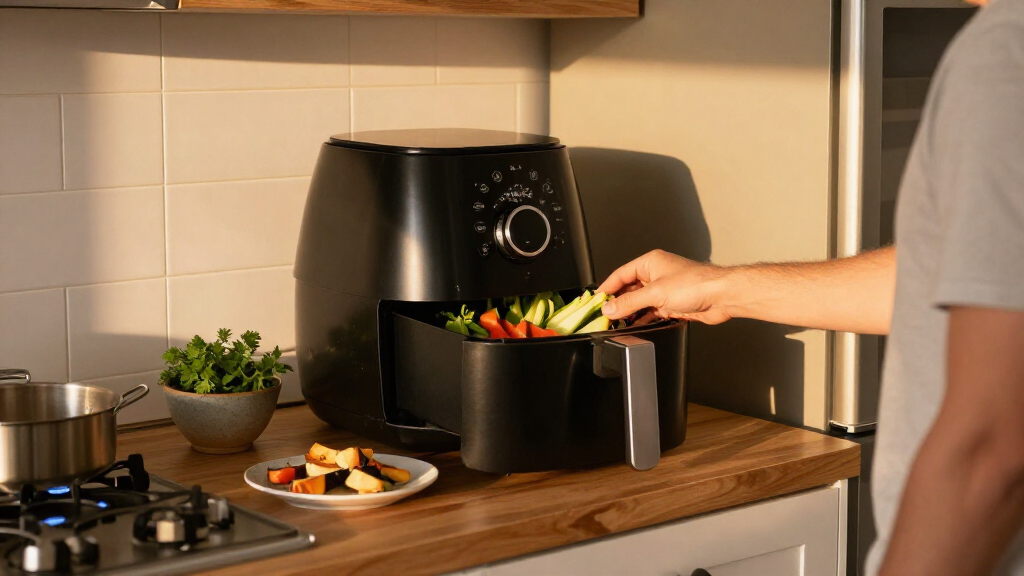
Air fryers for small kitchens come in several shapes, and the best one depends on what you cook and where you can place it. Basket models often have a compact footprint and a simple pull-out drawer; oven-style models offer shelves and a wider cooking area but usually claim more counter space. A dual-basket design separates foods, yet its width may be awkward on a narrow worktop.
Here is a useful distinction: exterior size describes the appliance itself, while usable capacity describes the food you can actually spread out for cooking. Advertised volume does not tell you whether a long piece of fish fits or whether fries can sit in one layer. A tall basket and a wide tray can have similar stated capacities but suit different meals.
| Style | Often suits | Small-kitchen trade-off |
|---|---|---|
| Basket | One or two portions, simple everyday cooking | Basket shape can limit long or flat foods |
| Oven-style | Food on shelves, toast, or broader trays | May take up more counter space |
| Dual-basket | Two foods cooked separately | Width can crowd a narrow counter |
| Multifunction | Replacing or supplementing appliances you already use | Extra modes may come with a larger body |
Imagine a couple making roasted vegetables and two pieces of tofu: a compact basket may be plenty. A household that wants chicken on one side and vegetables on the other may value separate compartments enough to accept a wider unit. Compare dimensions and food shape before buying; a bigger number on the box does not automatically mean a better fit.
Measure First to Avoid a Countertop Squeeze
Measure the appliance’s width, depth, and height, then check its required vent clearance and whether you can safely reach the basket or open the door. A unit that sits on your counter may still be too tall for a cabinet, too deep for a narrow worktop, or too close to a wall when its rear vent is running.
Use this quick fitting process before you shop:
- Measure the counter or shelf where you plan to cook, including the space needed to open drawers and doors.
- Check the manufacturer’s manual for required clearance around vents and overhead surfaces.
- Compare those measurements with the appliance dimensions, allowing space to remove the basket or tray without bumping a wall.
- Measure a storage cupboard too, if you plan to put the appliance away between uses.
For instance, if your counter is 45 centimeters deep and the appliance nearly fills it, the power cord and hot basket may leave little room to work. Mark the proposed footprint with paper or removable tape. That quick mock-up can reveal whether the unit blocks a cupboard door or your usual chopping board.
Keep vents clear and use the appliance on a stable, heat-resistant surface. Follow the manual’s placement and clearance instructions, especially in a tight kitchen.
Small homes make storage tempting, but do not operate an air fryer inside a closed cupboard or place it away while it is hot. Let it cool as directed, then store it only if the appliance and its cord fit safely.
Get Crisp Results Without Cooking Extra Batches
Food browns best when hot air has room to move around it, so spread ingredients out and cook in batches when needed. This simple rule matters more than chasing a large advertised capacity. An overloaded basket traps steam, leaving the bottom layer limp while exposed pieces darken.
To get better results in a compact model:
- Leave gaps between pieces, especially for fries, breaded vegetables, and other foods you want crisp.
- Shake or turn food partway through cooking when the recipe or appliance instructions call for it.
- Check early when adapting oven directions; smaller portions and different models can finish at different times.
- Use a modest amount of oil when a recipe needs it, and avoid pouring loose oil into the appliance.
Say you have one cup of cubed potatoes. Spreading them in a loose layer gives them a better chance at crisp edges than stacking them into a mound. If you are cooking enough for four people, split the potatoes into batches or choose an appliance with enough genuinely usable tray area.
An air fryer is a convection cooker, not a deep fryer: food is not immersed in hot oil. Its small chamber can be handy for a snack or side dish, but results depend on ingredients and airflow. If the food comes out soft, reduce the load or turn it; adding more time to a crowded basket may dry the outside without fixing uneven browning.
Pick Features You Will Actually Use and Clean
Choose controls and accessories around the meals you make, because every extra mode still needs space on the counter. A compact single-purpose model may be easier to store than a larger multifunction appliance. Presets, a viewing window, or a second cooking mode can be handy, but they do not guarantee better air-frying.
Picture a person who mainly reheats a slice of pizza and roasts vegetables. A clear temperature dial and a basket that rinses easily may matter more than a long menu of settings. Someone who regularly makes toast and tray bakes might find an oven-style unit worth its wider footprint.
Before buying, check exactly which pieces are dishwasher-safe. A removable basket may be listed as dishwasher-safe while the outer drawer, heating area, and appliance body still need careful hand cleaning. Grease and crumbs can build up; once the unit has cooled, clean it as the manual directs, and never immerse the electrical body in water.
Fans make noise, and cooking smells can linger in a small home. If you share a studio apartment, think about whether the appliance sits near your work desk or bedroom and whether a window or kitchen extractor can ventilate the area. Also read the power guidance: air fryers draw substantial power while running, so follow the manufacturer’s instructions and avoid overloading an outlet or power strip.
Use Recent Product Claims as a Starting Point
Compact bodies, digital presets, viewing windows, dual baskets, and easier-cleaning parts are common air fryer product trends. Those features can make a specific model more convenient, but marketing claims about speed, quiet operation, or crispness are not a promise of identical results in every kitchen. Your recipe, portion size, and how full the basket is all affect performance.
When you compare current models, look for independent reviews that describe actual foods and portions rather than repeating a feature list. A test with a small serving of frozen fries may tell you more about everyday use than a long catalogue of cooking modes. Check current product listings for prices and specifications because releases and offers change over time.
For example, if you are choosing between a compact basket model and a larger appliance with six modes, ask whether you will use those other modes often enough to give up counter space. A “faster” claim is also most useful when the reviewer explains the food, batch size, and comparison method. Results may differ in your home, so treat a specification as a clue to investigate rather than a guarantee.
Air fryers can suit small portions without heating a full-size oven, but they are not automatically more energy-efficient or cheaper to run. That comparison depends on the food, cook time, appliance, and alternative method. If electricity use matters to you, check reliable model-specific information and compare it with how you actually cook.
Frequently Asked Questions
What size air fryer works for one person or a couple?
Choose based on the foods and portions you cook, since models’ capacity figures do not translate neatly across designs. For one or two people, a smaller basket may handle everyday portions; check whether your usual meal fits in a loose layer for browning.
Can an air fryer sit under kitchen cabinets?
Only place and operate it according to the manufacturer’s instructions for overhead and side clearance. Vents must stay clear, so measure the height available and check the manual before using it beneath a cabinet.
Is a basket-style or oven-style air fryer better for a small kitchen?
A basket model often has a compact footprint and suits small portions, while an oven-style design offers shelves or a wider cooking area but may take more counter space. Compare the dimensions and the shape of foods you cook, such as a flat fillet or a handful of vegetables.
Why does food come out soggy in my air fryer?
A crowded basket can block airflow and trap steam. Spread food out, shake or turn it when appropriate, and cook in batches if needed; a small loose layer usually browns better than a heap.
Does an air fryer use less electricity than an oven?
It depends on the specific appliance, food, portion, and cooking time. An air fryer may be convenient for a small batch, but it is not automatically cheaper or more energy-efficient in every comparison.
Are air-fryer baskets dishwasher-safe?
Some removable parts may be dishwasher-safe, but that does not necessarily include every tray or accessory. Check the model’s manual for each component, let parts cool, and keep the electrical body out of water.
Conclusion
Choose an air fryer by the space it occupies, the portions it can cook well, and the effort it takes to clean. Measure first, read the clearance instructions, and think about the foods you make most often. A compact appliance earns its place when it fits your routine as neatly as it fits your counter.
Leave room for the fan’s warm breath and for your hands to lift out the basket. Then let a small patch of countertop turn a handful of potatoes golden and crisp.