
🔍 Read the full analysis: Sunday Lunch In Emilia: Lasagne Alla Bolognese From Scratch on Mad Tasting
Open a free Amazon Business account
Business pricing, bulk buying and tax-exempt orders.
Create a free accountAs an affiliate, we earn on qualifying purchases.
TL;DR
Mad Tasting has published a method for making Emilia-Romagna’s lasagne alla Bolognese from scratch, with spinach pasta, meat-led ragù, pourable béchamel and Parmigiano Reggiano. The guide recommends preparing the ragù ahead, building five to seven thin layers and resting the baked lasagne before serving.
Mad Tasting has detailed a from-scratch method for Emilia-Romagna’s lasagne alla Bolognese, calling for thin spinach pasta, slow-cooked meat ragù, pourable béchamel and Parmigiano Reggiano. The guide’s main practical advice is to cook the ragù one or two days ahead, assemble five to seven restrained layers and let the baked pan rest for 15 to 30 minutes so it can be served in stable slices.
The method treats the dish as a combination of four separate components, each with a defined job. Green egg-pasta sheets create thin, distinct layers; ragù supplies concentrated meat flavor; béchamel provides moisture and mild richness; and finely grated Parmigiano Reggiano seasons the filling while forming a browned top. Mad Tasting advises against loading the pan with mozzarella, ricotta or a wet tomato sauce because those additions can obscure the individual textures and make the finished lasagne less stable.
For the ragù, the guide recommends rendering pancetta, gently cooking a finely chopped onion, carrot and celery base, and then browning coarse-ground beef in batches. Crowding cold meat into a narrow pan can cause it to release liquid and steam rather than brown. After the beef develops colored edges, dry wine is added and reduced before tomato and broth enter the pan. The sauce then cooks at a low simmer for two to three hours, with broth added as needed to prevent it from drying out.
Milk may be incorporated during cooking or near the end, although the source says some Emilia households omit it. An earlier addition produces a more integrated, mellow sauce, while a later addition leaves a clearer creamy note. The guide identifies proper meat browning and gentle simmering as more consequential than the precise timing of the milk. Tomato remains restrained so its water and acidity do not dominate the pasta, dairy and aged cheese.
Sunday Lunch in Emilia: Lasagne alla Bolognese
A composed regional classic built from thin spinach pasta, concentrated meat ragù, pourable béchamel and Parmigiano Reggiano. The secret is restraint: distinct layers, balanced moisture and enough resting time for a clean, stable slice.
Four components, four precise jobs
Lasagne alla Bolognese is not defined by a thick cheese blanket or a loose red sauce. Its identity comes from the way four restrained elements remain perceptible in every bite.
Green egg pasta
Thin spinach sheets separate the fillings and create tender, distinct layers. Well-drained spinach helps preserve a workable dough.
Meat-led ragù
Pancetta and browned beef provide concentrated savory flavor. Tomato supports the sauce without dominating it.
Pourable béchamel
Milk, butter and flour bring mild richness and hydration. A stiff paste will not spread moisture evenly.
Parmigiano Reggiano
Freshly grated aged cheese seasons each layer and forms the browned top. Look for the marked DOP rind.
Browning matters more than milk timing
Develop flavor in deliberate stages. Use a wide pan, avoid crowding cold meat and keep the final simmer calm enough to concentrate without drying the sauce.
Pancetta
Release its fat gently to create the savory foundation.
Vegetable base
Cook finely chopped onion, carrot and celery without scorching.
Coarse beef
Work in batches so the meat colors instead of steaming.
Dry wine
Let the wine cook down before adding tomato or broth.
Tomato + broth
Cook gently for two to three hours, adding broth as needed.
Optional milk
Add early for integration or later for a clearer creamy note.
Bolognese style versus a heavier stack
Family formulas vary, but the regional framework stays recognizable: green pasta, meat-focused ragù, béchamel, aged Parmigiano and controlled moisture.
| Element | Emilia framework | Heavier alternative | Effect on the slice |
|---|---|---|---|
| Pasta | ✓Thin spinach egg sheets | ~Thick or plain sheets | Thin sheets keep layers distinct and tender. |
| Ragù | ✓Meat-led, restrained tomato | ✗Loose, tomato-heavy sauce | Less water improves concentration and stability. |
| White sauce | ✓Pourable béchamel | ✗Dense, stiff paste | Fluid béchamel distributes moisture evenly. |
| Cheese | ✓Parmigiano Reggiano | ✗Mozzarella or ricotta load | Hard cheese seasons without weighing down the stack. |
| Layering | ✓Five to seven restrained layers | ✗Overfilled layers | Restraint produces a unified, clean-cut portion. |
Repeat thin layers, then let heat do the work
The stable-slice formula
Match the sauce quantity and pasta dimensions to the pan. Bake until the filling bubbles and the surface is browned, then resist cutting immediately.
Spread the labor, protect the ritual
Preparing the ragù in advance turns an elaborate meal into an orderly sequence and leaves serving day for pasta, béchamel, assembly and the table.
Cook the ragù
Simmer slowly, cool promptly and refrigerate in a covered container.
Roll the pasta
Prepare thin spinach egg sheets sized for the chosen pan.
Make béchamel
Keep it smooth and pourable so moisture reaches every layer.
Layer and bake
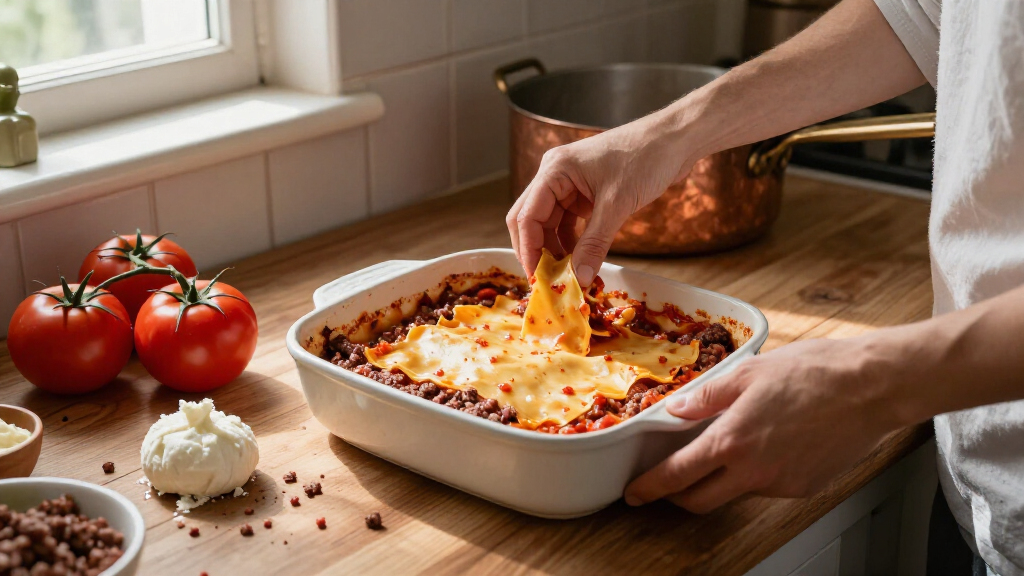
Build five to seven layers; bake until bubbling and browned.
Rest and serve
Wait 15–30 minutes, then cut into stable, generous portions.
Use the standard safe minimum internal temperature.
Reheat refrigerated leftovers thoroughly before serving.
Refrigerate promptly; do not leave perishables out beyond two hours.
A framework, not one mandatory formula
Regional identity with room for family practice
Households may adjust tomato, add milk at different stages or choose six layers instead of seven. What remains is the four-part balance of green pasta, meat ragù, béchamel and Parmigiano Reggiano. Lasagne may appear as a substantial primo after antipasti or serve as the centerpiece before a bitter-leaf salad.
Avoid the common traps
Layering Defines the Regional Dish
The guidance matters because lasagne alla Bolognese differs structurally from many internationally familiar lasagne recipes. Its identity does not rest on a thick blanket of melted cheese or a strongly tomato-based filling. Instead, moisture, seasoning and richness are distributed among green pasta, ragù, béchamel and Parmigiano, allowing each element to remain perceptible in a single bite.
The schedule also makes an elaborate Sunday meal more manageable. Preparing the ragù in advance spreads the work across several days and gives the sauce time to settle before assembly. Once the pasta and béchamel are ready, cooks can focus on building five to seven thin layers rather than correcting a hurried sauce. The final 15-to-30-minute rest is part of the method, not idle waiting: it allows bubbling sauce to settle and reduces the chance that the portions will slide apart.
Lasagne alla Bolognese ingredients set
As an affiliate, we earn on qualifying purchases.
As an affiliate, we earn on qualifying purchases.
Emilia’s Long Sunday-Lunch Ritual
In the meal pattern described by Mad Tasting, lasagne traditionally appears as a primo, or substantial first course, after antipasti and before a meat course. In many present-day households, however, the lasagne can serve as the main centerpiece, followed by little more than a bitter-leaf salad. The lengthy preparation is tied to the social rhythm of Sunday lunch, when pasta rolling, sauce cooking and family gathering occupy the same stretch of time.
Mad Tasting points to the reference formula for ragù alla Bolognese registered by the Italian Academy of Cuisine with the Bologna Chamber of Commerce. The source describes that formula as a regional guide rather than a binding rule. Family versions may use different amounts of tomato, add milk at different stages or assemble six layers instead of seven, while still retaining the dish’s meat-led sauce and four-part structure.
Ingredient selection reinforces that regional pattern. A typical shopping list includes eggs, flour, spinach, pancetta, beef, milk, butter, onion, carrot, celery and Parmigiano Reggiano with its marked DOP rind. Wet spinach can weaken the pasta dough, while béchamel cooked into a stiff paste may fail to distribute moisture. Shelf-stable powdered cheese is also presented as a poor substitute for freshly grated aged Parmigiano Reggiano.
As an affiliate, we earn on qualifying purchases.
Exact Family Formulas Still Vary
The source does not provide one mandatory ingredient ratio, a single pan size or an exact baking temperature and duration for every kitchen. It also leaves the timing of the milk open and acknowledges that households differ in their use of tomato and number of layers. Readers will need to match sauce quantity, pasta dimensions and baking time to their chosen recipe and pan.
The guide’s cultural observations describe common practices but do not establish how widely every method is followed across Emilia-Romagna today. It is also unclear whether the supplied version reproduces the registered ragù formula ingredient for ingredient. What the material supports is a regional framework rather than uniformity: green pasta, meat-focused ragù, béchamel, Parmigiano Reggiano and restrained layering.
As an affiliate, we earn on qualifying purchases.
Advance Ragù Starts the Schedule
Cooks following the guide should begin by making the ragù one or two days before lunch, cooling it promptly and storing it in a covered container in the refrigerator. On serving day, they can prepare the spinach pasta and pourable béchamel, assemble the layers, and bake until the filling bubbles and the top is browned. The pan should then rest for 15 to 30 minutes before cutting.
Food-safety guidance also applies throughout the process. Ground beef should reach 160°F, or 71°C, according to standard USDA guidance. Perishable food should not remain at room temperature for more than two hours; leftovers should be refrigerated promptly, generally used within three to four days, and reheated to 165°F, or 74°C. The dish contains common allergens including wheat, eggs and milk. Wine is used in the ragù, and cooking may not remove every trace of alcohol; any wine served with lunch is for adults and should be consumed responsibly.
As an affiliate, we earn on qualifying purchases.
Key Questions
What makes this lasagne Bolognese in style?
Its defining structure combines thin green egg pasta, a concentrated meat ragù, pourable béchamel and Parmigiano Reggiano. Tomato plays a supporting role rather than turning the filling into a loose red sauce.
Why should the ragù be prepared ahead?
Making the ragù one or two days early divides the workload and leaves Sunday for pasta, béchamel, assembly and baking. The chilled sauce must be stored in a covered refrigerator container and handled within food-safe time limits.
How many layers should the lasagne have?
Mad Tasting recommends five to seven restrained layers. The aim is a tender, unified structure in which pasta and sauces remain distinct, rather than a tall stack overwhelmed by cheese or excess liquid.
Can mozzarella or ricotta be added?
They can be used in other lasagne styles, but they are not part of the four-component Bologna structure described in the source. Added mozzarella or ricotta may produce a heavier and less stable slice.
Why must the lasagne rest after baking?
A 15-to-30-minute rest lets the hot sauces settle and the layered structure firm enough for cutting. Serving immediately increases the chance of loose filling and sliding portions.
Source: Mad Tasting
Fall Picks
fall essentials
As an affiliate, we earn on qualifying purchases.