TL;DR

Get kitchen staples and gadgets delivered free — and shop member deals
- Fast, free delivery on millions of items
- Access to Prime Big Deal Days deals on October 6–7
- Prime Video, Amazon Music and more included
A Good Housekeeping test found that one pound of frozen ground beef thawed 90 minutes faster on an aluminum baking sheet than on a ceramic plate. Both packages sat at room temperature for at least three hours, exceeding USDA guidance for perishable food left out to thaw. Safer options are the refrigerator, cold water or a microwave followed by immediate cooking.
Ground beef thawed 90 minutes faster on an aluminum baking sheet than on a ceramic plate in a Good Housekeeping test, but both methods kept the meat on the counter longer than USDA guidance allows. The result shows that the viral-style metal-sheet trick can speed thawing while still posing a food-safety concern.
A contributing analyst and writer in the Good Housekeeping Institute Kitchen & Cooking Lab compared two one-pound packages of frozen ground beef: one on an uncoated metal baking sheet and one on a ceramic dinner plate. Both were left on a countertop in a room measured at 73°F. The tester checked surface temperatures on both sides every 30 minutes with an infrared thermometer, and counted the meat as thawed when a probe thermometer slid easily into its center.
The beef on the metal sheet was fully thawed after three hours, with a center temperature of 31°F. Its top surface measured 44.6°F and its bottom 53.6°F. The package on the ceramic plate took four and a half hours to thaw. The report says the metal surface appeared to transfer room heat to the meat more effectively: after 30 minutes, ice under the beef on the sheet had melted, while the plate-held beef remained quite frozen.
The report says the USDA advises against thawing perishable food on the counter or leaving it at room temperature for more than two hours, because bacteria can multiply quickly between 40°F and 140°F. In this test, both packages spent at least three hours on the counter and were above 40°F when they finished thawing. Good Housekeeping therefore does not recommend either counter method.
Faster Thawing Still Carries Risk
The test addresses a practical dinner-time problem: frozen meat may need to be ready quickly, and the metal-sheet method did reduce the wait in this comparison. But the speed result does not make the method safe. The metal-held beef’s surface readings reached above 40°F, and the meat remained on the counter beyond the two-hour limit cited by the report.
That distinction matters for people deciding whether to copy a food hack. A method can work as a way to thaw meat faster and still expose perishable food to conditions in which bacteria can multiply. The report’s test involved one kind and amount of meat, two surfaces and a 73°F room; it does not establish how long every cut or package would take, or whether the results hold in other kitchens. Its main consumer guidance is clear: do not use counter thawing as a safe shortcut.
How the Kitchen Test Worked
The test compared the same weight of frozen ground beef on two household surfaces under the same reported room conditions. At the start, the tops of both packages measured 2.5°F. The bottom of the package on the baking sheet measured 10.1°F, compared with 3.9°F for the package on the ceramic plate.
After two hours, the metal-sheet beef had softer edges and released more juice when turned; the plate-held beef was still firmer. At three hours, the metal-sheet package met the tester’s thawing test, while the other took another 90 minutes. The report attributes the faster result to metal’s ability to conduct heat, but the experiment does not compare other metals, meat shapes, room temperatures or package thicknesses.
Good Housekeeping’s report identifies its tester as Mark Marino, a writer, food editor and product tester with more than seven years of experience in digital food media. It describes the experiment as a Kitchen & Cooking Lab test. The reported findings are observations from that test, while the food-safety recommendation is attributed to USDA guidance.
““Both sets of frozen meat sat on the counter for a minimum of three hours and were above 40°F when they finished thawing.””
— Good Housekeeping report
Limits of the Single Test
The reported comparison covers one pound of ground beef on two surfaces in a 73°F room. It does not say whether different package shapes, meat types, sheet materials or room temperatures would produce the same thawing times. The report also does not provide bacterial test results, so it does not quantify bacterial growth in either package.
The finding that the metal sheet was faster applies to this test; it does not change the report’s stated USDA safety guidance. The source provides no broader trial results or estimate of how often people use this hack.
Safer Ways to Thaw Meat
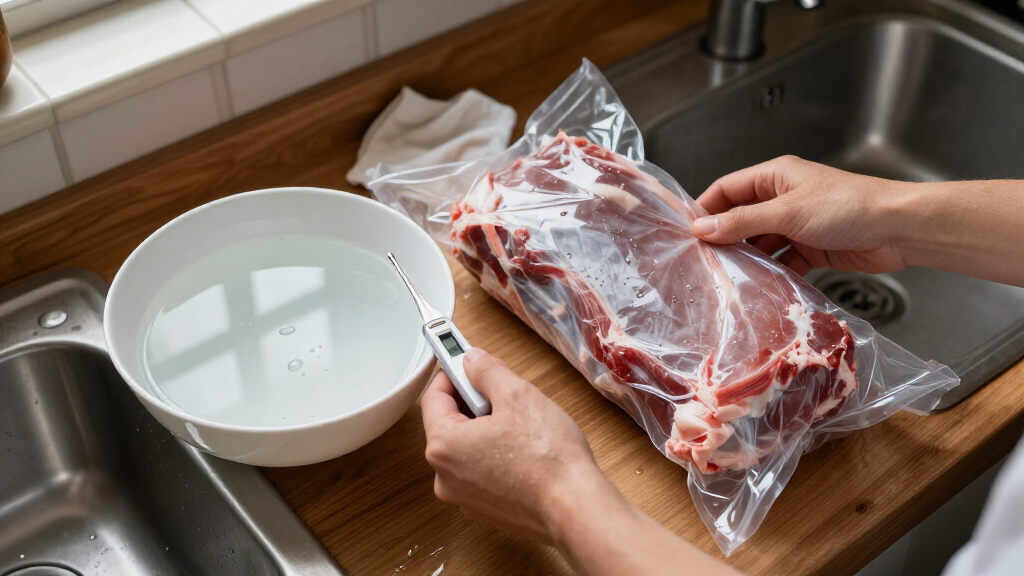
For a quick thaw, the report recommends placing meat in a sealed bag in cold water, changing the water every 30 minutes and cooking the meat as soon as it thaws. It also recommends following the microwave manufacturer’s defrost instructions and cooking the meat immediately afterward.
For advance planning, thaw meat in the refrigerator, where it can remain at a safe, constant temperature, according to the report. Good Housekeeping’s article offers these alternatives but does not announce a further test or an upcoming update.
Key Questions
Did the metal baking sheet thaw the beef faster?
Yes. In the reported test, one pound of ground beef thawed on an aluminum baking sheet in three hours, 90 minutes faster than the package on a ceramic plate.
Does faster thawing mean the metal method is safe?
No. The report says both packages were left on the counter for at least three hours and were above 40°F when thawed. It cites USDA guidance against counter thawing and leaving perishable food at room temperature for more than two hours.
What is a safer quick method?
Put the meat in a sealed bag, submerge it in cold water, and change the water every 30 minutes. The report says to cook it as soon as it thaws.
Can I thaw meat in the microwave?
Yes, following the microwave manufacturer’s defrost instructions. The report advises cooking the meat immediately after thawing.
What if I have time to plan ahead?
Thaw the meat in the refrigerator, which the report describes as keeping it at a safe, constant temperature.
Source: rss
NFL season / tailgating Picks
team gear
As an affiliate, we earn on qualifying purchases.