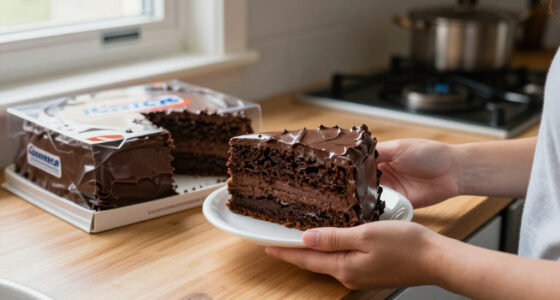
To save baking days, regularly check your oven with a reliable thermometer placed in the center. Preheat to your desired temperature and wait 15-20 minutes, then compare the thermometer’s reading to the dial setting. If there’s a discrepancy, you can adjust or recalibrate your oven to guarantee even, accurate heat. Consistent checks prevent guesswork and ruined batches, making baking more predictable. Keep going to discover how this simple step can transform your baking confidence.

Get kitchen staples and gadgets delivered free — and shop member deals
- Fast, free delivery on millions of items
- Access to Prime Big Deal Days deals on October 6–7
- Prime Video, Amazon Music and more included
Key Takeaways
- Regular oven thermometer checks ensure accurate temperatures, preventing recipe failures and uneven baking results.
- Preheating the oven fully and verifying thermometer readings help catch temperature discrepancies early.
- Correcting oven calibration based on thermometer data maintains consistent baking conditions over time.
- Accurate oven temperature reduces wasted ingredients and baking days caused by failed or inconsistent results.
- Routine checks improve baking precision, saving time and effort in the long run.

Ensuring your oven reaches the correct temperature is essential for successful cooking and baking. When your oven isn’t calibrated properly, it can throw off your baking precision, leading to uneven results or failed recipes. That’s where a simple oven thermometer check can save your baking day. Rather than relying solely on your oven’s built-in temperature dial, which can be inaccurate over time, you need to verify its accuracy through a straightforward process. This step helps you perform effective temperature calibration, ensuring your oven heats exactly as it should.
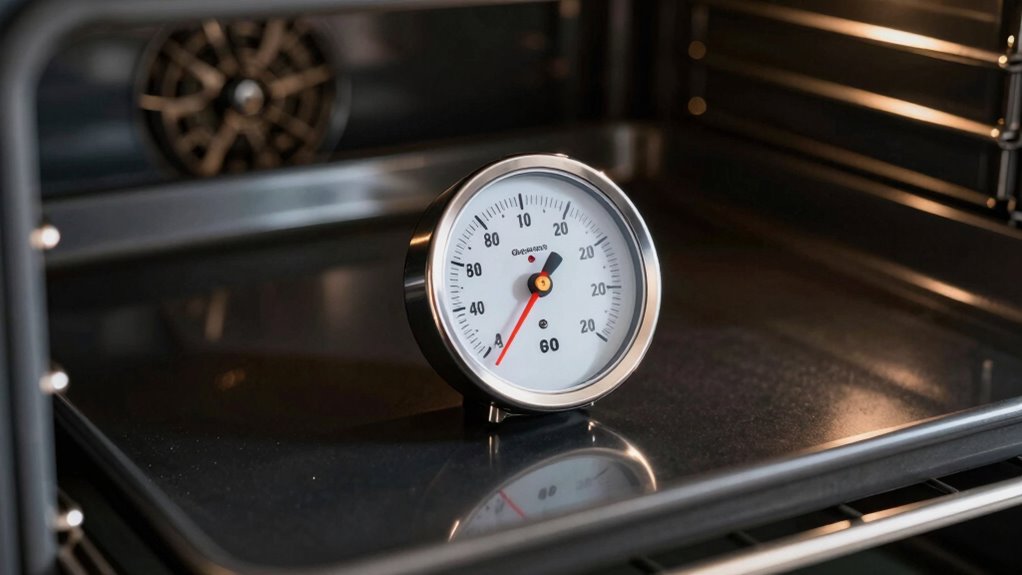
Start by placing an oven thermometer in the center of your oven, where heat distribution is usually most consistent. Turn your oven on and set it to the temperature specified in your recipe or to a common baking temperature like 350°F (175°C). Allow the oven to preheat fully—this usually takes about 15-20 minutes. Once the oven indicates it’s reached the set temperature, check the thermometer. If the reading matches, you’re good to go. However, if it’s off by a significant margin, you’ll need to calibrate your oven.
Place an oven thermometer in the center, preheat to 350°F, then check for accuracy once heated.
If the thermometer shows a different temperature than what you set, it’s a clear sign that your oven’s temperature calibration is off. For example, if you set the oven to 350°F but the thermometer reads 340°F, your oven is running cooler than the dial indicates. Conversely, if it reads 360°F, it’s running hotter. Knowing this discrepancy allows you to adjust your baking expectations and time accordingly, or better yet, recalibrate your oven’s thermostat if possible. Regular oven calibration checks can help maintain consistent baking results over time. Additionally, understanding your oven’s actual temperature can help you prevent uneven heating, which is critical for achieving evenly baked goods. Performing these checks frequently can help you catch gradual temperature drift before it significantly affects your baking. Regularly testing your oven’s temperature helps account for wear and tear, which can affect performance.
Performing this check regularly is key to maintaining baking precision. Over time, ovens tend to drift from their original calibration due to wear and tear, so a quick check every few months helps keep your baking consistent. If you find your oven’s temperature is consistently inaccurate, consider consulting your oven’s manual for calibration instructions or calling in a professional to fine-tune the thermostat. Making these adjustments ensures your oven heats evenly and accurately, which is crucial for delicate baked goods like soufflés or cookies that require precise temperature control.
In the end, simple temperature calibration and regular oven thermometer checks can dramatically improve your baking results. They help you avoid undercooked or burnt dishes, saving you both time and frustration. Understanding your oven’s actual temperature allows you to better plan your baking process and troubleshoot issues more effectively. With a little effort, you’ll ensure your oven consistently performs at its best, making every baking day a success.
As an affiliate, we earn on qualifying purchases.
Frequently Asked Questions
How Often Should I Check My Oven Thermometer?
You should check your oven thermometer at least once a month to guarantee accurate baking temperature and maintain kitchen safety. Regular checks help you catch temperature inconsistencies early, preventing burnt or undercooked baked goods. If you notice discrepancies, calibrate your oven or replace the thermometer. Staying vigilant with your oven’s accuracy keeps your baking safe and consistent, making your kitchen a safer, more reliable space for every baking adventure.
Can a Faulty Oven Thermostat Affect Baking Results?
A faulty oven thermostat can definitely affect your baking results by disrupting temperature consistency. When your thermostat malfunctions, it causes uneven heating, leading to overbaked or underbaked goods. Regular oven repair can restore accurate temperature control, ensuring your baked items turn out perfectly each time. You’ll enjoy consistent results, save time on troubleshooting, and prevent wastage caused by unreliable oven performance. Proper maintenance keeps your oven functioning at its best, making baking a smoother, more enjoyable experience.
Are Digital Oven Thermometers More Accurate Than Analog Ones?
Digital oven thermometers are generally more accurate than analog ones because they provide precise temperature readings and are less affected by external factors. Digital vs. analog thermometers differ mainly in readability and consistency. If you want reliable oven thermometer accuracy, go for a digital model with good reviews. This guarantees you bake at the right temperature, saving time and preventing ruined baked goods caused by temperature inaccuracies.
How Do I Calibrate My Oven Thermometer?
Think of your oven thermometer as a tiny ship needing precise steering. To calibrate, place it in boiling water or an ice bath, using calibration tools like a screwdriver if needed. Check if the thermometer reads 212°F or 32°F respectively. If it’s off, adjust the calibration screw gently until accuracy is maintained. This guarantees your oven thermometer’s accuracy, making every bake a perfectly guided voyage.
What’s the Best Placement for an Oven Thermometer?
Place your oven thermometer in the center of the middle oven rack to guarantee ideal oven safety and temperature consistency. This position helps you get an accurate reading of the actual temperature, preventing hot spots and uneven baking. Keep it away from walls and the oven door, as these areas can distort the temperature reading. Proper placement ensures safe baking conditions and consistent results every time you bake.
As an affiliate, we earn on qualifying purchases.
Conclusion
Now that you know how to check your oven thermometer, aren’t you excited to see how much more consistent your baking turns out? This quick step can save you from ruined cakes or over-baked cookies, making every baking day smoother and more enjoyable. Why not give it a try today? Once you trust your oven’s temperature, you’ll wonder how you ever baked without this simple, game-changing trick. Ready to bake smarter?
As an affiliate, we earn on qualifying purchases.
As an affiliate, we earn on qualifying purchases.
NFL season / tailgating Picks
team gear
As an affiliate, we earn on qualifying purchases.