
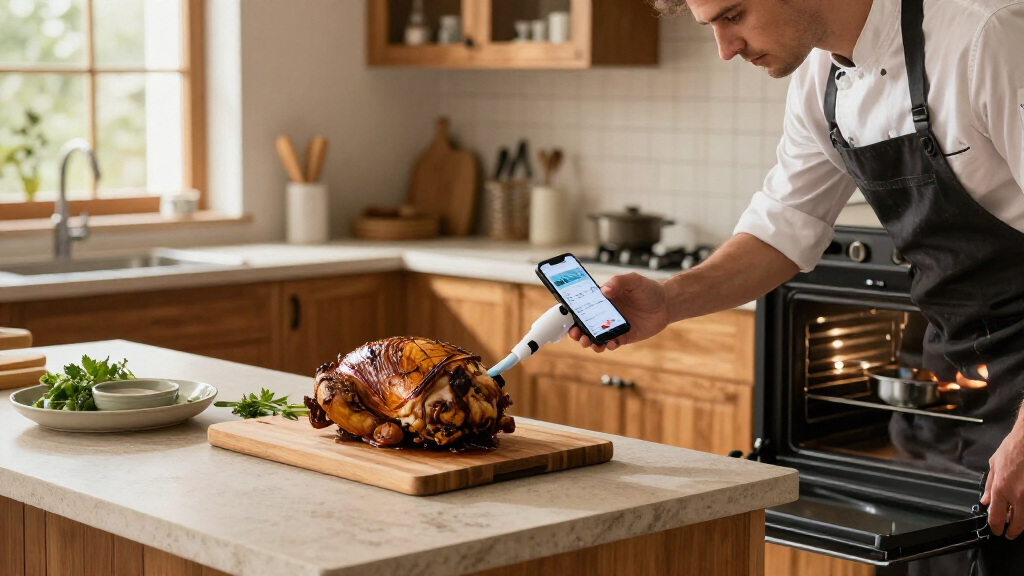
A smart kitchen thermometer system with app connectivity lets you track cooking temperatures remotely, but the experience depends on more than having an app. My best overall pick is the ThermoMaven Sub-1G, which pairs an extended-range wireless link with a standalone base for cooks who want more than phone-only monitoring. The ThermoMaven WiFi model suits cooks who want remote access, while the GoveeLife is a notable alternative for app-led Bluetooth monitoring. The main tradeoffs are connection range, standalone controls, probe design, and setup complexity. Read on for the full breakdown and a guide to matching those features to your cooking routine.

Get kitchen staples and gadgets delivered free with Prime
- Fast, free delivery on millions of items
- Prime Video, Amazon Music and more included
- Member-only deals all year
Key Takeaways
- Connection design separates the leading options: ThermoMaven’s Sub-1G model prioritizes an extended-range link, while its WiFi model adds a different route for remote monitoring.
- A standalone display can reduce phone dependence: The Sub-1G, dual-probe WiFi model, and Bluetooth model with a display base offer local information when app access is inconvenient.
- Probe count and sensor layout serve different purposes: The six-sensor options emphasize readings along the probe, while dual-probe designs let cooks monitor separate food or grill conditions.
- Bluetooth-first models favor simpler cooking setups: GoveeLife and Newise may suit cooks monitoring nearby, but buyers should check the stated connection range against their kitchen or yard.
- Feature-rich systems ask for more setup attention: WiFi, multiple probes, and standalone hardware can add flexibility, but buyers should confirm compatibility and charging routines before choosing.
| GoveeLife Smart Bluetooth Wireless Meat Thermometer with App Alerts |  | Best for Long-Range App Monitoring | Display: 10-inch LCD screen | Connectivity: Wi-Fi and Bluetooth | Stated range: Up to 500 feet | VIEW ON AMAZON | See Our Full Breakdown |
| Smart Bluetooth Wireless Meat Thermometer with 6 Sensors and Instant Read |  | Best for Fast, Precise Bluetooth Readings | Sensor count: 6 | Precision: ±0.5°F | Read time: 0.5 seconds | VIEW ON AMAZON | See Our Full Breakdown |
| ThermoMaven Sub-1G Smart Wireless Meat Thermometer with Standalone Base |  | Best for Monitoring Without App Dependence | Connectivity: Sub-1G, Bluetooth, and Wi-Fi | Stated range: Up to 3,000 feet unobstructed; up to 700 feet obstructed | Sensor count: 6 (5 internal and 1 external) | VIEW ON AMAZON | See Our Full Breakdown |
| Wireless Meat Thermometer, Stable WiFi Connection Food Thermometer with Standalone Booster Screen, Dual Probes, 7 Sensors, 1000F Ambient, IP68 Waterproof for Grilling, Smoking, Oven (Bamboo Wood Color) |  | Best for Tracking Two Dishes at Once | Probe count: 2 | Sensors: 7 per probe (6 internal food-sensing nodes and 1 ambient sensor) | Connectivity: Sub-1GHz wireless and 2.4GHz Wi-Fi | VIEW ON AMAZON | See Our Full Breakdown |
| ThermoMaven Smart Bluetooth Wireless Meat Thermometer with 6 Sensors and WiFi Connectivity |  | Best for Multi-Dish Wi-Fi Cooking | Probe count: 2 | Sensor count: 6 (5 internal and 1 external) | Accuracy: ±0.5°F | VIEW ON AMAZON | See Our Full Breakdown |
| Bluetooth Wireless Meat Thermometer, Smart App & Standalone Display Base |  | Best for Phone-Free Monitoring | Connectivity: Bluetooth | Display: Standalone LCD base | Sensors: Dual sensors for internal meat and ambient temperature | VIEW ON AMAZON | See Our Full Breakdown |
| CHEF iQ Sense Smart Wireless Meat Thermometer |  | Best for Long Cooks and App Guidance | Model: iQ Sense CQ60-1C-Z1-E | Connectivity: Wi-Fi and Bluetooth | Sensors: 5 total: 4 internal and 1 ambient | VIEW ON AMAZON | See Our Full Breakdown |
| Newise Bluetooth Wireless Meat Thermometer with Smart App |  | Best for Fast-Charging Bluetooth Simplicity | Connectivity: Bluetooth | Listed range: Over 230 feet | Probe battery life: 18–24 hours | VIEW ON AMAZON | See Our Full Breakdown |
| smart kitchen thermometer system app connected | Connectivity |
|---|---|
| GoveeLife Smart Bluetooth Wire | Wi-Fi and Bluetooth |
| Smart Bluetooth Wireless Meat | Bluetooth |
| ThermoMaven Sub-1G Smart Wirel | Sub-1G, Bluetooth, and Wi-Fi |
| Wireless Meat Thermometer | Sub-1GHz wireless and 2.4GHz Wi-Fi |
| ThermoMaven Smart Bluetooth Wi | 2.4GHz Wi-Fi and Bluetooth |
| Bluetooth Wireless Meat Thermo | Bluetooth |
| CHEF iQ Sense Smart Wireless M | Wi-Fi and Bluetooth |
| Newise Bluetooth Wireless Meat | Bluetooth |
More Details on Our Top Picks
GoveeLife Smart Bluetooth Wireless Meat Thermometer with App Alerts
The GoveeLife is a strong fit for cooks who want app alerts and a visible readout without relying on a nearby Bluetooth connection alone. Its Wi-Fi and Bluetooth connectivity and stated range of up to 500 feet give it a useful balance for backyard grilling, while the magnetic base can sit on a grill or nearby metal surface. The 10-inch LCD is a more prominent local display than the simpler digital readout listed for the six-sensor Bluetooth model, though that rival specifies faster, 0.5-second readings and more sensors.
The tradeoff is the probe’s 212°F internal-temperature ceiling, which limits its headroom for some high-heat cooking setups. Full app features also depend on a smartphone, and the listed 48-hour battery life may vary with use. I’d choose it for guided cooking and remote alerts, not for maximum probe heat tolerance.
Pros:- Wi-Fi and Bluetooth support remote monitoring beyond a Bluetooth-only setup.
- 10-inch LCD provides a large local temperature display.
- Magnetic base offers hands-free placement on compatible metal surfaces.
- App includes guided cooking and alerts.
Cons:- Internal sensor tops out at 212°F, below the ambient sensor limit.
- Full functionality depends on a smartphone and the app.
- Listed 48-hour battery life may vary with usage.
Best for: Backyard grillers who want app-guided cooking, alerts, and a large local screen while checking food from across the yard.
Not ideal for: Cooks using very high-heat methods or anyone who wants a thermometer that works fully without a smartphone; the internal sensor is limited to 212°F and app features require a phone.
- Display:10-inch LCD screen
- Connectivity:Wi-Fi and Bluetooth
- Stated range:Up to 500 feet
- Battery life:48 hours
- Charging time:25 minutes
- Internal sensor temperature limit:212°F / 100°C
- Ambient sensor temperature limit:572°F / 300°C
Our verdict“Choose the GoveeLife if you want a large screen and app alerts for ordinary grilling, but pick a higher-heat model for more demanding cooking.”
Smart Bluetooth Wireless Meat Thermometer with 6 Sensors and Instant Read
This six-sensor model prioritizes speed and stated precision over broad connectivity. Its 0.5-second read time and ±0.5°F precision make it a better match than the GoveeLife for cooks who want quick temperature checks and detailed readings from the probe. App control adds remote monitoring and customizable menus, while the probe’s dishwasher-safe, waterproof design reduces cleanup after grilling or smoking.
The main compromise is its Bluetooth-only connection: unlike the GoveeLife or ThermoMaven P2, the supplied data does not list Wi-Fi, so monitoring depends on Bluetooth range. Compatibility is also limited for iPhone XR, X, and 8 Plus users. Its 100-hour probe battery life is appealing, but the base is listed for 32 hours, so buyers should distinguish probe endurance from system runtime. This is a focused pick for nearby cooking, not the most flexible remote setup.
Pros:- Six sensors and stated ±0.5°F precision support detailed temperature readings.
- 0.5-second read time gives quick updates.
- Probe is waterproof and dishwasher safe for simpler cleanup.
- App supports remote monitoring and customizable menus.
Cons:- Bluetooth-only connectivity can limit monitoring distance compared with Wi-Fi models.
- Not compatible with iPhone XR, X, and 8 Plus according to the supplied product data.
- Base battery life is listed as 32 hours, shorter than the probe’s 100-hour figure.
Best for: Cooks who want fast, precise app readings at a grill or oven and have a compatible phone within Bluetooth range.
Not ideal for: People who monitor cooks from indoors or across a large property, or owners of iPhone XR, iPhone X, or iPhone 8 Plus; the listed connection is Bluetooth and those phones are noted as incompatible.
- Sensor count:6
- Precision:±0.5°F
- Read time:0.5 seconds
- Probe battery life:100 hours
- Base battery life:32 hours
- Connectivity:Bluetooth
- Material:Stainless steel
Our verdict“Pick this model for quick, precise Bluetooth-based cooking checks, but choose a Wi-Fi thermometer if you need monitoring beyond local range.”
ThermoMaven Sub-1G Smart Wireless Meat Thermometer with Standalone Base
The ThermoMaven G1 stands apart by making its display base usable on its own: cooks can check readings and set temperatures at the device without opening the app. That gives it a more self-contained feel than the GoveeLife, whose full functionality requires a smartphone. Its Sub-1G link is specified for up to 3,000 feet unobstructed and 700 feet with obstructions, while Wi-Fi app monitoring adds a separate route for remote access. The six-sensor probe and stated ±0.5°F accuracy also put it in the precision-focused group.
The probe handles ambient temperatures up to 752°F and has an IPX8 rating, but the base is only splash-resistant and needs wiping rather than submersion. Its range figures are stated under particular conditions, so walls and layout matter. Compared with the dual-probe BBQOVN, this pick emphasizes a standalone control base and long-range link rather than tracking two cuts at once.
Pros:- Standalone base displays readings and allows temperature setting without an app.
- Sub-1G range is stated as up to 3,000 feet unobstructed and 700 feet obstructed.
- Six sensors with stated ±0.5°F accuracy support precise monitoring.
- IPX8 probe and dishwasher-safe description aid cleanup.
Cons:- The base is splash-resistant, not designed for submersion.
- Listed long-range performance depends on unobstructed or obstructed conditions.
- Compared with the dual-probe BBQOVN, the supplied description does not specify monitoring two probes at once.
Best for: Grill and smoker owners who want to set targets and read temperatures at the base, with app access available but not required for basic control.
Not ideal for: Cooks who need two probes to track separate dishes simultaneously or expect the base to be waterproof; the supplied description lists one probe and a splash-resistant base.
- Connectivity:Sub-1G, Bluetooth, and Wi-Fi
- Stated range:Up to 3,000 feet unobstructed; up to 700 feet obstructed
- Sensor count:6 (5 internal and 1 external)
- Accuracy:±0.5°F
- Resolution:0.01°F
- Probe temperature limits:Meat up to 221°F; ambient up to 752°F
- Response time:0.5 seconds
Our verdict“Choose the ThermoMaven G1 if you want a capable standalone display with long-range monitoring, rather than a setup built around multiple probes.”
Wireless Meat Thermometer, Stable WiFi Connection Food Thermometer with Standalone Booster Screen, Dual Probes, 7 Sensors, 1000F Ambient, IP68 Waterproof for Grilling, Smoking, Oven (Bamboo Wood Color)
The BBQOVN’s clearest advantage is its two-probe setup: it can track separate cuts or dishes at once, something the single-probe GoveeLife description does not offer. Each probe has six internal sensing nodes plus an ambient sensor, and the standalone screen shows temperatures and battery levels without requiring a phone check. Its Wi-Fi relay works with a 2.4GHz network, while Sub-1GHz wireless links the probes to the booster screen; that combination is aimed at stable app access as well as local viewing.
The product description claims the ceramic handle withstands 1,000°F, while the listed specification gives an upper temperature range of 572°F, so buyers should verify which limit applies to the relevant sensor before choosing it for extreme heat. Monitoring is listed for up to 20 hours, and the three-second response is slower than the ThermoMaven G1’s stated 0.5 seconds. It makes most sense when two simultaneous readings matter more than speed or longer runtime.
Pros:- Two probes allow simultaneous monitoring of separate cuts or dishes.
- Standalone screen displays live temperatures and probe battery levels.
- Six internal sensing nodes plus an ambient sensor are specified per probe.
- IP68-rated probes are designed for hand-washing after cooling.
Cons:- Temperature limits conflict across the supplied data: the description claims 1,000°F handle resistance, while the specification lists 572°F.
- Listed continuous monitoring time is up to 20 hours.
- Three-second response time is slower than the ThermoMaven G1’s stated 0.5 seconds.
Best for: Hosts and barbecue cooks who regularly prepare two cuts or dishes together and want local screen readings plus Wi-Fi app monitoring.
Not ideal for: Anyone who needs clearly consistent temperature-limit specifications, very long cooks beyond the listed 20-hour runtime, or the fastest response; the product data gives differing heat figures and a three-second response time.
- Probe count:2
- Sensors:7 per probe (6 internal food-sensing nodes and 1 ambient sensor)
- Connectivity:Sub-1GHz wireless and 2.4GHz Wi-Fi
- Display:Standalone digital screen
- Listed upper temperature range:572°F
- Ambient handle claim:Up to 1,000°F in product description
- Response time:3 seconds
- Continuous monitoring:Up to 20 hours
Our verdict“Choose the BBQOVN when keeping tabs on two dishes at once is the priority, but check the applicable heat limit before high-temperature cooking.”
ThermoMaven Smart Bluetooth Wireless Meat Thermometer with 6 Sensors and WiFi Connectivity
The ThermoMaven P2 is the more app-connected choice here for cooks who want Wi-Fi monitoring beyond Bluetooth range and two probes for separate dishes. Its smart display base provides local readings and direct temperature control, while the iOS and Android app adds remote tracking over 2.4GHz Wi-Fi. Against the Bluetooth-only six-sensor model, the P2 is better suited to stepping away from the grill; against the single-probe ThermoMaven G1, its two probes make parallel cooking the stronger use case.
The six NIST-certified sensors are listed at ±0.5°F accuracy, and the probes are waterproof and dishwasher safe. The tradeoff is setup: the supplied description notes that connecting the system may be challenging, and full Wi-Fi operation requires a 2.4GHz network. The listed probe battery figure—two hours of use per two-minute charge—also needs careful interpretation for long cooks. I’d favor it for connected, multi-dish cooking, not for buyers seeking the simplest setup.
Pros:- Two probes support simultaneous monitoring of separate dishes.
- Wi-Fi provides app monitoring beyond the local Bluetooth connection.
- Smart display base shows readings and supports direct temperature control.
- Six NIST-certified sensors are specified at ±0.5°F accuracy.
Cons:- Full Wi-Fi functionality requires a 2.4GHz network.
- Setup may be challenging for less technical users.
- The stated probe battery figure is brief and may require checking against long-cook needs.
Best for: Home cooks or restaurant users who monitor two dishes at once and want app access over Wi-Fi while moving away from the cooking area.
Not ideal for: Buyers who want plug-and-play simplicity or lack a 2.4GHz Wi-Fi network; the supplied data flags setup as potentially challenging and requires 2.4GHz Wi-Fi for full functionality.
- Probe count:2
- Sensor count:6 (5 internal and 1 external)
- Accuracy:±0.5°F
- Resolution:0.01°F
- Temperature limits:Meat up to 221°F; ambient up to 752°F
- Connectivity:2.4GHz Wi-Fi and Bluetooth
- App compatibility:iOS and Android
- Base charging time:2 hours
- Probe battery figure:2 hours of use per 2-minute charge
Our verdict“Pick the ThermoMaven P2 for Wi-Fi app monitoring across two dishes, provided you have a 2.4GHz network and are comfortable with setup.”
Bluetooth Wireless Meat Thermometer, Smart App & Standalone Display Base
The standalone LCD base gives this thermometer a practical distinction: I can check temperatures and set targets at the cooker without keeping a phone open. Its probe tracks meat and ambient temperatures together, while the PROBE PLUS app adds guided recipes and remote alerts. Compared with the CHEF iQ Sense, this model offers a local display instead of relying on app-centered guidance, but it lacks CHEF iQ’s stated Wi-Fi connectivity and longer 50-hour battery life. The listing also gives two different Bluetooth range figures—229 feet in one section and 49 feet in another—so I would not choose it based on a specific long-range expectation. Its 19-hour battery claim and 212°F internal limit suit many cooks, though extended smoking or high-heat use may favor a model with more headroom.
Pros:- LCD base displays live meat and ambient temperatures without requiring a phone.
- Dual sensors track food temperature and surrounding cooking heat at once.
- App includes guided recipes and customizable doneness targets.
- IP68 probe is dishwasher-safe, and USB-C charging simplifies powering it.
Cons:- Bluetooth range is inconsistent across the listing, which makes remote-distance expectations uncertain.
- The stated 19-hour battery life is shorter than CHEF iQ Sense’s up-to-50-hour runtime.
- The 212°F internal temperature limit leaves less stated headroom than the CHEF iQ Sense’s 1000°F probe rating.
Best for: Grill owners who want to read temperatures and adjust targets at the cooker without reaching for a smartphone.
Not ideal for: Long-session smokers who need a clearly specified long-range connection or more than the stated 19-hour probe runtime.
- Connectivity:Bluetooth
- Display:Standalone LCD base
- Sensors:Dual sensors for internal meat and ambient temperature
- Accuracy:±1.8°F
- Temperature limits:Internal up to 212°F; ambient up to 572°F
- Probe battery life:Up to 19 hours
- Probe care:IP68 waterproof; dishwasher-safe
- Charging:USB-C rechargeable
- App:PROBE PLUS, with guided recipes and custom doneness settings
Our verdict“Choose this model if a readable standalone base matters more than long battery life or clearly specified remote range.”
CHEF iQ Sense Smart Wireless Meat Thermometer
The CHEF iQ Sense is the strongest fit here for cooks who want sustained monitoring and detailed temperature coverage through an app. Its four internal sensors plus an ambient sensor give a fuller picture of food and cooker conditions than the dual-sensor Bluetooth model in this lineup, while Wi-Fi and Bluetooth support remote monitoring. Up to 50 hours per charge also makes it better suited to long smokes than the Newise thermometer’s listed 18–24-hour probe runtime. The tradeoff is a more app-dependent setup: guided cooking features require the CHEF iQ app, and the included components are a probe and hub rather than a described standalone display. Its 1000°F probe rating is generous, but I would still match that figure to the cooking method and follow the product’s use instructions.
Pros:- Five sensors monitor multiple points inside food alongside ambient cooking temperature.
- Wi-Fi and Bluetooth provide more connection options than Bluetooth-only models such as Newise.
- Up to 50 hours of rechargeable operation suits long smoking sessions.
- Waterproof, dishwasher-safe probe simplifies cleanup.
Cons:- Guided cooking features depend on the CHEF iQ app.
- The listed components are a probe and hub, with no standalone display specified.
- The 1000°F upper rating may not be relevant to many everyday cooking methods and calls for attention to use guidance.
Best for: Home cooks and BBQ enthusiasts who want app-guided cooking, multiple food-temperature readings, and long runtimes for smoking.
Not ideal for: Cooks who want to set and monitor temperatures directly on a standalone screen or avoid using a companion app.
- Model:iQ Sense CQ60-1C-Z1-E
- Connectivity:Wi-Fi and Bluetooth
- Sensors:5 total: 4 internal and 1 ambient
- Temperature range:32°F to 1000°F
- Probe length:4.75 inches
- Response time:3 seconds
- Battery life:Up to 50 hours per charge
- Probe care:Waterproof and dishwasher-safe
- Included components:Probe and hub
Our verdict“Pick the CHEF iQ Sense for app-led cooking and long sessions, but skip it if you want a screen-first, phone-free system.”
Newise Bluetooth Wireless Meat Thermometer with Smart App
The Newise is a straightforward pick for cooks who want Bluetooth app alerts without adding Wi-Fi to their setup. Its listed range of over 230 feet is a useful advantage for moving around a home or yard, though real-world connection conditions can affect that reach. Fast probe charging—listed at 30–40 minutes—also makes it easier to get back to cooking than a system with a longer recharge cycle. Compared with the CHEF iQ Sense, Newise has fewer stated connectivity options and no sensor count or temperature limits supplied, but it offers a simpler Bluetooth-only approach. The base’s listed battery life exceeds 190 hours, while the probe is rated for 18–24 hours; that probe runtime may be limiting for very long smoking sessions. Full functionality requires a smartphone, so it is not a phone-free alternative to the standalone-base model.
Pros:- Bluetooth range is listed as over 230 feet for remote monitoring.
- Probe charging time is listed at 30–40 minutes.
- IP67 waterproof probe is described as dishwasher-safe.
- App supports real-time alerts and temperature management on iOS and Android.
Cons:- Full functionality requires a smartphone.
- Bluetooth-only connectivity does not offer Wi-Fi monitoring like the CHEF iQ Sense.
- The listed 18–24-hour probe runtime may not cover especially long cooks, and battery life varies with use.
Best for: Backyard grillers who want app alerts, a long listed Bluetooth range, and quick probe recharging without Wi-Fi setup.
Not ideal for: Long-session smokers who need probe runtime beyond the listed 18–24 hours, or cooks who want a standalone display or Wi-Fi monitoring.
- Connectivity:Bluetooth
- Listed range:Over 230 feet
- Probe battery life:18–24 hours
- Base battery life:More than 190 hours
- Probe charging time:30–40 minutes
- Base charging time:3–4 hours
- App compatibility:iOS and Android
Our verdict“Choose Newise for quick-charging Bluetooth app monitoring, but favor CHEF iQ Sense for Wi-Fi and longer stated probe runtime.”
How We Picked
I ranked these systems around what makes an app-connected thermometer useful during an actual cook: connection approach and practical range, the quality of the monitoring setup, and whether the system provides useful information away from a phone. Probe count, sensor coverage, stated temperature capabilities, water resistance, and the presence of a standalone base or display also informed the comparison. I gave more weight to features that solve distinct cooking problems than to a long feature list on its own.
The ranking favors products whose listed designs address clear needs, such as longer-range monitoring, WiFi access, or multiple probes. Models without a clearly specified standout system feature sit lower, not because they cannot work, but because the available details give buyers fewer grounds for choosing them over better-differentiated alternatives. I also weighed likely setup and everyday-use tradeoffs: a more connected system can be more flexible, while a simpler Bluetooth model may be easier to match to nearby cooking.
Factors to Consider When Choosing Smart Kitchen Thermometer System App Connected
Choosing an app-connected thermometer is less about collecting the most features and more about avoiding a mismatch between the connection system and your cooking habits. I would start with where you cook, what you want to monitor, and whether you need a local display when your phone is elsewhere.
Match the Connection to Your Cooking Location
Bluetooth can be a sensible fit when your phone stays near the grill, oven, or smoker, while WiFi or an extended-range link may suit cooks who move farther away. Do not assume an app connection will reach through every wall or across every yard; layout and interference can change real-world performance. Check whether the thermometer connects directly to your phone or relies on a base or booster. That extra device may improve flexibility, but it also needs a suitable location and power. If you mostly cook indoors nearby, paying for remote-access features may add little. For long smoking sessions away from the cooking area, connection design should rank ahead of cosmetic details.
Decide Whether You Need a Standalone Display
An app is helpful for alerts and trend tracking, but a local screen can make quick checks easier without unlocking a phone. A standalone base is especially useful if several people are watching a cook or if your phone is occupied with other tasks. It can also provide a fallback when you prefer not to rely on an app for every temperature check. The tradeoff is another component to charge, place, or store. Before buying, find out whether the display works independently or only relays information from a probe connected to the app. Buyers who value a minimal setup may prefer a simpler thermometer without extra hardware.
Choose Probe Count for the Food You Actually Cook
Multiple probes help when you cook several cuts at once or want to monitor meat and cooking conditions separately. A probe with several sensors along its length can offer a different kind of insight from two separate probes; those designs are not interchangeable. Think about whether you need multiple food readings, a second cooking-zone reading, or better temperature information within one cut. More probes can make a system more versatile, but each one adds cleaning, placement, and charging considerations. A single-probe setup may be easier to manage for occasional roasts. Avoid choosing by probe count alone without checking what the sensors measure.
Check App and Device Compatibility Before Buying
Smart features depend on both the thermometer hardware and a compatible phone, app, and wireless setup. Check the product’s current requirements for your phone’s operating system and the network bands or permissions it needs. Consider who will control the cook: shared access can matter in a household where one person starts dinner and another checks progress. App alerts are only useful if notifications are enabled and the phone can receive them reliably. Buyers who want a basic readout should ask whether core functions remain available without an account or constant app connection. Reviewing these details before purchase can prevent a capable device from becoming an awkward fit.
Treat Cleaning and Charging as Part of the Decision
Wireless probes sit close to food and heat, so care instructions matter as much as headline temperature claims. Check whether the probe is rated for water exposure and whether the product calls for hand washing, careful drying, or another cleaning routine. Charging arrangements also vary: a system may require returning probes to a case or base between cooks. If you often grill for long stretches, review the stated probe and base runtime rather than assuming all wireless models last equally long. A design that is easy to clean and recharge can matter more over time than an extra app feature. Keep the device’s specified heat limits in mind, especially when using high-temperature searing or open flames.
Frequently Asked Questions
Is Bluetooth enough, or should I choose WiFi for an app-connected thermometer?
Bluetooth can work well when you remain near the cooking area and mainly want phone alerts. WiFi or an extended-range system may be a better match if you want to move farther away, though the connection path and setup differ by product. A WiFi model can depend on your home network, while other systems may use a dedicated base or booster. Check the manufacturer’s stated connection method and range rather than assuming every app-connected thermometer supports remote access. Pick based on where you expect to be during a typical cook.
What is the practical difference between a standalone base and a phone app?
A standalone base or display can show temperatures locally, which is convenient when you do not want to keep checking your phone. An app may provide alerts, cooking information, and remote monitoring, depending on the model. These functions can complement each other, but a base does not automatically mean the thermometer will work independently of the probe or app for every feature. Check which readings and controls remain available if your phone disconnects. If several people need to follow a cook, a visible display can be more convenient than passing around one phone.
Do multiple sensors mean I can monitor more than one piece of meat?
Not necessarily. Multiple sensors along a single probe can measure temperatures at different points within one piece of food, while multiple probes can monitor separate items or zones. The six-sensor models in this roundup and the dual-probe design address different monitoring needs. Look for a clear explanation of how readings are assigned and displayed in the app. If you cook multiple cuts at once, confirm how many independent probes are included rather than relying on the sensor count alone.
Should I pay more for a thermometer with both WiFi and a standalone display?
That combination makes the most sense if you want remote access as well as a quick local readout. It may be unnecessary if you cook close to your phone and are satisfied with Bluetooth monitoring. More connection options can bring added setup steps, components, and charging needs, so think about whether you will use both. Compare the actual monitoring functions and connection method, not just the number of features listed. A simpler model can be a better fit when your cooking routine is predictable and nearby.
What should I verify before using a wireless thermometer for high-heat grilling?
Check the probe’s stated maximum temperature and distinguish the probe limit from any ambient-temperature rating. Read the manufacturer’s placement and use instructions, since exposed parts may have different heat limits from the sensing tip. Confirm whether the probe is intended for the cooking method you plan to use, including direct heat or searing. Water-resistance claims do not mean a probe can be exposed to every cleaning method or cooking condition. When a model lists a high ambient limit, verify what part of the device that rating applies to.
Conclusion
For the broadest mix of app-connected monitoring and a local control point, I would start with the ThermoMaven Sub-1G as the best overall pick. The GoveeLife is a reasonable best-value direction for cooks who want a more straightforward Bluetooth-first setup, while the ThermoMaven WiFi model is the best premium choice for buyers seeking WiFi connectivity and multiple sensors. Beginners should favor the system whose connection method and display are easiest to manage in their own cooking space; the Bluetooth model with a standalone display base is worth a close look. For specific needs, choose the dual-probe WiFi model for monitoring separate cooking points, or a six-sensor design when readings along a probe matter more. Before deciding, match the connection type and probe arrangement to your routine rather than choosing by feature count alone.