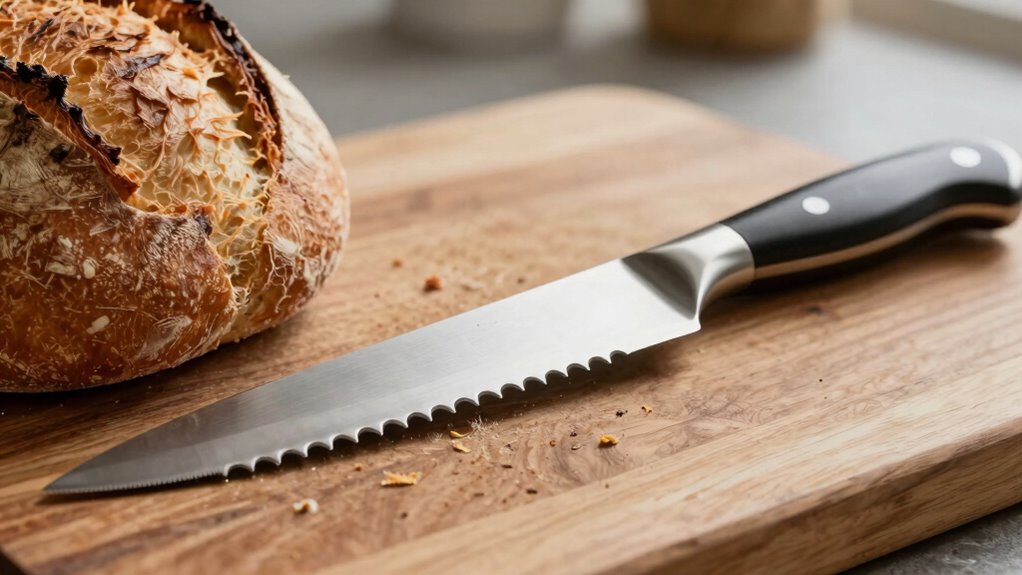

For a premium bread knife for sourdough, I would start with the Mercer Culinary Millennia 10-Inch Serrated Bread Knife for its practical length and straightforward design. The HexClad 8-Inch Japanese Damascus knife stands out for buyers who want a more refined, compact blade, while the SYOKAMI Bow-Frame Bread Knife adds a thickness guide for more even slices. The main choice is between a conventional knife that stores easily and a bow-style or guided slicer that can help with crusty, tall loaves but takes more space. Adjustable wooden slicers add repeatable slice widths, though they bring extra parts and cleanup. Read on for the full comparison and a pick matched to your bread and kitchen.

Get kitchen staples and gadgets delivered free — and shop member deals
- Fast, free delivery on millions of items
- Access to Prime Big Deal Days deals on October 6–7
- Prime Video, Amazon Music and more included
Key Takeaways
- Conventional blades are the easiest all-round fit: the Mercer Millennia and imarku 10-Inch give sourdough bakers a familiar format without a slicing frame.
- Long blades and bow designs address different loaf problems: longer or bow-shaped blades can give more room for broad loaves, while their larger profiles demand more storage space.
- Guides trade flexibility for consistency: the adjustable Kravon, Woodever, and keechee slicers and the SYOKAMI bow frame suit buyers who want repeatable slice thickness.
- Compact knives are not automatically poor sourdough choices: the 8-inch HexClad and Orblue are easier to store, but may feel limiting on wide, tall loaves.
- Premium should mean a better fit, not simply more features: a Damascus-style finish, replacement blade, sheath, or wood frame matters only if it suits your cutting habits and care routine.
| Kravon Adjustable Acacia Wood Bread Slicer with Stainless Steel Serrated Blade |  | Best for Fine Slice Control | Brand: Kravon | Frame and handle: Acacia wood | Blade material: Stainless steel | VIEW ON AMAZON | See Our Full Breakdown |
| Uprichya Sourdough Bread Bow Knife with Replacement Blade |  | Best Bow Knife for Right-Handed Bakers | Brand: Uprichya | Model: UP-MBD-5 | Blade material: Stainless steel | VIEW ON AMAZON | See Our Full Breakdown |
| Adjustable 17-Inch Bread Knife with 1/2-Inch and 1-Inch Thickness Guides |  | Best for Two Everyday Slice Sizes | Brand: MonteHerra | Blade material: Stainless steel | Blade edge: Serrated | VIEW ON AMAZON | See Our Full Breakdown |
| HexClad 8″ Japanese Damascus Stainless Steel Serrated Bread Knife Full Tang |  | Best Premium Standalone Knife | Brand: HexClad | Model number: CTBK08-EPW | Blade length: 8 inches | VIEW ON AMAZON | See Our Full Breakdown |
| Woodever Adjustable Beechwood Bread Slicer with Stainless Steel Serrated Blade |  | Best for Thick Sourdough Slices | Brand: Woodever | Model: WE2109 | Blade material: Stainless steel | VIEW ON AMAZON | See Our Full Breakdown |
| Mercer Culinary Millennia 10-Inch Serrated Bread Knife | 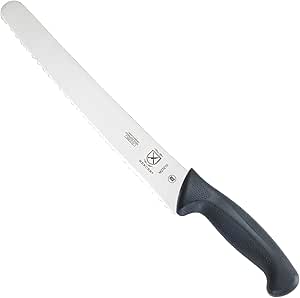 | Best Conventional Knife for Sourdough | Brand: Mercer Culinary | Model: M23210 | Blade length: 10 inches | VIEW ON AMAZON | See Our Full Breakdown |
| ISAIDNO 14.5-Inch Bow-Shaped Sourdough Bread Knife |  | Best Bow Knife for Simple Storage | Brand: ISAIDNO | Set: Pack of 1 | Frame material: Acacia wood | VIEW ON AMAZON | See Our Full Breakdown |
| RAPSAKEMOH 15.6-Inch Wooden Bread Bow Knife |  | Best Bow Knife for Left-Handed Bakers | Brand: RAPSAKEMOH | Blade material: 304 stainless steel | Handle material: Acacia wood | VIEW ON AMAZON | See Our Full Breakdown |
| SYOKAMI Bow-Frame Bread Knife with Thickness Guide |  | Best for Consistent Slice Thickness | Brand: SYOKAMI | Blade material: 420J2 stainless steel | Blade edge: Serrated | VIEW ON AMAZON | See Our Full Breakdown |
| imarku 10-Inch Serrated Bread Knife, Japanese High-Carbon Stainless Steel |  | Best for Easy Cleanup | Brand: imarku | Model: G01 | Blade length: 10 inches | VIEW ON AMAZON | See Our Full Breakdown |
| SYOKAMI Acacia Wood Bread Slicer Set with Bread Knife |  | Best All-in-One Slicing and Serving Set | Board material: Acacia wood | Board dimensions: 16 x 9 x 0.7 in | Knife length: 10.5 in | VIEW ON AMAZON | See Our Full Breakdown |
| NULAS 10-Inch Serrated Bread Knife with Sheath |  | Best Practical Knife-Only Pick | Blade length: 10 in | Blade material: 1.4116 German stainless steel | Blade edge: Serrated | VIEW ON AMAZON | See Our Full Breakdown |
| keechee Adjustable Bread Knife for Sourdough and Homemade Loaves | 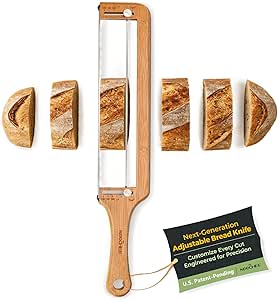 | Best for Custom Slice Thickness | Model: K006 | Blade material: Stainless steel | Blade edge: Serrated | VIEW ON AMAZON | See Our Full Breakdown |
| Orblue Serrated Bread Knife, 8-Inch Blade | 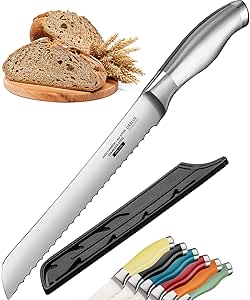 | Best Compact, Low-Fuss Knife | Blade material: Stainless steel | Handle material: Stainless steel | Blade length: 8 in | VIEW ON AMAZON | See Our Full Breakdown |
| bread knife for sourdough premium | Blade material | Blade length | Blade edge | Brand |
|---|---|---|---|---|
| Kravon Adjustable Acacia Wood | Stainless steel | 10.6 inches | Serrated | Kravon |
| Uprichya Sourdough Bread Bow K | Stainless steel | 10.6 inches | Serrated | Uprichya |
| Adjustable 17-Inch Bread Knife | Stainless steel | — | Serrated | MonteHerra |
| HexClad 8" Japanese Damascus S | Japanese Damascus stainless steel, 67 layers | 8 inches | — | HexClad |
| Woodever Adjustable Beechwood | Stainless steel | 10.6 inches | Serrated | Woodever |
| Mercer Culinary Millennia 10-I | High-carbon Japanese steel | 10 inches | Serrated | Mercer Culinary |
| ISAIDNO 14.5-Inch Bow-Shaped S | Stainless steel | 9.2 inches | Serrated | ISAIDNO |
| RAPSAKEMOH 15.6-Inch Wooden Br | 304 stainless steel | 10.6 inches | Serrated | RAPSAKEMOH |
| SYOKAMI Bow-Frame Bread Knife | 420J2 stainless steel | 10.7 inches | Serrated | SYOKAMI |
| imarku 10-Inch Serrated Bread | Japanese high-carbon stainless steel | 10 inches | — | imarku |
| SYOKAMI Acacia Wood Bread Slic | — | — | — | — |
| NULAS 10-Inch Serrated Bread K | 1.4116 German stainless steel | 10 in | Serrated | — |
| keechee Adjustable Bread Knife | Stainless steel | 7.5 in | Serrated | — |
| Orblue Serrated Bread Knife | Stainless steel | 8 in | Serrated | — |
More Details on Our Top Picks
Kravon Adjustable Acacia Wood Bread Slicer with Stainless Steel Serrated Blade
The Kravon is the strongest fit here for households that want to choose slice thickness rather than rely on a standard knife stroke. Its guide adjusts from 1/4 to 1 3/4 inches, giving it more flexibility than the MonteHerra, which offers only 1/2- and 1-inch settings. That range is useful when the same sourdough loaf needs thin toast slices one day and thicker servings the next. The 10.6-inch serrated blade is removable for cleaning, and adjustable tension adds another way to tune the cut. Unlike the standalone HexClad knife, this is a bread-specific slicer, not an all-purpose kitchen knife; its 17.7-inch frame also needs dedicated storage space. I’d choose it for repeatable slices, but skip it if counter or cupboard space is tight.
Pros:- Thickness adjustment spans 1/4 to 1 3/4 inches.
- Adjustable blade tension offers control over the slicing setup.
- Removable serrated blade can be taken out for cleaning.
- Designed for left- and right-handed use.
Cons:- Bread-only design is less versatile than the HexClad standalone knife.
- The 17.7-inch frame needs more storage room than a loose bread knife.
Best for: Sourdough bakers and households that want a broad range of repeatable slice thicknesses, including very thin toast cuts.
Not ideal for: Cooks who need one knife for several kitchen tasks or have limited storage space for a 17.7-inch bread slicer.
- Brand:Kravon
- Frame and handle:Acacia wood
- Blade material:Stainless steel
- Blade edge:Serrated
- Blade length:10.6 inches
- Item length:17.7 inches
- Adjustable slice thickness:1/4 to 1 3/4 inches
- Included components:Adjustable bread knife, blade protective cover, blade handle, instruction manual
Our verdict“Choose the Kravon if adjustable, repeatable sourdough slices matter more to you than compact storage or all-purpose use.”
Uprichya Sourdough Bread Bow Knife with Replacement Blade
The Uprichya is a focused choice for right-handed bakers who prefer a bow-style stroke through crusty sourdough. Its serrated 10.6-inch stainless steel blade is intended to cut the crust without compressing the softer crumb, while the sapele handle and bow form provide a distinct grip from the flat-frame Kravon and Woodever slicers. The included replacement blade and two guards make storage and eventual blade changes part of the package, a useful distinction from those adjustable slicers, which emphasize guided slice thickness. The tradeoff is its stated right-handed orientation: left-handed users should look elsewhere, including at the Kravon or Woodever. This is also a specialized bread tool rather than a general-purpose knife, and its cutting feel depends on the bow format suiting your technique.
Pros:- Serrated blade is designed for crusty bread with a tender interior.
- Includes an extra blade and two blade guards.
- Embedded screws support blade changes.
- Sapele wood handle is shaped for an ergonomic grip.
Cons:- Intended for right-handed users only.
- Does not list slice-thickness guides like the Kravon or MonteHerra.
- Maintaining cutting performance may call for replacing the blade.
Best for: Right-handed sourdough bakers who want a bow-style knife and value having a spare blade and blade guards included.
Not ideal for: Left-handed users or buyers who want a thickness guide and a slicer frame to help keep cuts uniform.
- Brand:Uprichya
- Model:UP-MBD-5
- Blade material:Stainless steel
- Blade edge:Serrated
- Blade length:10.6 inches
- Item length:15.71 inches
- Handle material:Sapele wood
- Intended user:Right-handed
- Included components:Bow bread knife, 2 blade guards, extra blade
Our verdict“Pick the Uprichya if you are right-handed and want a bow knife with a spare blade, rather than a guided slicer.”
Adjustable 17-Inch Bread Knife with 1/2-Inch and 1-Inch Thickness Guides
The MonteHerra keeps slice control simple: its magnetic guides set cuts at 1/2 inch or 1 inch, covering two familiar sourdough portions without the wider adjustment range of the Kravon or Woodever. That narrower choice can suit bakers who want a repeatable setting and do not need unusually thin or thick slices. A serrated stainless steel blade is intended to move through crusty loaves, and the beechwood handle has a grooved shape for grip. At 17 inches long, it is still a substantial tool, not a compact knife like the 8-inch-blade HexClad. The blade can be changed with a stainless steel thumb screw, but the product data does not list a spare blade. I’d favor it for straightforward portioning, not for users who want many thickness options.
Pros:- Magnetic guides provide two specified slice thicknesses.
- Serrated stainless steel blade is intended for crusty loaves.
- Grooved beechwood handle is shaped for an ergonomic grip.
- Thumb screw allows blade changes.
Cons:- Only 1/2-inch and 1-inch settings are specified, fewer than the Kravon and Woodever ranges.
- Its 17-inch length may be awkward in compact kitchens.
- No replacement blade is listed among the included components.
Best for: Home bakers who routinely cut sourdough into either half-inch or one-inch slices and prefer a simple guide system.
Not ideal for: People who need more than two thickness settings, want a compact knife, or expect a spare blade to be included.
- Brand:MonteHerra
- Blade material:Stainless steel
- Blade edge:Serrated
- Handle material:Beechwood
- Length:17 inches
- Slice thickness settings:1/2 inch and 1 inch
- Construction:One-piece
- Color:Yellow-B (beech)
Our verdict“Choose the MonteHerra if two standard slice sizes meet your needs and you value a guided cut over broad adjustability.”
HexClad 8″ Japanese Damascus Stainless Steel Serrated Bread Knife Full Tang
Unlike the Kravon, Woodever, and MonteHerra, the HexClad is a standalone knife rather than a frame slicer with thickness guides. Its 8-inch blade and full-tang build make it the more conventional choice for someone who wants a premium bread knife that can also handle cakes and other slicing jobs. The listed 67-layer Japanese Damascus stainless steel, wide serrations, and 12-degree edge are designed for controlled cuts through crust and soft interiors; the Pakkawood handle adds a balanced grip. That versatility comes with less help producing uniform slices, so it asks more of the user than a guided slicer. Care is another tradeoff: it is hand wash only, and frequent honing is recommended. Choose it for a refined, multi-use knife, not automated thickness consistency.
Pros:- Full-tang construction pairs with a Pakkawood handle for balanced control.
- Wide serrations are designed for crusty bread and softer cakes.
- 67-layer Japanese Damascus stainless steel blade construction.
- Shorter blade than the 10.6-inch blades on the guided slicers.
Cons:- No slice-thickness guide, unlike the Kravon or MonteHerra.
- Hand washing is required; dishwasher use voids the warranty.
- Frequent honing is recommended to maintain performance.
Best for: Cooks who want a premium standalone serrated knife for sourdough, cakes, and other slicing tasks, and are willing to hand wash it.
Not ideal for: Bakers who prioritize guided, uniform slice thickness or want a low-maintenance knife that can go in the dishwasher.
- Brand:HexClad
- Model number:CTBK08-EPW
- Blade length:8 inches
- Item length:12.76 inches
- Blade material:Japanese Damascus stainless steel, 67 layers
- Handle material:Pakkawood (engineered wood)
- Construction:Full tang
- Edge angle:12 degrees
Our verdict“Choose the HexClad if you want a premium, versatile standalone knife and accept hand care in place of guided slices.”
Woodever Adjustable Beechwood Bread Slicer with Stainless Steel Serrated Blade
The Woodever suits bakers who like generous portions as well as thin cuts: its guide spans 1/4 to 2 inches, reaching thicker slices than the Kravon’s 1 3/4-inch maximum. That extra range is the clearest reason to choose it over the otherwise similar guided slicers. A 10.6-inch serrated stainless steel blade is specified for sourdough and other breads, while the beechwood frame and handle keep the setup focused on bread slicing. It works for left- and right-handed users, unlike the right-handed Uprichya bow knife, but it is not as versatile as the standalone HexClad. The full frame also takes more storage space than a loose knife, and the listed blade length may feel large in a compact kitchen.
Pros:- Adjusts from 1/4 to 2 inches, the widest listed range among these guided slicers.
- Designed for several bread types, including sourdough, brioche, bagels, and baguettes.
- Suitable for left- and right-handed users.
- Beechwood frame and handle form a dedicated slicing setup.
Cons:- Bread-only design is less versatile than the HexClad standalone knife.
- The 16.5-inch frame needs more storage space than a loose knife.
- The 10.6-inch blade may be large for compact storage.
Best for: Households that want guided sourdough slices from thin toast portions up to thick, hearty servings, with either left- or right-handed use.
Not ideal for: Small-kitchen cooks who lack storage space or buyers seeking an all-purpose knife rather than a dedicated bread slicer.
- Brand:Woodever
- Model:WE2109
- Blade material:Stainless steel
- Blade edge:Serrated
- Blade length:10.6 inches
- Item length:16.5 inches
- Adjustable slice thickness:1/4 to 2 inches
- Frame and handle material:Beechwood
- Color:Natural beech
Our verdict“Pick the Woodever if you want the broadest specified thickness range here, especially for thick sourdough slices, and have room to store the frame.”
Mercer Culinary Millennia 10-Inch Serrated Bread Knife
For buyers who want a familiar knife rather than a bow frame, the Mercer Culinary Millennia is my strongest conventional pick here. Its 10-inch wavy edge is suited to sawing through a firm sourdough crust while limiting pressure on the softer crumb, and the textured handle supports a steady grip during longer cuts. Compared with the ISAIDNO 14.5-Inch Bow-Shaped Sourdough Bread Knife, Mercer is easier to use like a standard kitchen knife and takes up less unusual storage space. The tradeoff is that it offers no thickness guide, so evenly portioned slices depend on the user’s technique. Its stamped build keeps the knife light, but the hand-wash-only care asks for more attention than the dishwasher-safe imarku. A sensible choice if cutting control matters more than cleanup convenience.
Pros:- 10-inch serrated blade is suited to cutting through crust without pressing hard on soft crumb
- Textured ergonomic handle supports a secure grip
- Light 4.8-ounce build is easier to maneuver than the larger bow knives
- High-carbon Japanese steel is designed to hold a sharp edge
Cons:- Hand washing and careful drying are required
- No guide helps produce consistently even slices
- Dishwasher use is excluded from the warranty
Best for: Home bakers who prefer a lightweight, conventional knife for slicing crusty sourdough by hand
Not ideal for: Buyers who want guided, repeatable slice thickness or need a knife they can put in the dishwasher
- Brand:Mercer Culinary
- Model:M23210
- Blade length:10 inches
- Blade material:High-carbon Japanese steel
- Blade edge:Serrated
- Handle:Textured black ergonomic handle
- Construction:Stamped
- Weight:4.8 ounces
- Care:Hand wash and dry; do not place in dishwasher
Our verdict“Choose the Mercer if you want a light, familiar bread knife for sourdough and do not mind hand washing it.”
ISAIDNO 14.5-Inch Bow-Shaped Sourdough Bread Knife
The ISAIDNO is a straightforward bow-style option for sourdough bakers who want a longer cutting stroke without moving to the larger SYOKAMI frame. Its 9.2-inch serrated stainless steel blade sits within a 14.5-inch acacia frame, and the grooved wooden handle is intended to help guide the cut across a crusty loaf. A blade cover is included, which is useful when the knife is stored in a drawer or carried between prep areas. Compared with the SYOKAMI Bow-Frame Bread Knife, ISAIDNO has no thickness markings, so it is less suited to bakers who want set slice sizes. The bow shape also takes some adjustment if you are used to a conventional knife such as the Mercer Millennia. Its wood frame and handle call for gentler cleaning and dry storage, making it less convenient for a busy, dishwasher-dependent kitchen.
Pros:- Bow design provides a long stroke for cutting across crusty loaves
- Serrated stainless steel blade is designed to reduce tearing of soft bread interiors
- Grooved wooden handle supports control
- Blade cover is included for storage
Cons:- No thickness guide for consistent portions
- Bow-shaped cutting motion may feel unfamiliar to conventional-knife users
- Wooden frame and handle need careful cleaning and storage
Best for: Sourdough bakers who want a compact bow-frame cutting motion and a covered blade for storage
Not ideal for: Buyers who want measured slice thickness, a familiar straight-knife grip, or low-maintenance dishwasher cleanup
- Brand:ISAIDNO
- Set:Pack of 1
- Frame material:Acacia wood
- Handle material:Wood
- Blade material:Stainless steel
- Blade edge:Serrated
- Blade length:9.2 inches
- Item length:14.5 inches
- Included component:Blade cover
Our verdict“Pick the ISAIDNO if you want a covered, modest-size bow knife and are comfortable caring for its wooden frame.”
RAPSAKEMOH 15.6-Inch Wooden Bread Bow Knife
Among these bow knives, the RAPSAKEMOH has the clearest fit for households where handedness matters: its blade can be switched for left-handed use. The 10.6-inch serrated 304 stainless steel blade is described for crusty bread as well as cakes, pastries, and bagels, giving it more stated versatility than the ISAIDNO. The package also includes a safety cover and spare screws, useful if the knife will be stored or adjusted over time. Compared with the SYOKAMI, it does not provide thickness markings, so slice consistency remains a matter of hand control. Switching the blade requires a screwdriver, making the left-handed setup less immediate than simply picking up a conventional knife such as the Mercer Millennia. Its 15.6-inch frame also needs more storage room than that standard design.
Pros:- Blade can be switched for left-handed use
- 10.6-inch serrated blade is intended for crusty bread and other baked goods
- Includes a safety cover, screwdriver, and spare screws
- Acacia wood handle offers a wooden grip
Cons:- A screwdriver is needed to change blade orientation
- No thickness guide for repeatable slice sizes
- Long bow frame takes more storage space than a conventional bread knife
Best for: Left-handed sourdough bakers or shared kitchens that need a bow knife adaptable to different users
Not ideal for: Buyers who want marked slice thickness, a compact conventional knife, or adjustments without tools
- Brand:RAPSAKEMOH
- Blade material:304 stainless steel
- Handle material:Acacia wood
- Blade edge:Serrated
- Blade length:10.6 inches
- Item length:15.6 inches
- Handedness:Convertible for left-handed use
- Included components:Safety cover, screwdriver, 2 spare screws, instruction manual
Our verdict“Choose the RAPSAKEMOH if left-handed compatibility is your priority and you are willing to make a tool-assisted adjustment.”
SYOKAMI Bow-Frame Bread Knife with Thickness Guide
If your sourdough servings need to be more uniform, the SYOKAMI is the most guide-focused choice in this group. Its bow frame has four thickness markings—1/4, 1/2, 3/4, and 1 inch—so the user has a visual reference while cutting. The offset wooden handle provides clearance for completing a slice, while the 10.7-inch serrated blade is designed to move through crust without crushing the crumb. Compared with the ISAIDNO bow knife, the markings give SYOKAMI a practical advantage for repeatable portions; compared with the Mercer Millennia, it takes up more room and requires adapting to a bow-style motion. It is optimized for right-handed use, and its tightly tensioned blade should not be adjusted by removing the securing screws. That makes it a poor match for left-handed users or anyone wanting a readily serviceable frame.
Pros:- Four thickness markings guide cuts from 1/4 to 1 inch
- Serrated 10.7-inch blade is designed for crusty bread and soft interiors
- Offset handle provides clearance for completing slices
- Protective blade cover is included
Cons:- Optimized for right-handed use
- Tightly tensioned blade should not have its securing screws removed
- 16.5-inch overall length requires more storage space than a conventional knife
Best for: Right-handed home bakers who want visual guidance for cutting sourdough into repeatable slice thicknesses
Not ideal for: Left-handed users or buyers who want a compact knife with a blade they can readily adjust
- Brand:SYOKAMI
- Blade material:420J2 stainless steel
- Blade edge:Serrated
- Blade length:10.7 inches
- Item length:16.5 inches
- Item weight:0.4 kg
- Thickness markings:1/4, 1/2, 3/4, and 1 inch
- Orientation:Optimized for right-handed use
- Included components:Bread knife and protective blade cover
Our verdict“Choose the SYOKAMI if you are right-handed and value marked slice thickness more than compact storage or adjustability.”
imarku 10-Inch Serrated Bread Knife, Japanese High-Carbon Stainless Steel
The imarku is the practical choice for sourdough bakers who want a conventional serrated knife without the hand-washing routine attached to the Mercer Millennia. Its dishwasher-safe, seamless stainless steel construction makes cleanup simpler, and the 10-inch double-bevel blade is designed to cut crusty loaves with less pressure. The anti-slip steel handle avoids exposed rivets, though its all-steel feel may not suit buyers who prefer a softer or more contoured grip. Compared with the wood-framed ISAIDNO and RAPSAKEMOH bow knives, this is easier to handle as an everyday kitchen knife and takes up less unusual storage space, but it offers no frame or thickness guide for repeatable slices. Towel drying is still recommended to keep the finish looking clean, so dishwasher-safe does not mean entirely maintenance-free.
Pros:- Dishwasher-safe construction offers simpler cleanup than the Mercer Millennia
- 10-inch serrated, double-bevel blade is designed to cut crust with less pressure
- Seamless handle has no exposed rivets
- Anti-slip steel handle supports a steady grip
Cons:- All-steel handle may feel less comfortable than a softer or contoured grip
- Towel drying is recommended to keep the finish looking clean
- No thickness guide for consistent sourdough slices
Best for: Home bakers who want a conventional 10-inch sourdough knife and prefer dishwasher-safe cleanup
Not ideal for: Buyers who prefer a cushioned or contoured handle, or want a bow frame to guide even slices
- Brand:imarku
- Model:G01
- Blade length:10 inches
- Handle length:5 inches
- Blade material:Japanese high-carbon stainless steel
- Blade hardness:HRC 57 ± 1
- Construction:Stamped
- Weight:0.43 lb
- Dishwasher safe:Yes
Our verdict“Pick the imarku if easy cleanup and a conventional knife format matter more to you than a guided bow cut or cushioned handle.”
SYOKAMI Acacia Wood Bread Slicer Set with Bread Knife
For sourdough buyers who want a guided cut and a place to catch crumbs, this set pairs a 10.5-inch serrated knife with an acacia board that offers four slice widths, from 1/4 to 1 inch. That range helps tailor slices for toast, sandwiches, or a thicker serving without relying on guesswork. The crumb-catching groove and reversible serving side add utility beyond slicing, while the magnetic slot keeps the knife with the board between uses.
Compared with the keechee Adjustable Bread Knife, SYOKAMI includes a dedicated board and storage solution, but its guide choices stop at 1 inch rather than extending to 2 inches. The tradeoff is footprint and specialization: the 16-by-9-inch board is useful for bread service, but it may not replace a general-purpose cutting board.
Pros:- Four thickness guides support several common sourdough slice styles.
- Crumb groove helps contain crust and crumb during cutting.
- Reversible board offers a serving surface for bread, fruit, or cheese.
- Magnetic storage slot keeps the included knife attached to the board.
Cons:- The specialized board may not suit general-purpose chopping.
- Guide settings top out at 1 inch, less flexible for extra-thick slices than the keechee adjustable model.
- The board and knife require more storage space than a knife alone.
Best for: Home sourdough bakers who want repeatable slice thickness, crumb control, and a board that can go straight to the table.
Not ideal for: Cooks seeking one board for all kitchen prep, or bakers who regularly cut slices thicker than 1 inch.
- Board material:Acacia wood
- Board dimensions:16 x 9 x 0.7 in
- Knife length:10.5 in
- Knife edge:Serrated
- Knife handle:Wenge wood
- Thickness guides:1/4 in, 1/2 in, 3/4 in, 1 in
- Included components:Bread knife and wooden chopping board
- Storage feature:Magnetic knife slot
Our verdict“Choose this set if you want guided sourdough slicing and serving in one dedicated setup, and skip it if you need a multipurpose prep board.”
NULAS 10-Inch Serrated Bread Knife with Sheath
The NULAS is a straightforward choice for sourdough slicing when a dedicated board or adjustable guide is not needed. Its 10-inch serrated blade is designed to work through a crisp crust while limiting pressure on the softer interior, and the blade length can handle a range of loaf sizes as well as cakes and other foods. A protective sheath makes drawer storage more practical than it is with an unguarded blade.
Compared with the SYOKAMI Acacia Wood Bread Slicer Set, this is the simpler, more compact purchase: it supplies a knife and sheath, not thickness guides or crumb management. Its stamped construction and plastic handle favor a functional setup over the wood-and-board presentation of SYOKAMI. Care is another tradeoff: although the listing says dishwasher safe, hand washing and prompt drying are recommended to help preserve the blade.
Pros:- 10-inch serrated blade is suited to crusty loaves and softer centers.
- Long blade can also slice cakes, produce, and cooked meats.
- Included sheath protects the blade during storage.
- Black plastic handle keeps the design uncomplicated.
Cons:- Stamped construction is less substantial than a full-tang premium knife.
- No guide or board is included for consistent slice thickness or crumb control.
- Hand washing and prompt drying are recommended despite the dishwasher-safe listing.
Best for: Sourdough bakers who want a long, general-purpose serrated knife with protected drawer storage and no board system.
Not ideal for: Buyers who want measured slice thickness, a premium wood-handled presentation, or the convenience of a complete slicing board set.
- Blade length:10 in
- Blade material:1.4116 German stainless steel
- Blade edge:Serrated
- Handle material:Plastic
- Construction:Stamped
- Item length:15.4 in
- Item weight:181 g
- Included components:Knife and sheath
- Care:Dishwasher safe; hand wash and dry promptly recommended
Our verdict“Pick the NULAS for a capable, sheathed bread knife without extra gear, but choose the SYOKAMI set if guided slicing and a dedicated board matter more.”
keechee Adjustable Bread Knife for Sourdough and Homemade Loaves
Among these four options, the keechee offers the broadest stated control over slice thickness: its adjustable guide spans 1/4 to 2 inches. That makes it a fit for households that move between thin sandwich slices and thick-cut toast or serving pieces. The serrated stainless steel blade is set in a lightweight bamboo frame, and the design can be configured for either hand, giving left-handed bakers a feature the SYOKAMI board set does not specify.
That flexibility has a setup cost. Switching handedness requires a screwdriver, and at 18.5 inches long, the assembled tool takes more storage room than the Orblue 8-inch knife. It is a guided slicer rather than a compact knife for varied kitchen tasks, and no dishwasher-safe claim is provided. Choose it for slice control; skip it if quick cleanup and minimal storage are priorities.
Pros:- Adjustable guide accommodates slices from 1/4 to 2 inches.
- Bamboo handle and frame keep the assembly lightweight.
- Can be configured for right- or left-handed use.
- One-year warranty is specified.
Cons:- Changing handedness requires a screwdriver.
- 18.5-inch overall length can be awkward to store.
- No dishwasher-safe claim is provided.
Best for: Home bakers who cut loaves in several thicknesses, especially households with both right- and left-handed users.
Not ideal for: Bakers with limited storage or anyone wanting a compact, conventional bread knife with simple cleanup guidance.
- Model:K006
- Blade material:Stainless steel
- Blade edge:Serrated
- Blade length:7.5 in
- Adjustable slice thickness:1/4–2 in
- Handle and frame material:Bamboo
- Item length:18.5 in
- Item weight:0.35 lbs
- Warranty:1 year
Our verdict“Choose the keechee when varied slice thickness and left- or right-handed setup matter more than compact storage and a simple knife-only format.”
Orblue Serrated Bread Knife, 8-Inch Blade
Orblue is the compact choice in this group: its 8-inch serrated blade is shorter than the NULAS blade and the SYOKAMI set’s knife, making it a reasonable fit for smaller loaves, bagels, cakes, and pastries. The one-piece stainless steel construction keeps the knife’s build simple, while the rubber tip guard protects the sharp point in storage. Its 5-inch handle gives the knife a defined grip without adding a board or guide system.
This is less tailored to large, tall sourdough boules than the NULAS 10-inch knife, whose longer blade offers more reach across a loaf. Orblue also provides no slice-thickness guide or crumb-catching board, so even portions depend on the user’s cutting technique. The listing supplies no specific care instructions, which leaves less guidance for upkeep than some alternatives. It suits buyers prioritizing a short, simple knife over guided precision.
Pros:- 8-inch blade offers a compact format for smaller loaves and baked goods.
- One-piece stainless steel construction keeps the design simple.
- Ergonomic handle is designed for comfortable slicing.
- Rubber guard protects the sharp tip during storage.
Cons:- Shorter blade offers less reach across large boules than the NULAS 10-inch model.
- No thickness guide or crumb-catching board is included.
- No specific care instructions are supplied in the product data.
Best for: Bakers with smaller loaves or limited drawer space who also want one knife for bagels, cakes, and pastries.
Not ideal for: People who often slice wide, tall sourdough boules or want a guide for consistently even portions.
- Blade material:Stainless steel
- Handle material:Stainless steel
- Blade length:8 in
- Handle length:5 in
- Item length:13 in
- Blade edge:Serrated
- Construction:One-piece
- Included accessory:Rubber tip guard
- Warranty:Lifetime replacement and money-back warranty
Our verdict“Choose Orblue for a compact, multipurpose serrated knife, but favor the longer NULAS or guided SYOKAMI setup for large loaves and more controlled slices.”

How We Picked
I ranked these 14 options for the demands of sourdough: a crisp, thick crust, a soft interior, and loaves that can be tall or wide. My main criteria were useful blade length and serration, control through crust without crushing the crumb, handle or frame stability, and how readily each design fits everyday storage and care. For guided models, I also weighed whether the thickness control adds practical value or introduces extra bulk and cleaning.
The ranking favors adaptable knives that can serve a range of loaves without requiring a dedicated slicing station. Guided and bow-style options rise when their design addresses a specific need, such as even slices or broad loaves, but they rank below versatile conventional knives for buyers who do not need that feature. Premium materials and included accessories count only when they improve the likely buying experience; they do not outweigh a poor fit for the reader’s loaf size, storage, or maintenance preferences.
Factors to Consider When Choosing Bread Knife For Sourdough Premium
Choosing a premium sourdough knife is less about collecting features and more about matching the tool to your loaves, slicing habits, and available space. These broader factors can help narrow the field before you choose between a conventional blade, a bow knife, or a guided slicer.
Match Blade Length to Your Loaves
Measure the widest loaves you usually bake, not just the smaller ones you make most often. A blade that is too short may force extra strokes across a broad loaf, which can make even slicing harder. Longer blades give more room to saw through a large boule, but need more drawer or counter space. An 8-inch knife can be convenient for compact storage and smaller loaves, while a 10-inch or longer design is a more natural fit for larger rounds. Avoid buying the longest option by default if your bread is modest in size or your kitchen has limited storage. The best length is the one that reaches across your typical loaf without making the knife awkward to handle.
Choose Serrations for Crust, Not Just Appearance
Serration shape and spacing affect how a knife catches a tough crust and moves into the softer crumb. A sharp bread knife should let you use a light sawing motion rather than pressing down hard. That matters because heavy downward force can compress the loaf before the blade passes through. Product listings do not always make tooth geometry easy to compare, so treat decorative finishes as separate from cutting performance. Keep the blade clean and dry, and use a stable cutting board so the teeth can work through the crust without the loaf slipping. If you often bake very hard-crusted loaves, prioritize control and comfortable strokes over visual styling.
Decide Whether a Slicing Guide Earns Its Space
A thickness guide can help when you regularly prepare uniform slices for sandwiches, toast, or serving a group. It may also help newer bakers keep slices steady while they learn how much pressure a crust needs. The tradeoff is a larger setup, more surfaces to clean, and less flexibility for cutting unusual shapes or very small pieces. A conventional knife asks for more hand control but is simpler to store and use for other kitchen tasks. Before choosing a frame or adjustable slicer, think about where it will live and how often you will set it up. If consistent thickness is only an occasional goal, a knife and a little practice may be the more useful premium purchase.
Treat Bow Knives as a Specialized Format
Bow-style knives use a framed blade, often with a handle at each end, rather than the familiar single-handled format. That shape can give the user a different grip and can make long, straight strokes feel natural on a broad loaf. It is not automatically easier for everyone: a frame can be less familiar, may take more room, and can feel cumbersome if you mainly cut small loaves. Look at the total frame size as well as the blade length, since the frame determines how the tool fits in a drawer. Buyers who slice large sourdough loaves often may welcome the dedicated design. Those who want one knife for bread and other kitchen jobs may prefer a conventional serrated blade.
Balance Materials and Care Needs
Premium cues such as Damascus-style detailing, high-carbon stainless steel, wood components, and full-tang construction can appeal for different reasons, but no single feature guarantees the best sourdough cut. Handle comfort and a secure grip matter during repeated sawing, while a wood frame or slicer may call for gentler cleaning than an all-metal knife. A sheath can protect a blade in storage, but it does not remove the need to clean and dry the knife before putting it away. Check the maker’s care instructions instead of assuming every component is dishwasher safe. A simpler knife may be a better match if you want minimal upkeep. Pay extra attention to materials when they offer a benefit you will actually use, such as easier storage or a preferred feel in hand.
Think About Resharpening and Replacement Parts
Serrated knives can be harder to sharpen at home than straight-edged knives, so the long-term care plan deserves a place in your decision. A replacement blade, where available, may be useful for a design built around a removable blade, but it is only an advantage if replacements remain accessible and fit correctly. For a fixed serrated knife, check whether the manufacturer offers sharpening guidance or a service route. Do not assume a blade can be restored with a standard pull-through sharpener; many are not suited to serrations. If you bake frequently, durability and a clear care path can matter more than an included accessory. Occasional bakers may be better served by a simpler knife that they can store safely and clean easily.
Frequently Asked Questions
Is a bow knife better than a standard bread knife for sourdough?
Neither format is better for every baker. A bow knife may suit you if you regularly slice large loaves and prefer a two-ended frame for long strokes. A conventional knife is more familiar, easier to store in many kitchens, and more versatile for other bread-cutting tasks. Bow frames can also make small loaves or tight counter spaces less convenient. Choose based on your usual loaf size and where the knife will be kept, rather than assuming the specialized shape will cut better for everyone.
Do I need a thickness guide for homemade sourdough?
You may appreciate a guide if matching slice thickness matters for sandwiches, toast, or serving several people. It can help make repeated cuts more consistent, especially if you are still developing a steady sawing motion. Guides add bulk and can limit how freely you position unusual-shaped loaves. If you mainly cut a few slices at a time and do not mind small variations, a standard knife may be simpler. Consider how often you will use the guide, not just whether the feature sounds helpful.
Should I choose an 8-inch or 10-inch blade for sourdough?
Base the choice on the width of your regular loaves and how much storage space you have. An 8-inch blade is easier to manage in compact kitchens and can be enough for smaller boules or everyday loaves. A 10-inch blade gives more reach across broad, tall bread and may reduce the need for short repositioning strokes. A longer knife can be less convenient in a crowded drawer, so it is not an automatic upgrade. If possible, compare blade length with the diameter of a loaf you bake often.
Can a premium serrated bread knife be sharpened at home?
Some serrated blades can be sharpened with a tool designed for the tooth shape, but the process takes more care than sharpening a straight edge. A general-purpose pull-through sharpener may not contact each serration properly and could damage the edge. Check the manufacturer’s care guidance before attempting home sharpening. For a knife you use often, find out whether professional sharpening is available or whether the design has a replacement-blade option. Keeping the blade clean and dry and avoiding hard surfaces can help reduce avoidable wear.
Is a wooden adjustable slicer a better buy than a standalone knife?
A wooden adjustable slicer makes more sense when you value repeatable slice thickness and have room to store a dedicated bread-cutting setup. It is less appealing if you want a tool that can move easily between tasks or fit in a standard knife drawer. Wood components can call for more careful cleaning and drying than a simple standalone knife. Also check how the guide accommodates your loaf size and whether adjustment is straightforward. For occasional sourdough slicing, a regular serrated knife may offer a better balance of simplicity and usefulness.
Conclusion
For most sourdough bakers, I would start with the Mercer Culinary Millennia as the best overall choice: its conventional 10-inch format balances reach and everyday usability. If you want strong utility without a frame or guide, the imarku 10-Inch is my best value-style pick in this lineup. For a more premium, compact-feeling option, consider the HexClad 8-Inch Damascus, especially if storage and finish matter more than maximum blade reach. Beginners who want help producing even slices may prefer the SYOKAMI Bow-Frame with Thickness Guide, while frequent bakers of large loaves should compare the long bow knives and adjustable slicers, including the RAPSAKEMOH, ISAIDNO, and Woodever. Choose the guide or frame only if you are ready for its extra footprint; otherwise, a well-sized standard serrated knife is the simpler fit.
Halloween Picks
halloween
As an affiliate, we earn on qualifying purchases.