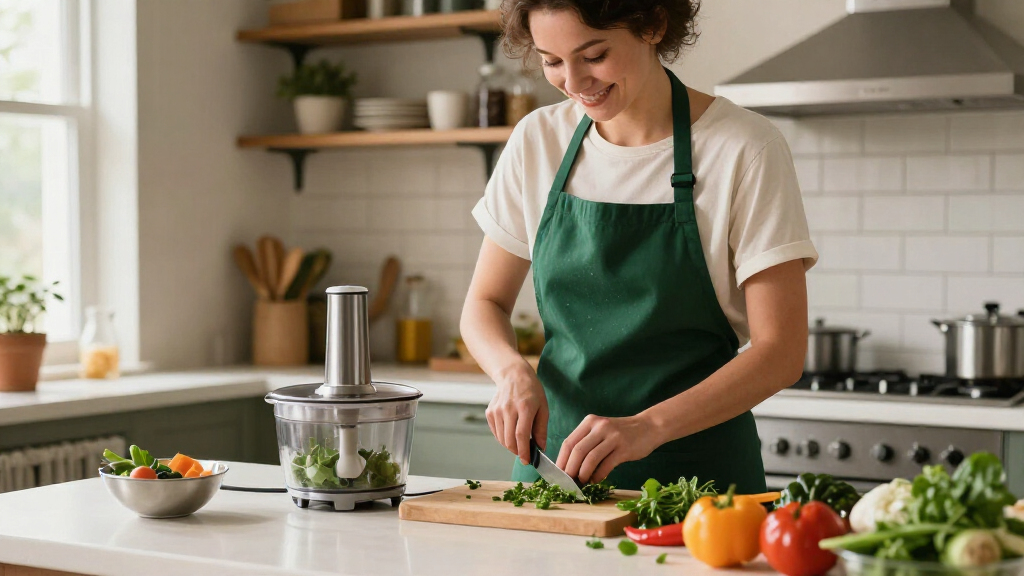
Home chefs comparing a food processor with a high-speed blender are deciding which machine will earn more counter space: one that chops, slices, shreds, and mixes, or one that makes exceptionally smooth soups, sauces, and drinks. Both can reduce hands-on work, but they solve different kitchen problems. A food processor is the stronger all-purpose prep tool for cooks who regularly handle vegetables, dough, and chunky mixtures. A high-speed blender is the better choice for people who make smoothies, purées, and emulsified sauces often and care most about a fine, even texture.

Get kitchen staples and gadgets delivered free with Prime
- Fast, free delivery on millions of items
- Prime Video, Amazon Music and more included
- Member-only deals all year
The practical gap is largest when the ingredients are mostly solid or mostly liquid. A processor gives you more ways to work with solids; a blender gives you a smoother result when enough liquid can circulate around the blades. The comparisons below focus on the jobs each machine can reliably cover, the effort they save, and whether paying for both makes sense.
At a Glance
| Criteria | Food processor | High-speed blender | Winner |
|---|---|---|---|
| Chopping and slicing | Strong for chopping, slicing, and shredding with the right attachments | Limited; ingredients need liquid or frequent scraping to blend evenly | A |
| Smooth purées and drinks | Good for thicker, textured mixtures; less suited to very smooth drinks | Excellent for smooth smoothies, soups, purées, and many sauces | B |
| Dough and thick mixtures | Can mix many pastry and dough recipes, within the model’s capacity | Can struggle with thick dough and mixtures that cannot circulate | A |
| Batch size and control | Wide bowl makes it easy to process larger solid ingredients in batches | Narrow jar suits liquid batches; minimum quantities and tamping vary by model | Depends |
| Cleanup and storage | Several parts and attachments may need washing and storage | Usually fewer parts, though the jar and blade area can be awkward to clean | B |
| Value for common cooking | High value for cooks who prep vegetables and varied solid ingredients often | High value for cooks who blend drinks, soups, and sauces frequently | Depends |
TMEDW Nylon Meat Chopper and Masher, Black

When ground meat is a regular part of our weeknight cooking, the TMEDW chopper targets a small but repetitive job: breaking meat apart in the pan as it cooks. Its five curved, beveled blades give us several edges for chopping and mixing, while the nylon construction is intended to avoid scratching nonstick cookware. That combination makes it a more natural choice for pan work than the Pisol set, whose tools focus on grating, peeling, and slicing, or the QPEY holder, which steadies ingredients rather than chopping them.The handle is described as ergonomic and non-slip, and the utensil is rated for temperatures up to 430°F. It can also mash or mix other foods, giving it some reach beyond ground meat. Still, the design is purpose-built: it is not a knife, and its nylon body may feel less rigid than a metal utensil when working through dense food. We would choose it for a specific cooking routine, not as a general prep tool. Dishwasher-safe cleanup helps, but cooks who rarely brown ground meat may get more use from Pisol’s assortment.
Pros:
- Five curved, beveled blades are designed to break up ground meat efficiently.
- Nylon construction is described as non-scratch for nonstick cookware.
- Heat resistance is specified up to 430°F.
- Non-slip handle and dishwasher-safe care support routine use.
Cons:
- Nylon may be less rigid than metal utensils.
- Its main job is chopping and mashing, not cutting.
Best for: Home cooks who often brown ground meat in nonstick pans and want a dedicated utensil for breaking it up and mixing.
Not ideal for: Cooks looking for a cutting tool, a broad set of prep implements, or the rigidity of a metal utensil.
Bottom line: For cooks who frequently prepare ground meat in nonstick cookware, TMEDW is the most directly useful and focused choice in this lineup.
“For cooks who frequently prepare ground meat in nonstick cookware, TMEDW is the most directly useful and focused choice in this lineup.”
Pisol 6-Piece Space-Saving Kitchen Gadget Set
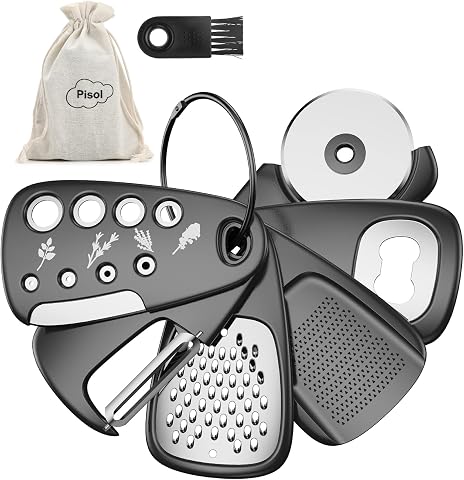
Rather than concentrating on one cooking task, the Pisol set groups six manual gadgets: a cheese grater, ginger grinder, pizza cutter, bottle opener, fruit and vegetable peeler, and herb stripper. That breadth gives it the most varied role here. If our kitchen is short on small prep tools, having them stack together can make the assortment easier to keep in one place than collecting each piece separately. The stainless steel blades support edge-based jobs, while light ABS plastic handles keep the tools easy to handle.Its range is also its limit. We get exactly the six included functions, so it does not replace the TMEDW for stirring and breaking up ground meat or the QPEY for holding an onion steady during slicing. The set is manual, and plastic handles may be less durable than metal ones. Its stated compact dimensions and weight point to a lightweight collection, but we should consider whether the stack will fit our drawer or storage spot. For a cook who already owns a good peeler, grater, and pizza cutter, the value of adding a bundled set is less clear.
Pros:
- Includes six distinct tools for grating, grinding, cutting, opening, peeling, and stripping herbs.
- Stackable design helps keep the pieces together.
- 430 stainless steel blades are specified for the cutting and grating tools.
- Dishwasher-safe care makes routine cleanup simpler.
Cons:
- The set is limited to its six included functions.
- ABS plastic handles may be less durable than metal handles.
Best for: New or space-conscious home cooks who want several small manual prep tools kept together in a stackable set.
Not ideal for: Cooks who already own these tools, need a dedicated meat chopper, or prefer metal-handled utensils.
Bottom line: Pisol makes the most sense when we need several everyday prep tools in one compact collection, but it is less compelling as a solution to any single specialized task.
“Pisol makes the most sense when we need several everyday prep tools in one compact collection, but it is less compelling as a solution to any single specialized task.”
Stainless Steel Onion Slicing Holder
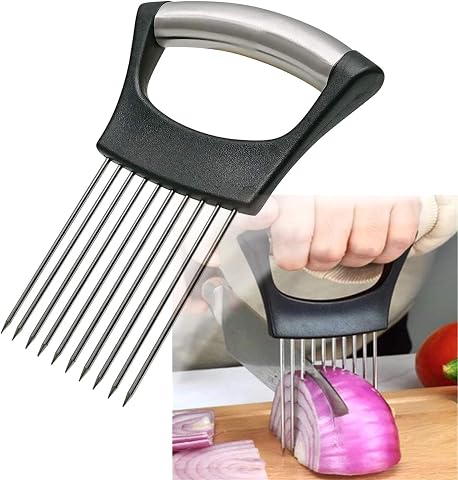
The QPEY slicing holder addresses a particular challenge: keeping an onion or another food steady while we slice it. Its stainless steel tines are designed to hold ingredients in place, which may help us make more uniform cuts and keep fingers farther from the blade path. That is a different kind of assistance from TMEDW, which works directly on food in a pan, and from Pisol, which supplies cutting and grating implements without a stated food-holding function.An extra-thick, non-slip plastic handle provides a grip, and the holder is dishwasher safe. The description also lists tenderizing meat as a possible use, so it is not limited to vegetables. But the tool remains manual and specialized; it cannot slice on its own or perform the range of jobs covered by the Pisol set. The supplied specifications do not state its dimensions, which makes it harder to judge how it will sit in a drawer or fit different ingredients. We would pick it when steadier slicing is a recurring concern, and skip it if a sharp knife and stable cutting technique already meet our needs.
Pros:
- Stainless steel tines are designed to steady food for more uniform slicing.
- Can also be used to tenderize meat, according to the product description.
- Extra-thick, non-slip handle supports a controlled grip.
- Dishwasher-safe care.
Cons:
- The holder’s dimensions are not specified in the provided product details.
- It requires manual use and has a narrower role than the Pisol set.
Best for: Home cooks who regularly slice onions or other ingredients and want a hand-held aid to keep food steadier.
Not ideal for: Cooks seeking a multi-function prep set, an automatic slicer, or a tool with fully specified dimensions.
Bottom line: QPEY is the most targeted choice for steadier hand slicing, provided that this specific prep aid solves a real need in our kitchen.
“QPEY is the most targeted choice for steadier hand slicing, provided that this specific prep aid solves a real need in our kitchen.”
As an Amazon Associate we earn from qualifying purchases.
Key Differences
The food processor wins on task range for solid food. Its broad bowl and interchangeable blades make it useful for chopping onions, slicing vegetables, shredding cheese, and combining ingredients. A blender can chop some ingredients, but it is built around circulation: food needs to move toward the blades, often with liquid or repeated scraping. For a cook who sees prep as the time-consuming part of dinner, that difference can matter more than a blender’s motor rating.
The blender wins when texture is the goal. Its jar and blade design are suited to moving liquid-rich ingredients into a consistent mixture, which makes it a better match for smoothies, silky soups, and finely blended sauces. A processor can make a good purée, but it may leave more texture, especially with small quantities. Buying both is worthwhile only when both sets of jobs appear regularly in your cooking. If one machine would sit unused for weeks, choose the one that matches your repeated tasks.
Detailed Comparison
Chopping and slicing (Food processor wins — major)
The food processor wins by a major margin for routine solid-food prep. With a chopping blade or slicing and shredding discs, it can turn a pile of vegetables into evenly prepared ingredients without asking you to add liquid. That helps when making slaw, prepping onions for several meals, or shredding cheese. A blender can break down some solids, but ingredients may stick above the blades or become unevenly chopped before the bottom turns to paste. Choose a processor if cutting and shredding are frequent jobs; a blender is a poor substitute for those tasks.
Smooth purées and drinks (High-speed blender wins — major)
The high-speed blender wins by a major margin when a smooth finish matters. Its tall jar encourages liquid and soft ingredients to circulate through the blades, making it effective for smoothies, puréed soups, and sauces. A processor can combine ingredients into a thick mixture, but a small batch may not reach the blade evenly, and the result can retain a grainier texture. For a household that blends drinks most mornings or wants silky purées often, the blender’s advantage is easy to notice. For occasional blending, a processor may be adequate.
Dough and thick mixtures (Food processor wins — moderate)
The food processor has a moderate advantage for many pastry and dough tasks. A suitable model can combine ingredients for pie crust, pastry, or some bread dough faster than mixing by hand, though capacity and manufacturer guidance matter. A blender generally needs fluid ingredients to keep the contents moving; thick dough can stall, compact, or strain the motor. Neither machine replaces a stand mixer for every baking job, but between these two, the processor is the more useful choice for cooks who make dough at home.
Batch size and control (moderate difference)
There is no universal winner here; the better fit depends on what is being made. A food processor’s wide bowl gives solid ingredients room to move and makes it easier to work through a large quantity of vegetables. A blender jar can handle generous volumes of liquid, but some models need a minimum amount to circulate properly. For small amounts of sauce or a single smoothie, jar shape and minimum fill level matter more than advertised capacity. Check the vessel sizes and the batch sizes in your own recipes before choosing.
Cleanup and storage (High-speed blender wins — minor)
The high-speed blender has a minor advantage in routine cleanup because many models have a single jar and lid, and a quick rinse or a water-and-soap cycle may handle fresh mixtures. Blade assemblies can still trap food, and dishwasher rules vary. A food processor often adds a bowl, lid, pusher, blade, and discs, each requiring attention and storage space. Those extras are useful only if they are easy to reach and wash. If you have limited cabinet space or dislike handling several parts, the simpler blender setup may be easier to live with.
Value for common cooking (moderate difference)
The value winner depends on which tasks repeat in your kitchen, so the gap is moderate rather than universal. A food processor earns its cost when it regularly replaces hand chopping, slicing, shredding, or mixing. A blender earns its cost when smoothies, blended soups, and sauces are staples. Paying for a premium motor or extra attachments makes little sense if the machine will be used only a few times a year. Compare the specific jobs you do each week with the included accessories; a lower-priced model that covers those jobs can be the better buy.
Food processor: Pros and Cons
Pros:
- Handles chopping, slicing, and shredding with suitable attachments
- More useful for many solid ingredients and thick mixtures
- Can help with some dough and pastry recipes
- Wide bowl makes vegetable prep straightforward
Cons:
- Usually includes several parts to clean and store
- Less effective than a high-speed blender for very smooth drinks and purées
- Small quantities may not reach the blade evenly
- Attachments and bowl capacity vary by model
High-speed blender: Pros and Cons
Pros:
- Makes smooth drinks, soups, and many sauces effectively
- Usually simpler to set up than a processor with multiple attachments
- Well suited to liquid-rich recipes
- Useful for cooks who blend food frequently
Cons:
- Limited for slicing, shredding, and dry chopping
- Thick mixtures may need added liquid, pauses, or scraping
- May not handle dough as well as a processor
- Some recipes require a minimum batch size
Who Should Choose What
Choose Food processor if:
- You prep vegetables, cheese, or other solid ingredients in quantity.
- You want one appliance to cover chopping, slicing, shredding, and some dough tasks.
- You cook from scratch often and value faster hands-on prep.
Choose High-speed blender if:
- You make smoothies, puréed soups, or blended sauces several times a week.
- A fine, consistent texture matters more to you than slicing or shredding.
- You want a machine centered on liquid-rich recipes and a relatively simple setup.
Skip both if: You rarely prepare blended recipes or large amounts of produce, and a knife, grater, or immersion blender already covers your occasional jobs.
Value for Money
Pay more for a food processor when its capacity, durable parts, or useful attachments will speed up jobs you do often. A model with discs you will never use does not create value just because it offers more functions. Pay more for a blender when you blend frequently and the model’s jar, controls, and power produce the textures your recipes require. A premium blender is hard to justify for an occasional smoothie, just as an elaborate processor is poor value if you mainly want soup.
For most home chefs who want to reduce everyday dinner prep, a food processor is the more versatile first purchase. The blender is the better value for a smoothie-focused kitchen or for someone who prioritizes smooth purées over prep flexibility. Buying both pays off when you regularly make solid-food preparations and blended recipes; otherwise, spend on the machine that will see weekly use.
Final Verdict
Choose a food processor as your first appliance if your cooking involves frequent chopping, slicing, shredding, or dough preparation. It covers more kinds of solid-food work and can save time across ordinary meals. Choose a high-speed blender if smooth drinks, soups, and sauces are the jobs you repeat most; its advantage in texture is substantial. The deciding factor is whether your bottleneck is preparing ingredients or blending them smoothly. For a typical scratch-cooking home chef who wants broader prep help, the food processor is the stronger all-round purchase. Pay for the blender instead when blending is already a regular part of your routine.
Frequently Asked Questions
Can a blender replace a food processor?
Only for some tasks. A blender can combine and purée liquid-rich ingredients, but it does not replace a processor’s slicing and shredding discs, and it is less convenient for dry chopping. If those prep jobs are regular parts of your cooking, a blender alone will leave a gap.
Can a food processor make smoothies?
It can blend some smoothies, especially thicker ones, but the result may be less smooth and small batches may not circulate well. A high-speed blender is the better pick if smooth drinks are a frequent priority.
Which appliance is better for soup?
A high-speed blender is generally better for a very smooth soup. A food processor can break down cooked ingredients, but its texture may be less even. Follow the appliance maker’s instructions for hot liquids, since safe handling limits vary by model.
Should a home chef buy both?
Buy both if you regularly prepare solid ingredients and also make smoothies, silky soups, or blended sauces. If one group of tasks is occasional, start with the appliance that addresses your most repeated job and add the other only when a clear need appears.