
TL;DR

Get kitchen staples and gadgets delivered free with Prime
- Fast, free delivery on millions of items
- Prime Video, Amazon Music and more included
- Member-only deals all year
Peperonata is an Italian method of slowly cooking sweet peppers with onions, tomatoes, and olive oil until silky and naturally sweet. It is defined by technique rather than a fixed recipe, varies widely by region and household, and tastes better after resting. It keeps 3-4 days refrigerated and works as a side, pasta sauce, bruschetta topping, or antipasto.
Peperonata — the Italian preparation of sweet peppers slowly cooked with onions, tomatoes, and olive oil until glossy and naturally sweet — is having a quiet moment among vegetable-centered home cooks, and a new guide from Mad Tasting explains why the dish rewards patience more than precision. The piece breaks down what peperonata actually is (a method, not a fixed recipe), how long it takes (35 minutes to an hour of gentle cooking), and why it tastes better the next day.
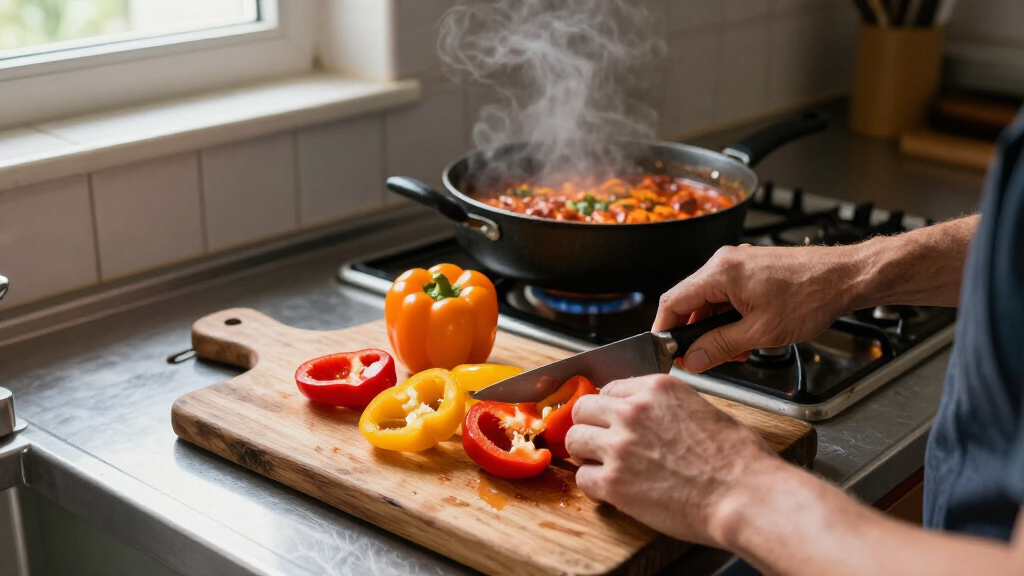
The base of peperonata is simple, according to the guide: red and yellow bell peppers, onion, ripe tomatoes, extra-virgin olive oil, and salt. From there, households diverge sharply. Garlic, basil, oregano, parsley, black pepper, vinegar, capers, olives, and even potatoes appear in regional and family versions. Some cooks peel the peppers first; others slice them raw. Some omit tomatoes entirely.
What unites every version, Mad Tasting argues, is the technique: low, slow cooking that collapses the peppers into a jammy, glossy mass. The sweetness is not added — it develops as the peppers’ own sugars concentrate and caramelize slightly against the pan. Because of this, the guide states plainly that the dish cannot be rushed. Raw bell peppers are crunchy and faintly grassy; after roughly 45 minutes of gentle heat, they transform into something deeply aromatic and sweet.
Like its cousins caponata and ratatouille, peperonata improves with rest. The guide attributes this to chemistry as much as tradition: fat carries aroma, acid brightens it, and salt needs hours to draw both deeper into the vegetable fibers. A peperonata eaten straight from the stove tastes like peppers; the same pan tasted the next day tastes like a composed dish. Refrigerated, it keeps for 3-4 days. Because the leftover version is better than the fresh one, cooking a double batch is, in the guide’s framing, not extra work but a head start.
Why Home Cooks Are Revisiting It
Peperonata matters to modern cooks because it solves a familiar problem: how to turn cheap, abundant vegetables into something that tastes richer than its ingredient list. The guide classifies it as cucina povera — Italy’s resourceful tradition of transforming inexpensive ingredients through patient cooking. Peppers are cheap in late summer; the only real cost is time.
Its versatility also drives its appeal. According to the guide, peperonata works as a side dish, a pasta sauce, a bruschetta topping, or an antipasto, and it fits squarely into the current wave of vegetable-centered cooking, where technique-driven vegetable dishes do the work that meat once did. For meal planners, the fact that it improves overnight makes it a practical weeknight workhorse rather than a special-occasion project.
As an affiliate, we earn on qualifying purchases.
How It Compares to Ratatouille and Pisto
Peperonata is frequently confused with other slow-cooked late-summer vegetable stews, but the differences matter at the stove. According to the guide, peperonata is a pepper dish with tomato support, centered on peppers, onions, and often tomatoes. French ratatouille, by contrast, is a broader medley including eggplant and zucchini, where each vegetable keeps its identity. Spanish pisto, from La Mancha, sits between the two and is often topped with a fried egg. Sicilian caponata is built on eggplant, celery, olives, and capers, with an agrodolce — sweet-and-sour — finish.
There is also a regional split within Italy. Northern versions lean gentle and sometimes include butter or potatoes — the guide offers the example of a Piedmontese cook starting with butter and finishing with Parmesan. Southern versions, especially from Puglia and Calabria, bring garlic, oregano, capers, olives, and occasionally a sharper sweet-and-sour edge. Both approaches, the guide emphasizes, are correct.
A related linguistic note: the word derives from peperone, the Italian word for bell pepper. Order a “pepperoni pizza” in Italy and you will receive a pie topped with sweet peppers, not sausage — a mix-up that reflects how central peppers are to the Italian kitchen.
“Peperonata is a method, not a recipe etched in stone.”
— Mad Tasting
As an affiliate, we earn on qualifying purchases.
Peeling, Timing, and Regional Debates
Several points remain genuinely contested, and the guide is explicit that there is no single authority to settle them. Whether to peel the peppers before cooking divides cooks: some peel for a silkier texture, others slice raw and let the pan do the work. Cooking times range from 35 minutes to a full hour depending on the peppers, the pan, and the desired consistency. Whether tomatoes belong in the dish at all is a household-level decision, not a rule.
Northern and southern versions differ enough — butter and Parmesan versus garlic, vinegar, and capers — that no canonical version exists. The guide treats this variation as a feature of the dish rather than a defect, but it means readers seeking one definitive recipe will not find one.
As an affiliate, we earn on qualifying purchases.
Peak Season and the Home Kitchen
Peperonata is a seasonal dish at its best in late August and September, when ripe peppers are cheapest and sweetest — the guide’s own imagery of market stalls sagging under crates of red and yellow peppers ties it directly to this window. Home cooks attempting it can follow the guide’s five-move framework: soften onions slowly, cook peppers gently, add tomatoes in moderation, reduce to a glossy sauce, and let the dish rest before serving. For food-safety purposes, refrigerate leftovers within two hours of cooking and consume within the guide’s stated 3-4 day window; the dish also serves as a base for improvisation with garlic, herbs, capers, or olives once the core technique is understood.
food storage containers for leftovers
As an affiliate, we earn on qualifying purchases.
As an affiliate, we earn on qualifying purchases.
Key Questions
What exactly is peperonata?
It is an Italian preparation of sweet bell peppers slowly cooked with onions, tomatoes, and olive oil until silky and naturally sweet. It is best understood as a cooking method rather than one fixed recipe, with wide regional and household variation.
How long does peperonata take to cook?
Between 35 minutes and one hour of gentle, low heat, according to the Mad Tasting guide. The time cannot be shortened much, because the sweetness develops as the peppers’ sugars concentrate during slow cooking.
How long does it keep, and is it better the next day?
It keeps 3-4 days refrigerated. The guide states that peperonata improves with rest, as salt, fat, and acid need hours to penetrate the vegetable fibers — the next-day version tastes more composed than the fresh one.
How is peperonata different from ratatouille?
Peperonata centers on peppers with tomato support; ratatouille is a broader medley including eggplant and zucchini, where vegetables keep their individual identity. In peperonata, peppers are meant to collapse into a glossy, jammy mass.
Do you have to peel the peppers?
No — the guide notes that this divides cooks. Some peel for a finer texture, others slice the peppers raw and let long cooking soften them. Both approaches are considered correct.
Source: Mad Tasting
Halloween Picks
halloween
As an affiliate, we earn on qualifying purchases.