
TL;DR

Get kitchen staples and gadgets delivered free — and shop member deals
- Fast, free delivery on millions of items
- Access to Prime Big Deal Days deals on October 6–7
- Prime Video, Amazon Music and more included
Search and media interest is surging in household attempts to stop buying plastic-packaged groceries, prompted by a first-person account from a shopper who reported saving about $40 a month. The savings figure is a single unverified anecdote, not a study, and results will vary by household, store access, and diet.
A first-person account from a shopper who set out to stop buying groceries sold in plastic — and reported saving roughly $40 a month as a result — is driving a sharp spike in search and media interest around low-waste grocery shopping. The savings figure comes from a single individual’s experience and has not been independently verified, but the story has tapped into a broader, well-documented consumer shift away from single-use packaging.
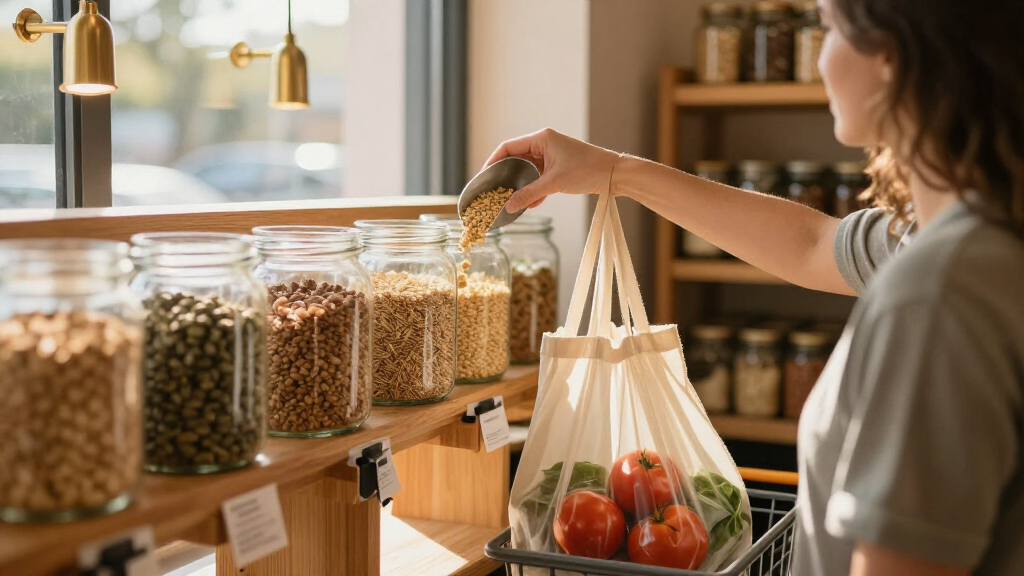
The account, circulating widely through syndicated feeds this week, describes a household experiment: the author attempted to eliminate plastic-packaged foods from regular grocery purchases, relying instead on bulk bins, produce sold loose, refillable containers, and from-scratch cooking. According to the author, the shift unexpectedly reduced the grocery bill by about $40 per month — a figure attributed mainly to buying fewer pre-packaged snacks, prepared foods, and beverages.
What is confirmed at this point is limited to the existence and spread of the account itself, not its financial claims. The $40 monthly savings is a self-reported anecdote from one household with an unspecified size, location, and starting budget. No retailer data, consumer survey, or peer-reviewed study supports the figure as typical.
What is well-established independently: packaging-free and low-waste retail formats — bulk food stores, refill shops, and package-free sections in conventional supermarkets — have expanded steadily over the past decade in North America and Europe. Long-standing consumer research has also found that processed and pre-packaged foods generally carry a price premium per unit compared with raw ingredients, which gives the anecdotal savings claim a plausible mechanism even though its size is unverified.
Why Shoppers Are Watching This Story
The story matters because it links two pressures on household budgets and shopping habits at once: plastic packaging waste and grocery costs, which have been a persistent strain for consumers since the inflation surge of 2022–2023. An account suggesting the two goals align — less plastic and a lower bill — is inherently attractive, which explains the interest spike even without verified numbers.
For readers considering a similar switch, the relevant takeaway is directional rather than numerical: shoppers who replace packaged snacks, pre-cut produce, and ready meals with whole ingredients often do spend less, and generate less packaging waste. But the $40 figure should be treated as one household’s outcome, not an expected result. Households without access to bulk stores, farmers markets, or refill options — common in food deserts and many suburban areas — may find the swap harder or more expensive, not cheaper.
The Decade-Long Shift Away From Packaging
Efforts to cut plastic packaging are not new. Plastic bag bans and fees have spread across U.S. states and dozens of countries since the 2000s. The zero-waste movement popularized package-free shopping in the 2010s through bulk stores and bring-your-own-container retailers, and large supermarket chains in Europe and North America have since added refill stations and loose-produce options.
On the cost side, food inflation in 2022–2023 pushed many households toward from-scratch cooking and private-label goods, and multiple consumer surveys during that period recorded increased interest in reducing food waste and packaging. The current account appears to sit at the intersection of these trends, which is a plausible reason for the surge in attention — though the specific trigger for this week’s spike is unconfirmed.
“I set out to quit buying groceries sold in plastic, and ended up saving $40 a month.”
— The account’s author
What the $40 Claim Does and Doesn’t Show
Several things remain unclear. The household size, location, prior spending, and shopping venues behind the $40 figure are not specified in the circulating account, making it impossible to judge whether the savings would replicate. The author attributes the savings largely to buying fewer packaged convenience foods, but no itemized receipts or spending records have been shared.
It is also not confirmed what triggered the current spike in interest — whether the account’s spread through RSS and social feeds, a related news segment, or seasonal attention to budgeting. No retailer, consumer-research firm, or government agency has published data tying plastic-free shopping to a specific average savings level.
Testing the Claim at Your Own Store
Readers interested in testing the approach can do so with low risk: compare a typical week’s receipts against a week built around loose produce, bulk dry goods, and whole ingredients, tracking both cost and packaging. Food-safety basics apply when using refillable containers — clean and dry containers before filling, store dry goods in airtight containers at room temperature, and keep refrigerated items below 40°F (4°C).
Whether the $40 figure holds up more broadly will only become clear if consumer groups, researchers, or retailers publish comparative spending data — none of which is currently announced.
Key Questions
Is the $40 monthly savings a verified figure?
No. It is a self-reported anecdote from one shopper. No independent data confirms that quitting plastic-packaged groceries produces that level of savings for typical households.
Why might plastic-free shopping cost less?
According to the account, the savings came mostly from buying fewer packaged snacks, prepared foods, and drinks. Long-standing price comparisons also show whole ingredients are generally cheaper per serving than processed, pre-packaged foods.
Can everyone shop this way?
Access varies. Bulk bins, refill stores, and loose produce are unevenly distributed, and households in areas with limited store options may find plastic-free shopping harder or more expensive rather than cheaper.
Does quitting plastic packaging help the environment?
Reducing single-use plastic packaging generally reduces household waste, a long-established point. The overall environmental benefit also depends on what replaces the packaging and how food is transported.
What triggered the current interest in this story?
That is unconfirmed. A first-person account has spread widely through syndicated feeds, but no specific publication event or data release has been identified as the trigger.
Source: rss
NFL season / tailgating Picks
team gear
As an affiliate, we earn on qualifying purchases.