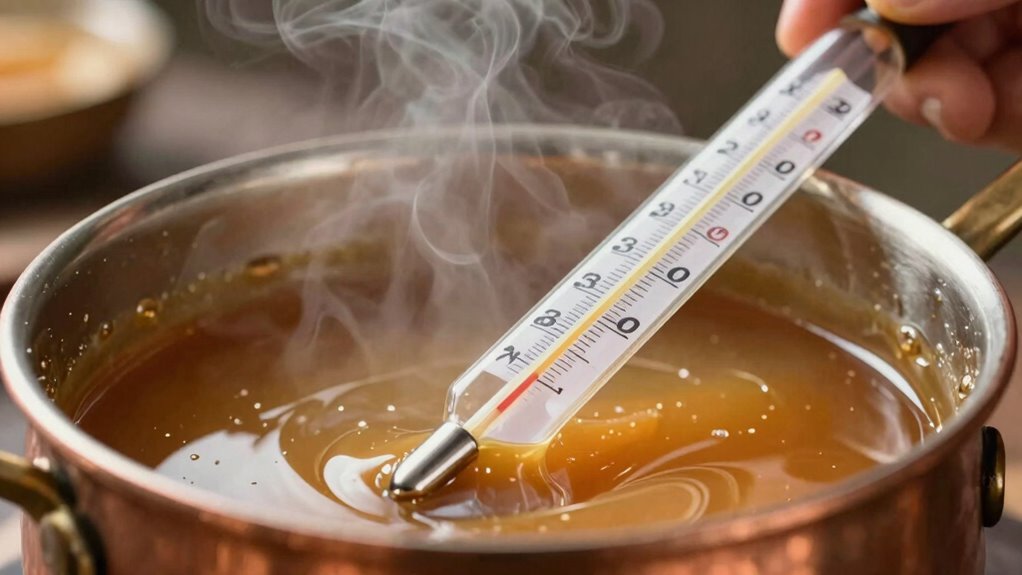

Using a thermometer in candy making removes the mystery by giving you precise temperature control, so you know exactly when your sugar reaches each critical stage. Instead of guessing, you can confidently monitor the soft ball, hard crack, or thread stages, preventing overcooking or undercooking. This trick makes sugar work less intimidating and more scientific, leading to perfect results every time. Keep exploring, and you’ll discover how mastering this simple tool transforms your candy craft into a confident, precise process.

Get kitchen staples and gadgets delivered free — and shop member deals
- Fast, free delivery on millions of items
- Access to Prime Big Deal Days deals on October 6–7
- Prime Video, Amazon Music and more included
Key Takeaways
- Use a reliable candy thermometer to monitor temperature precisely, removing guesswork from sugar stages.
- Clip the thermometer in the saucepan for continuous, hands-free readings during heating.
- Remove the pan from heat immediately once the target temperature is reached to prevent overcooking.
- Understand key temperature points for different sugar textures to predict and achieve desired results effortlessly.
- Practice regular temperature checking to build confidence and turn candy making into a predictable science.

If you’ve ever struggled to determine the perfect stage for your sugar, using a thermometer can make the process much easier. When you’re deep into candy making, precision is everything. You need to hit specific temperatures to achieve the right texture and consistency, whether you’re making caramel, fudge, or syrup. Without a thermometer, it can feel like a guessing game, risking overcooked or undercooked results. But with a good digital or candy thermometer, you gain a reliable tool that takes the guesswork out of sugar stages.
Using a thermometer makes sugar stages precise, easy, and less stressful for perfect candy every time.
In candy making, understanding the different sugar stages—soft ball, hard crack, thread, and others—is crucial. Each stage corresponds to a particular temperature which determines the final texture of your treat. Using a thermometer, you can watch the temperature rise in real-time and know exactly when to remove your saucepan from the heat. This ensures your sugar reaches the precise point needed for your recipe, making your baking more consistent and professional. No more relying on visual cues alone, which can be unreliable, especially for beginners. Proper temperature control is a key aspect of cooking science, helping you understand how heat impacts sugar’s behavior. Additionally, knowing the science behind sugar’s melting point can help you troubleshoot common issues like crystallization.
Baking precision becomes much more manageable when you incorporate a thermometer into your process. Sugar can change quickly, and the difference of a few degrees can alter the outcome dramatically. For example, at 235°F, you’re at the soft ball stage—perfect for fudges and fondants—while at 300°F, you reach the hard crack stage, ideal for lollipops and brittle. Investing in a thermometer helps you keep track of these stages accurately, saving you time, ingredients, and frustration. It also allows you to learn and memorize these key temperatures, gradually building your confidence and skill in candy making.
Using a thermometer isn’t complicated. Simply clip it onto your pot or hold it in place as your sugar heats. Keep a close eye on the temperature reading, especially as it approaches the target stage. Remember that sugar can rapidly go from just right to burnt, so quick adjustments are essential. Once you hit your desired temperature, remove the sugar from heat immediately to prevent overshooting. This technique makes your baking more precise, predictable, and less stressful. Mastering this technique can elevate your baking skills and help you create consistent, professional-quality confections.
Additionally, understanding the temperature control aspect of candy making helps reduce waste and promotes sustainable practices by minimizing failed batches. In the end, mastering sugar stages with a thermometer transforms what might seem like a mysterious art into a straightforward science. It’s a small investment that pays off by giving you consistent results and boosting your confidence in candy making and baking. Whether you’re a hobbyist or aspiring pastry chef, using a thermometer is the trick that brings clarity, control, and success to your kitchen.
As an affiliate, we earn on qualifying purchases.
Frequently Asked Questions
Can I Use a Digital Thermometer Instead of a Traditional One?
Yes, you can use a digital thermometer instead of a traditional one. Just guarantee it’s accurate and properly calibrated to prevent issues with sugar crystallization. Digital thermometers often provide quick readings, but check the calibration regularly for precision. Accurate temperature control is essential in sugar work, especially during boiling. By using a well-calibrated digital thermometer, you’ll better manage sugar stages and prevent crystallization problems.
What Temperature Should Sugar Reach for Different Candy Types?
For different candy types, you should heat sugar to specific temperatures to control sugar crystallization and achieve the desired candy texture. For soft ball stage, reach 235-240°F; for firm ball, 245-250°F; for hard ball, 260-270°F; for soft crack, 270-280°F; and for hard crack, 300-310°F. Monitoring these temperatures guarantees proper crystallization and texture, preventing graininess or incorrect consistency in your candies.
How Accurate Are Household Thermometers for Sugar Cooking?
Think of your household thermometer as a trusty compass—generally reliable but needing calibration for true accuracy. When cooking sugar, these thermometers are fairly precise for achieving candy clarity, but slight calibration errors can throw off your results. To guarantee accuracy, regularly test your thermometer in boiling water or ice water. This way, you’ll get consistent, perfect candy every time, steering clear of under- or over-cooked sugar.
Do Altitude Changes Affect Sugar Temperature Readings?
Altitude changes do affect sugar temperature readings because the sugar boiling point drops as altitude increases. You need to make altitude adjustments to your thermometer readings to get accurate results. For example, at higher elevations, sugar boils at a lower temperature, so you should lower your target temperature accordingly. This guarantees your sugar reaches the correct stage, preventing undercooking or overcooking, regardless of altitude.
How Do I Clean My Thermometer After Use?
You should clean your thermometer after use with warm, soapy water to remove any sugar residue or debris. For thorough cleaning, use a soft cloth or sponge, avoiding abrasive materials. To maintain accuracy, regularly calibrate your thermometer according to the manufacturer’s instructions. This guarantees precise readings, especially after cleaning. If your thermometer is digital, avoid submerging the entire device and instead, wipe the probe carefully.
As an affiliate, we earn on qualifying purchases.
Conclusion
Now that you’ve uncovered the thermometer trick, the mystery of sugar’s behavior becomes clearer. But don’t be too quick to assume you’ve mastered it all. There’s a subtle finesse to timing and temperature that can still surprise you, lurking just beneath the surface. Keep experimenting, stay curious, and let this new knowledge deepen your understanding. Because in the world of sugar, the real magic often happens just when you think you’ve got it figured out.
As an affiliate, we earn on qualifying purchases.
professional candy making thermometer
As an affiliate, we earn on qualifying purchases.
As an affiliate, we earn on qualifying purchases.
Halloween Picks
halloween
As an affiliate, we earn on qualifying purchases.