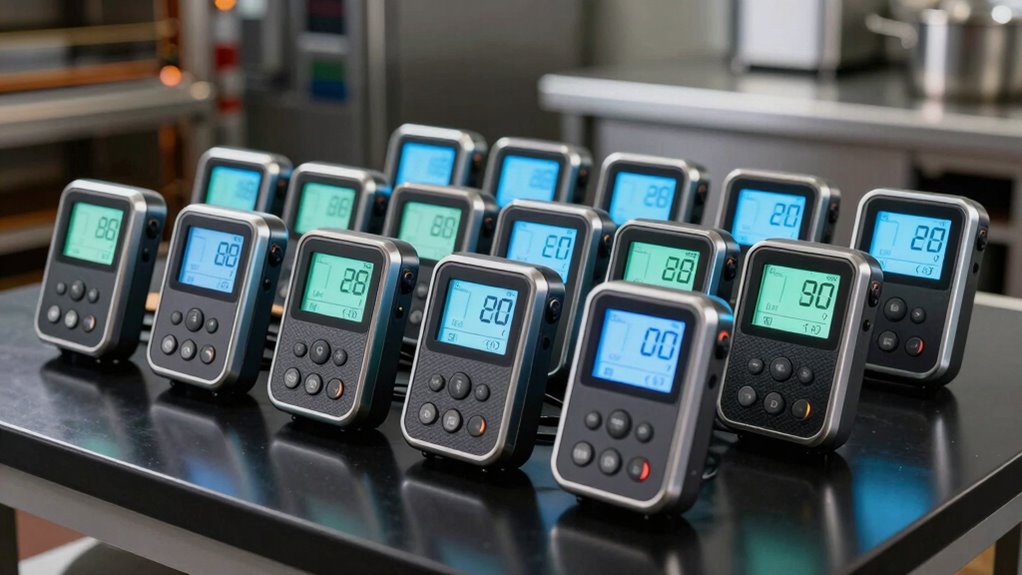
For monitoring several oven zones or checking temperature recovery between batches, I’d start with the DANOPLUS DP-373: its four thermocouple channels suit multi-point baking checks. The AZ Instruments 4-Channel Logger stands out for SD-card recording, while the Elitech RC-5 offers a simpler USB-based route for basic temperature tracking. The main tradeoff is between multi-channel flexibility and simpler setup, alongside probe compatibility, heat exposure, and how easily you can retrieve records. A logger’s temperature limit does not mean its display or logger body can sit inside a hot oven; probe placement and manufacturer limits matter. Read on for the full comparison and help matching a logger to your oven and workflow.

Get kitchen staples and gadgets delivered free with Prime
- Fast, free delivery on millions of items
- Prime Video, Amazon Music and more included
- Member-only deals all year
Key Takeaways
- Four-channel thermocouple models lead this lineup for comparing multiple oven zones, but buyers still need to check which probe types are supported and whether probes are included.
- The DP-373 and AZ Instruments logger fill different needs: the former is a direct multi-channel thermometer/logger option, while the latter adds an 8 GB SD card for recording and moving data.
- The Elitech RC-5 favors straightforward USB logging over multi-probe oven mapping, making it a better fit for simple monitoring than diagnosing uneven heat across a cavity.
- Bluetooth and dual-probe designs trade channel count for convenience; the Elitech ICT-220 and Tzone dual-probe models may suit focused checks, but they cover fewer locations than four-channel units.
- Probe and logger placement matter as much as channel count. RTD, thermocouple, and USB logger designs differ in probe compatibility and use, so oven heat limits must be checked for each component.
| DANOPLUS DP-373 4-Channel Thermocouple Data Logger Thermometer |  | Best Overall for Multi-Point Oven Logging | Channels: 4 | Thermocouple types: K and J | Main unit temperature range: -328°F to 2501°F (-200°C to 1372°C) | VIEW ON AMAZON | See Our Full Breakdown |
| Elitech RC-5 USB Temperature Data Logger |  | Best for Ambient Oven-Room Monitoring | Model: RC-5 | Temperature range: -30°C to 70°C (-22°F to 158°F) | Recording capacity: 32,000 points | VIEW ON AMAZON | See Our Full Breakdown |
| AZ Instruments 4-Channel K-Type Thermocouple Thermometer Data Logger with 8 GB SD Card |  | Best for Removable-Card Data Logging | Channels: 4 | Temperature range: -200°C to 1370°C (-328°F to 2498°F) | Accuracy: ±(0.3% of reading + 1°C) at 18–28°C ambient temperature | VIEW ON AMAZON | See Our Full Breakdown |
| Supco SL300T Temperature Monitor and Data Logger |  | Best Compact Logger for Cooler Bakery Zones | Temperature range: -40°F to 185°F (-40°C to 85°C) | Temperature accuracy: ±1°F (±0.5°C) | Temperature resolution: 0.01°F or 0.01°C | VIEW ON AMAZON | See Our Full Breakdown |
| 4-Channel K/J/T Thermocouple Thermometer Data Logger with 8 K-Type Probes |  | Best Probe Bundle for Multi-Point Checks | Channels: 4 | Compatible thermocouple types: K, J, and T | K-type temperature range: -328°F to 2501°F (-200°C to 1372°C) | VIEW ON AMAZON | See Our Full Breakdown |
| DANOPLUS 4-Channel Thermocouple Data Logger with 8GB SD Card |  | Best for Multi-Zone Oven Checks | Channels: 4 | Logger measurement range: -200 to 1370°C (-328 to 2498°F) | Included probes: 2 K-type bead probes, -50 to 200°C (-58 to 392°F) | VIEW ON AMAZON | See Our Full Breakdown |
| Tzone PTD602 RTD Temperature Data Logger with Dual PT100 Probes |  | Best for RTD Probe Users | Probe channels: 2 | Supported sensors: PT100 and PT1000 | Logger measurement range: -200 to 660°C | VIEW ON AMAZON | See Our Full Breakdown |
| TEKCOPLUS THTK-6 4-Channel K-Type Thermocouple Data Logger |  | Best for Straightforward SD-Card Logging | Channels: 4 | Logger temperature range: -200 to 1370°C (-328 to 2498°F) | Included probes: 2 K-type thermocouple probes, -50 to 200°C (-58 to 392°F) | VIEW ON AMAZON | See Our Full Breakdown |
| Landtek 4-Channel K/J/T Thermocouple Data Logger Thermometer | 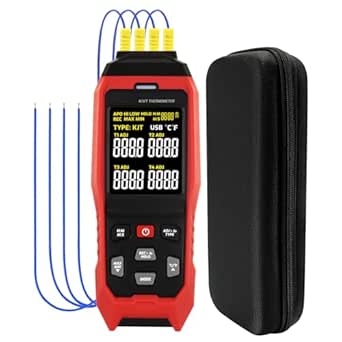 | Best for Thermocouple Flexibility | Channels: 4 | Thermocouple types: K, J, and T | K-type logger range: -200 to 1372°C (-328 to 2501°F) | VIEW ON AMAZON | See Our Full Breakdown |
| Elitech ICT-220 Bluetooth 2-Channel K-Type Thermometer Data Logger |  | Best for App-Based Oven Monitoring | Channels: 2 | Thermocouple type: K-type | Temperature range: -50 to 250°C (-58 to 482°F) | VIEW ON AMAZON | See Our Full Breakdown |
| Tzone Dual-Probe Thermocouple Data Logger |  | Best for Two-Zone Oven Checks | Channels: 2 | Supported sensor types: K, T, and J | Data capacity: 61,440 groups | VIEW ON AMAZON | See Our Full Breakdown |
| temperature data logger for baking oven | Channels | Connectivity | Power | Included probes |
|---|---|---|---|---|
| DANOPLUS DP-373 4-Channel Ther | 4 | USB | 3 AA batteries, included | 4 K-type thermocouple probes |
| Elitech RC-5 USB Temperature D | — | Built-in USB connector | CR2032 lithium metal battery, included | — |
| AZ Instruments 4-Channel K-Typ | 4 | — | — | 2 K-type thermocouples |
| Supco SL300T Temperature Monit | — | USB interface; cable included | 3.0 V CR2032 lithium battery, included | — |
| 4-Channel K/J/T Thermocouple T | 4 | — | — | 8 K-type probes; stated probe accuracy ±1.5% |
| DANOPLUS 4-Channel Thermocoupl | 4 | — | 4 AA batteries, included | 2 K-type bead probes, -50 to 200°C (-58 to 392°F) |
| Tzone PTD602 RTD Temperature D | — | USB report generation | — | — |
| TEKCOPLUS THTK-6 4-Channel K-T | 4 | — | 1 9V battery required | 2 K-type thermocouple probes, -50 to 200°C (-58 to 392°F) |
| Landtek 4-Channel K/J/T Thermo | 4 | USB export; Windows software | DC or 3 AA batteries | — |
| Elitech ICT-220 Bluetooth 2-Ch | 2 | Bluetooth with Elitech Tools app | — | — |
| Tzone Dual-Probe Thermocouple | 2 | — | — | 2 K-type probes, rated 0°C to 300°C |
More Details on Our Top Picks
DANOPLUS DP-373 4-Channel Thermocouple Data Logger Thermometer
For comparing heat across oven zones, the DP-373’s four channels and included four K-type probes make a practical starting point: I can track several positions at once without sourcing extra sensors. Its 5,000-reading memory, adjustable audible and visual alarms, and selectable sampling rates suit repeatable bake tests where I want both a live warning and a record of temperature changes. Compared with the Elitech RC-5, this logger is built for high-temperature probe work rather than lower-range ambient monitoring; compared with the AZ Instruments 4-Channel Logger, it includes probes for every channel but relies on PC software for extended storage. The tradeoff is that the included probes have a narrower stated range than the meter, and long-run data storage needs a USB-connected computer.
Pros:- Four channels allow simultaneous comparison of oven zones.
- Includes four K-type thermocouple probes, one for each channel.
- Adjustable audible and visual alarms help flag temperature limits.
- Supports multiple sampling rates and stores up to 5,000 readings internally.
Cons:- The included K-type probes have a narrower stated range than the main unit.
- Unlimited storage requires connection to PC software.
- The plastic construction may be less suited to rough workshop handling than a ruggedized instrument.
Best for: Bakers and oven technicians who want to compare four oven locations during heat-up or baking with probes included.
Not ideal for: Users who need long unattended logging without a connected PC, or who need the included probes to cover the meter’s full temperature range.
- Channels:4
- Thermocouple types:K and J
- Main unit temperature range:-328°F to 2501°F (-200°C to 1372°C)
- K-type probe range:-58°F to 572°F (-50°C to 300°C)
- Recording capacity:5,000 readings; additional storage via PC software
- Connectivity:USB
- Power:3 AA batteries, included
- Included probes:4 K-type thermocouple probes
Our verdict“Choose the DP-373 if you want an oven-focused four-probe setup with alarms and built-in logging, and can use a PC for extended records.”
Elitech RC-5 USB Temperature Data Logger
The Elitech RC-5 is the simplest pick here for tracking temperatures around an oven rather than measuring the oven’s hot interior. Its -22°F to 158°F range rules out direct high-heat cavity logging, but the 32,000-point memory, LCD, alarms, and built-in USB connector make it useful for monitoring a bakery room, proofing area, or cool-down environment and exporting a PDF record. Compared with the DANOPLUS DP-373, it is far easier to download and review without separate thermocouple probes, yet it cannot map multiple hot oven zones. The IP65 rating also suits storage or transport checks better than an exposed oven setup. Battery-life information is inconsistent in the supplied product details, and a calibration certificate requires contacting the seller.
Pros:- Stores up to 32,000 temperature points for extended ambient monitoring.
- Built-in USB connector supports data downloads and PDF reports without a separate reader.
- LCD displays readings, logged points, and alarm status.
- IP65 protection rating suits storage and transport monitoring.
Cons:- Its 158°F upper limit is far below normal baking-oven temperatures.
- It is a single logger rather than a multi-channel thermocouple system.
- Battery-life details are inconsistent, and obtaining a calibration certificate requires contacting the seller.
Best for: Bakery operators who need reusable records for room, storage, or transport temperatures near an oven rather than inside its hot cavity.
Not ideal for: Bakers measuring oven air or surfaces at baking temperatures; its upper limit is 158°F and it has no thermocouple probes.
- Model:RC-5
- Temperature range:-30°C to 70°C (-22°F to 158°F)
- Recording capacity:32,000 points
- Resolution:0.1°C/°F
- Response time:10 seconds
- Connectivity:Built-in USB connector
- Power:CR2032 lithium metal battery, included
- Battery life:Listed as up to 6 months; product details also state 365 days
Our verdict“Pick the RC-5 for portable, report-friendly monitoring around the bakery, but not for logging the temperature inside a hot oven.”
AZ Instruments 4-Channel K-Type Thermocouple Thermometer Data Logger with 8 GB SD Card
The AZ Instruments logger stands apart for its included 8 GB SD card: records can be stored on removable media instead of relying on the DP-373’s PC-connected extended storage. Its four channels, programmable sampling from one second, and independent high and low alarms help track oven recovery and temperature differences across baking zones. Compared with the DP-373, though, it comes with only two probes, so filling all four channels means buying or supplying two more. The broad stated K-type measurement range is relevant to hot-oven work, but the listed accuracy is specified at an ambient range of 18–28°C, not across every oven condition. I would also account for its automatic power-off after 20 minutes when planning unattended runs.
Pros:- Records four-channel measurements to an included 8 GB SD card.
- Automatic and manual logging offer flexible ways to capture readings.
- Sampling can be programmed from one second.
- Independent high and low alarm limits can be set for each channel.
Cons:- Only two K-type probes are included for four channels.
- Automatically powers off after 20 minutes, which can interrupt unattended logging.
- Stated accuracy is specified for an ambient temperature of 18–28°C.
Best for: Bakers and process technicians who want removable-card records, programmable sampling, and the option to monitor four oven points.
Not ideal for: Buyers who need four probes in the box or want a logger that stays on continuously without managing its automatic power-off.
- Channels:4
- Temperature range:-200°C to 1370°C (-328°F to 2498°F)
- Accuracy:±(0.3% of reading + 1°C) at 18–28°C ambient temperature
- Sampling rate:Programmable from 1 second
- Resolution:0.1°C / 0.1°F
- Storage:Included 8 GB SD card
- Alarms:Independent high and low limits for each channel
- Included probes:2 K-type thermocouples
Our verdict“Choose this AZ Instruments model if removable SD-card records matter more than having four probes included or uninterrupted unattended operation.”
Supco SL300T Temperature Monitor and Data Logger
The Supco SL300T is a compact logger for the cooler parts of a baking operation, such as ingredient storage, a proofing environment, or post-bake cooling—not for measuring a hot oven cavity. Its 43,344-sample capacity and adjustable recording interval, from one second to 18 hours, give more flexibility for long ambient checks than the Elitech RC-5’s stated 32,000 points. But the SL300T’s 185°F ceiling still falls well short of baking temperatures, and it lacks thermocouple channels for comparing oven zones like the DP-373. USB software is required for data analysis and calibration, so this is less convenient for someone seeking immediate standalone reports. Its small form and long stated battery life fit set-and-review monitoring where compact placement matters.
Pros:- Stores up to 43,344 temperature samples.
- Recording interval ranges from 1 second to 18 hours.
- Compact, one-ounce unit suits discreet placement in storage or cooler zones.
- Software supports data analysis and calibration; stated battery life is up to 6 years.
Cons:- The 185°F upper limit is unsuitable for typical hot-oven measurements.
- Requires a computer and software for data analysis and calibration.
- Does not provide multiple thermocouple channels for comparing oven positions.
Best for: Bakery managers monitoring refrigerators, storage areas, proofing spaces, or cooling zones who want a small logger with flexible recording intervals.
Not ideal for: Anyone logging baking-oven cavity temperatures or seeking standalone data review without a computer and software.
- Temperature range:-40°F to 185°F (-40°C to 85°C)
- Temperature accuracy:±1°F (±0.5°C)
- Temperature resolution:0.01°F or 0.01°C
- Sample capacity:43,344 temperature samples
- Sample rate:1 second to 18 hours
- Connectivity:USB interface; cable included
- Power:3.0 V CR2032 lithium battery, included
- Battery life:Up to 6 years
Our verdict“Pick the SL300T for compact, long-running records in cooler bakery areas, not for direct temperature logging inside a baking oven.”
4-Channel K/J/T Thermocouple Thermometer Data Logger with 8 K-Type Probes
This model’s clearest advantage is the bundle of eight K-type probes, giving a bakery spare sensors for repeated checks or setups across shifts; only four channels can be read at once. It also accepts K, J, and T thermocouples, making it more adaptable to an existing sensor inventory than the DP-373, which supports K and J types. Built-in storage for up to 5,000 data groups, USB connection to a Windows PC, alarms, and adjustable compensation cover core logging needs. The tradeoff is a notable gap between meter and probe capability: the included K-type probes are rated to ±1.5% and have a more limited range than the meter. Compared with the AZ Instruments logger, this one supplies many more probes, but its software is listed for Windows 7 through 11.
Pros:- Four channels support simultaneous readings at multiple oven points.
- Includes eight K-type probes, providing spares beyond the four channels.
- Accepts K, J, and T thermocouples for compatibility with varied sensors.
- Offers built-in storage, USB connectivity, configurable alarms, and adjustable compensation.
Cons:- Included probes have a more limited temperature range than the meter.
- Included Type K probes have a stated accuracy of ±1.5%, looser than the meter’s stated accuracy.
- PC software is listed as compatible with Windows 7 through 11.
Best for: Bakery technicians who run repeated multi-point oven checks, want spare K-type probes, or need compatibility with K, J, and T thermocouples.
Not ideal for: Users who need probe performance across the meter’s full temperature range, a stated removable-card workflow, or PC software beyond the listed Windows versions.
- Channels:4
- Compatible thermocouple types:K, J, and T
- K-type temperature range:-328°F to 2501°F (-200°C to 1372°C)
- J-type temperature range:-328°F to 2192°F (-200°C to 1200°C)
- T-type temperature range:-328°F to 752°F (-200°C to 400°C)
- Meter accuracy:±0.2% + 0.7°C
- Data storage:Up to 5,000 data groups
- Included probes:8 K-type probes; stated probe accuracy ±1.5%
Our verdict“Choose this logger when probe quantity and three thermocouple types matter more than matching the probes to the meter’s full range.”
DANOPLUS 4-Channel Thermocouple Data Logger with 8GB SD Card
For comparing temperatures across several oven zones, I’d put this DANOPLUS ahead of the two-channel Tzone PTD602: its four simultaneous readings can expose hot and cool areas without moving a probe between checks. The included 8GB SD card saves readings as .TXT files, making the record easier to review in spreadsheet software. Scheduled starts and T1–T2 differential measurement also suit repeatable bake trials, while alarms can flag readings outside chosen limits.
The tradeoff is that only two probes are included, and their stated range ends at 200°C, well below the logger’s maximum. Buyers need suitable additional probes for hotter oven work or all four locations. It also runs on four AA batteries, unlike the TEKCOPLUS THTK-6, which uses one 9V battery.
Pros:- Displays readings from four locations at once
- Logs to an included SD card in .TXT format for spreadsheet review
- High and low alarms provide audible and visual alerts
- Scheduled starts and T1–T2 differential measurement support repeatable comparisons
Cons:- Includes only two probes for its four channels
- Included probes are rated only to 200°C, below the logger’s maximum
- Requires four AA batteries
Best for: Bakers comparing several oven zones over scheduled test runs who can supply probes suited to their oven temperatures.
Not ideal for: Buyers who need four ready-to-use probes or probes rated for high-temperature oven interiors straight from the box.
- Channels:4
- Logger measurement range:-200 to 1370°C (-328 to 2498°F)
- Included probes:2 K-type bead probes, -50 to 200°C (-58 to 392°F)
- Accuracy:±(0.3% of reading + 1°)
- Resolution:0.1°C
- Storage:Included 8GB SD card; .TXT format
- Display:4.1 × 1.9 in backlit LCD
- Power:4 AA batteries, included
Our verdict“Choose this DANOPLUS for multi-zone logging and scheduled oven tests if you are prepared to match the probes to your temperature range.”
Tzone PTD602 RTD Temperature Data Logger with Dual PT100 Probes
The Tzone PTD602 is the distinct choice here for buyers already working with PT100 or PT1000 sensors, rather than the K-type thermocouple setup used by the DANOPLUS 4-Channel Logger. Its two probes let you compare two oven-related points, and USB report generation without extra software keeps exporting records straightforward. A backlit display, configurable logging intervals, and alarms make it practical for controlled checks where a pair of readings is enough.
For broad oven mapping, its two channels are a limitation compared with the four-channel TEKCOPLUS THTK-6. The supplied probes are rated from -80 to 120°C, so their range—not the logger’s -200 to 660°C span—sets the immediate ceiling. I’d skip it if you need probes for hotter oven interiors or do not use RTD sensors.
Pros:- Supports PT100 and PT1000 sensors
- Exports reports through USB without requiring software
- Two probes allow simultaneous readings from separate points
- Backlit LCD, foldable stand, and configurable alarms support bench use
Cons:- Only two probe channels, fewer than the DANOPLUS and TEKCOPLUS four-channel options
- Included probes are rated only from -80 to 120°C
- Requires three AA batteries
Best for: Bakers and process technicians who use PT100 or PT1000 probes and need simple USB reports from two measurement points.
Not ideal for: Users seeking a ready-to-use logger for high-temperature oven interiors, or those who need four simultaneous readings and K-type probes.
- Probe channels:2
- Supported sensors:PT100 and PT1000
- Logger measurement range:-200 to 660°C
- Included probe range:-80 to 120°C
- Resolution:0.1
- Response time:1 second
- Connectivity:USB report generation
- Power and weight:3 AA batteries; 295 g
Our verdict“Pick the PTD602 if your workflow already uses RTD probes and two-point USB reporting matters more than four-channel oven mapping.”
TEKCOPLUS THTK-6 4-Channel K-Type Thermocouple Data Logger
The TEKCOPLUS THTK-6 makes a strong fit for bakers who want four displayed channels and SD-card recording without relying on USB report software. Like the DANOPLUS 4-Channel Logger, it reads up to four thermocouples and includes only two probes, so either unit needs extra probes for a full four-point setup. The THTK-6’s Max/Min/Hold functions add quick ways to capture useful readings during manual checks, and its adjustable buzzer and LED alarms can flag excursions.
Its main practical distinction is power: it uses one 9V battery, rather than the DANOPLUS’s four AAs. But its included probes also stop at 200°C, and the stated operating conditions cap ambient use at 50°C and below 80% humidity. I’d choose it for portable logging, not as a logger to leave inside a hot oven.
Pros:- Shows and logs readings across four channels
- Includes an 8GB SD card for recording
- Max/Min/Hold functions help capture readings during manual checks
- Adjustable audible and visual alarms
Cons:- Only two probes are included for four channels
- Included probes are rated from -50 to 200°C, narrower than the logger range
- Operating conditions are limited to 0–50°C and humidity below 80%
Best for: Bakers who want four-channel oven measurements saved to an included SD card and prefer quick Max/Min/Hold checks.
Not ideal for: Users who need four probes in the box, probe coverage above 200°C, or operation outside its stated ambient conditions.
- Channels:4
- Logger temperature range:-200 to 1370°C (-328 to 2498°F)
- Included probes:2 K-type thermocouple probes, -50 to 200°C (-58 to 392°F)
- Accuracy:±(0.3% of reading + 1°C)
- Resolution:0.1°C/°F
- Data storage:Included 8GB SD card
- Display:Backlit LCD showing 4 readings
- Power:1 9V battery required
Our verdict“Choose the THTK-6 for portable four-channel SD logging and quick reading checks, provided you supply probes suited to your oven temperatures.”
Landtek 4-Channel K/J/T Thermocouple Data Logger Thermometer
Among these options, the Landtek is the one I’d favor when a bakery needs to work across K-, J-, and T-type thermocouples. That flexibility can make it easier to use existing compatible probes, while four channels support simultaneous oven-zone checks. It stores up to 5,000 data groups and exports through USB to Windows software; compared with the SD-card-based TEKCOPLUS THTK-6, this route suits users who want software-assisted review rather than a removable-card workflow.
The Landtek also responds in a stated 0.5 seconds, faster than the one-second figures listed for the DANOPLUS and TEKCOPLUS models. Its catch is software dependence: USB software is listed for Windows 7 through 11. The included K-type probe range ends at 300°C, so probe selection still matters when measuring hotter oven points.
Pros:- Accepts K-, J-, and T-type thermocouples
- Measures up to four channels simultaneously
- Stores up to 5,000 data groups with USB export
- Includes adjustable compensation, alarms, and max/min/average readings
Cons:- USB logging software is compatible with Windows 7 through 11
- Included K-type probe range is -50 to 300°C, below the logger’s K-type range
- No SD card is specified for standalone removable-card logging
Best for: Bakery technicians who already own different K-, J-, or T-type probes and want four-channel logging with Windows USB export.
Not ideal for: Buyers who need self-contained SD-card records, use a non-Windows computer for reporting, or require included probes rated beyond 300°C.
- Channels:4
- Thermocouple types:K, J, and T
- K-type logger range:-200 to 1372°C (-328 to 2501°F)
- Included K-type probe range:-50 to 300°C (-58 to 572°F)
- Data capacity:Up to 5,000 groups
- Response time:0.5 seconds
- Connectivity:USB export; Windows software
- Power:DC or 3 AA batteries
Our verdict“Choose the Landtek when probe-type flexibility and Windows-based four-channel records outweigh the simplicity of SD-card logging.”
Elitech ICT-220 Bluetooth 2-Channel K-Type Thermometer Data Logger
The Elitech ICT-220 is the clear pick here for bakers who want to follow a pair of readings on a phone: its Bluetooth app provides live readings and graphs, then supports CSV or PDF reports. Two K-type probes are included, so it is more ready for a two-point setup than the four-channel DANOPLUS and TEKCOPLUS, which each supply only two probes for four inputs. The ICT-220 also offers MAX, MIN, AVG, and temperature-difference functions, useful for comparing an oven area with a reference point.
Its -50 to 250°C range is narrower than the four-channel thermocouple loggers’ main-unit ranges, and it cannot map four zones at once. Recording capacity of up to 5,000 groups is listed as optional, while some logging and alarm functions require app unlocking. I’d choose it for connected two-point checks, not maximum standalone logging capacity.
Pros:- Bluetooth app displays live readings and graphs
- Exports CSV and PDF reports
- Includes two K-type thermocouples for two-point measurements
- MAX, MIN, AVG, and temperature-difference functions aid comparisons
Cons:- Two channels cannot match the four-zone coverage of the DANOPLUS, TEKCOPLUS, or Landtek
- Measurement range is -50 to 250°C, narrower than those four-channel loggers
- 5,000-group capacity is optional, and some functions require app unlocking
Best for: Bakers who want app-based graphs and report exports while monitoring two oven or reference points.
Not ideal for: Users who need four-zone mapping, broad high-temperature coverage, or all recording and alarm functions available without app unlocking.
- Channels:2
- Thermocouple type:K-type
- Temperature range:-50 to 250°C (-58 to 482°F)
- Accuracy:±(0.5°C + 0.5% of reading)
- Resolution:0.1°C/°F up to 100°C; 1.0°C/°F above
- Connectivity:Bluetooth with Elitech Tools app
- Recording capacity:Up to 5,000 groups optional; unlimited app-connected storage
- Power and stated battery life:3 AA batteries, included; up to 150 hours
Our verdict“Pick the ICT-220 for convenient Bluetooth graphs and two-point oven checks, but choose a four-channel logger for broader oven mapping.”
Tzone Dual-Probe Thermocouple Data Logger
For comparing two points in a baking oven at once, the Tzone TC602 is a practical pick: its two channels let you log temperatures in separate zones or compare a probe reading with another measurement. That makes it more useful for spotting uneven heating than the single-logger approach of the Elitech RC-5, while its USB reports in CSV, XLS, TXT, or PDF are straightforward to review without extra software. The included K-type probes suit many oven checks, but their stated limit is only 300°C, far below the logger’s maximum range; verify that the probe rating suits your oven and placement. Unlike several four-channel models in this roundup, it cannot map as many locations simultaneously. It also runs on three AA batteries, so ongoing operation depends on replacements.
Pros:- Two channels support simultaneous readings for comparing oven zones
- Exports TXT, CSV, XLS, and PDF reports over USB without additional software
- Includes two K-type probes for getting started with dual-point logging
- Backlit display, alarms, and T1–T2 calculations support on-site checks
Cons:- Included probes are rated only from 0°C to 300°C, limiting use in hotter locations
- Two channels provide less coverage than the four-channel logger options in this roundup
- Requires three AA batteries for operation
Best for: Bakers and oven technicians who want to log two oven locations at once and export readings for troubleshooting or records.
Not ideal for: Users mapping several shelves or oven zones simultaneously, or anyone whose probe placement may exceed the included probes’ 300°C limit.
- Channels:2
- Supported sensor types:K, T, and J
- Data capacity:61,440 groups
- Measurement range:-200°C to 1372°C (-328°F to 2501.6°F)
- Included probes:2 K-type probes, rated 0°C to 300°C
- Probe cable length:1.5 m
- Report formats:TXT, CSV, XLS, PDF over USB
- Display and power:Backlit LCD; 3 AA batteries
Our verdict“Choose the TC602 for simple two-point oven comparisons and easy report exports, but pick a four-channel logger for broader heat mapping.”

How We Picked
I ranked these loggers around the demands of baking ovens: tracking heat across more than one location, capturing changes during preheating and baking, and producing records a baker can retrieve and interpret. I gave more weight to channel capacity, recording and export methods, probe flexibility, and clarity of use than to feature count alone. An included probe set or removable SD card can reduce setup friction, but it does not replace checking temperature range, accuracy, and component heat limits.
The four-channel thermocouple models rank ahead for oven mapping because they can compare multiple points during the same run. Within that group, I distinguish models by recording workflow and probe support; a logger with storage or a broad probe set can be more practical than a bare thermometer-style unit. USB, Bluetooth, dual-probe, and RTD options rank lower for broad oven surveys, but may be better matches for simpler monitoring, specific sensor needs, or fewer measurement points. Since the list provides product names rather than verified specifications for every model, I avoid treating unconfirmed accuracy, range, or software details as proven advantages.
| temperature data logger for baking oven | Connectivity |
|---|---|
| DANOPLUS DP-373 4-Channel Ther | USB |
| Elitech RC-5 USB Temperature D | Built-in USB connector |
| AZ Instruments 4-Channel K-Typ | — |
| Supco SL300T Temperature Monit | USB interface; cable included |
| 4-Channel K/J/T Thermocouple T | — |
| DANOPLUS 4-Channel Thermocoupl | — |
| Tzone PTD602 RTD Temperature D | USB report generation |
| TEKCOPLUS THTK-6 4-Channel K-T | — |
| Landtek 4-Channel K/J/T Thermo | USB export; Windows software |
| Elitech ICT-220 Bluetooth 2-Ch | Bluetooth with Elitech Tools app |
| Tzone Dual-Probe Thermocouple | — |
Factors to Consider When Choosing Temperature Data Logger For Baking Ovens
I’d choose a baking-oven logger by starting with the problem I need to solve, not the number of features on the box. A logger for comparing shelf positions has different needs from one recording a single oven’s preheat curve or checking a production process over time.
How Many Oven Locations Need Monitoring?
Decide whether you need a single reading, a comparison between two positions, or a map of several shelves and zones. More channels can reveal hot spots and uneven recovery without requiring separate runs, but each channel needs a suitable sensor and a sensible placement plan. Avoid buying extra channels on the assumption that they automatically improve accuracy; poor probe placement can make a four-point comparison less useful than a careful two-point check. If you bake multiple products at once or need to compare shelf positions, four channels may justify the extra setup. For a single reference point, a simpler logger can be easier to operate and review.
Match the Probe Type to the Job
Thermocouple, RTD, and standalone USB loggers are not interchangeable sensor systems. Check the logger’s supported probe types, connector compatibility, temperature range, and whether the probes you need are supplied or sold separately. Do not assume that any K-type probe will work with a unit that also lists J or T types; the device must be configured for the sensor in use. A mismatch can lead to unusable readings or misleading records. Before choosing a sensor for an oven, decide whether you are measuring air, a surface, or a product core, since each calls for a different probe form and placement.
Keep the Logger Body Out of Unsafe Heat
A probe’s heat tolerance does not establish the safe operating limit of the logger, its cable, or its battery. Many oven checks call for placing the sensor in the cavity while keeping the instrument body outside, with the cable routed so it will not be pinched by the door. Read the limits for every component and follow the manufacturer’s placement guidance. A door gap can affect the seal and change oven performance, so use an appropriate feed-through or approved setup where available. Never leave a logger inside a hot oven unless its manufacturer explicitly permits that use.
Choose a Recording and Export Workflow You Will Use
Think through what happens after a bake: do you need a live reading, a stored temperature curve, or files that can be attached to a quality record? USB logging can be convenient for direct computer access, while removable SD storage can simplify transferring records without relying on a wireless connection. Bluetooth may help with remote viewing, but connection range, app compatibility, and phone access can affect the workflow. Check logging interval, memory capacity, file format, and software requirements before buying. A large storage figure is less useful if exporting or interpreting the data takes more effort than your process can support.
Prioritize Useful Accuracy and Calibration
For baking, a logger should be judged by its stated accuracy across the temperature range you actually use, not just its widest advertised range. Compare the accuracy specification with the process tolerance you need to monitor, and check whether it varies at higher temperatures. Calibration status and the ability to arrange recalibration matter more when records support production checks or customer requirements. A high channel count cannot compensate for a sensor that has drifted or a calibration record that is out of date. For informal troubleshooting, ease of repeatable placement may matter more than a feature intended for formal quality programs.
Pay for Features That Solve a Recurring Problem
Spending more can make sense when it buys a capability you will use repeatedly, such as multi-point recording, supported probes for your oven layout, or a data-export method that fits your records. A premium feature set is poor value if you only need occasional checks at one location. Conversely, saving on a basic logger may cost time if you later need several simultaneous readings or a more convenient record trail. Check whether probes, cables, batteries, software, and calibration support are included or require separate purchases. Make the decision around the complete working setup, not the logger name alone.
Frequently Asked Questions
Can I leave a temperature data logger inside a baking oven?
Do not assume the logger body is safe inside the oven just because its probe is rated for high temperatures. Check the specified operating limits for the logger, sensor, cable, and battery separately. Many setups place only the probe in the oven and keep the instrument outside, with the lead routed carefully. A door that does not close properly can alter heat loss and affect the readings. Follow the model’s instructions rather than relying on a probe’s temperature rating alone.
Do I need four channels to find hot spots in my oven?
Four channels are useful when you want to compare several shelves or corners in one bake, since all locations are recorded at the same time. They are not essential for every oven: a two-point logger can still compare a suspected hot spot with a reference position. Multiple channels also require more probes, careful placement, and more data to interpret. If you bake one tray at a time, a simpler setup may answer your question. Choose channel count based on the number of locations you need to compare concurrently.
Is an SD-card logger better than a USB logger for oven records?
Neither method is automatically better; the right choice depends on how you handle records. An SD card can make file transfer convenient when the logger is not connected to a computer during a bake. USB may be simpler if you routinely download data directly to a computer and the model’s software suits your workflow. Check file formats, logging capacity, and any software or operating-system requirements before deciding. Also confirm whether the logger records independently or needs a connected device for the functions you want.
Should I choose a thermocouple or an RTD logger for baking?
Start with the temperature range, sensor response, accuracy needs, and probes available for the measurement you plan to make. Thermocouple models in this roundup include several multi-channel options suited to comparing oven locations, while the Tzone PTD602 is an RTD-based choice with dual PT100 probes. Sensor types have different compatibility and operating characteristics, so do not swap probes between systems unless the logger supports them. Confirm the stated accuracy across your working range rather than choosing by sensor label alone. If the data supports a formal process record, check calibration arrangements as well.
What should I check before buying a logger for production records?
Check whether the logger captures the intervals and duration your process requires, and whether its exported files can be retained or shared in your record system. Verify the accuracy specification at baking temperatures, calibration status, and available recalibration support. Make sure the probes can be positioned consistently and that the logger records without a phone or computer if that is needed during production. Confirm memory capacity and how data is recovered before the first production run. A logger that records temperature is not automatically a validated monitoring system, so match it to your quality procedures.
Conclusion
For a general-purpose choice, I’d put the DANOPLUS DP-373 first for its four-channel format, which fits common oven-mapping needs. For buyers who want removable storage, the AZ Instruments 4-Channel Logger with 8 GB SD Card is the strongest alternative; its workflow may suit people who need to transfer records. The Elitech RC-5 is my pick for beginners who want a simpler USB logging path, while the Elitech ICT-220 is a better match for buyers who value Bluetooth access and only need two K-type channels. For specialized sensor needs, consider the Tzone PTD602 with dual PT100 probes; for a lower-complexity, focused setup, compare the dual-probe Tzone thermocouple model. I’d treat the four-channel models as the value-focused group for multi-point oven checks, but verify included probes, range, accuracy, and storage details before choosing. The best fit is the logger that matches your measurement locations and record workflow—not simply the one with the most channels.
Halloween Picks
halloween
As an affiliate, we earn on qualifying purchases.