
TL;DR

Get kitchen staples and gadgets delivered free with Prime
- Fast, free delivery on millions of items
- Prime Video, Amazon Music and more included
- Member-only deals all year
A professional chef knife’s performance relies on the complete system—steel, geometry, handle, and maintenance—not just brand or price. The right knife fits your hand, tasks, and care habits, making every cut safer and easier.
Imagine slicing through a ripe tomato with the ease of butter melting on a warm day. That’s the magic of a well-chosen professional chef knife. But behind that effortless cut lies a world of decisions that can turn your kitchen from good to great.
Whether you’re a home cook craving restaurant-quality prep or an aspiring chef sharpening your tools, understanding what makes a knife truly perform is key. This isn’t about flashy marketing—it’s about the perfect fit, balanced design, and steel that works with your habits. Stick around, and I’ll show you how to pick a knife that turns every meal into a masterpiece.
A complete knife system—steel, geometry, handle, and maintenance—dictates performance more than brand names or price tags.
Blade geometry and heat treatment influence cutting ease, edge retention, and resistance to chipping, often more than steel type alone.
Comfortable, balanced handles boost safety and reduce fatigue during long prep sessions.
Proper sharpening and storage are essential to keep your knife performing at its best for decades.
Hybrid designs and advanced steels are expanding what’s possible, blending Japanese finesse with Western toughness.
How to Pick the Perfect Chef Knife for Your Style
Choosing the right chef knife depends on what you cook most—and this matters more than most buyers realize. Every blade profile is a set of tradeoffs. A Western chef’s knife with a curved edge excels at rocking cuts and chopping large vegetables because that curve lets the blade stay in contact with the board through the stroke, reducing wrist motion. The cost is precision: the taller, thicker blade can feel clumsy on delicate herbs.
A Gyuto, its Japanese cousin, trades some durability for finesse. Its thinner grind means less force per cut and cleaner cell walls—so sliced onions weep less and fish fillets look cleaner—but that same thinness means it should never twist through a squash or contact bone. A Santoku fits snugly in smaller hands and favors push cuts, which can reduce strain if you have smaller hands or do lots of fine vegetable work, though its flatter profile gives up the rocking motion many Western cooks rely on.
Specialization pays off: a boning or filleting knife flexes around joints and pinbones in ways a stiff chef’s knife never can, and a nakiri makes quick, even work of vegetables with its straight, rectangular edge. The reason to avoid a jack-of-all-trades is simple—a blade designed for everything compromises on everything, forcing you to use more pressure or accept rougher cuts on half your tasks.
Pro tip: always test weight and balance in your hand before buying. A knife that feels like an extension of your arm isn’t just comfortable—it lets your grip stay relaxed, which means better control, less fatigue, and fewer accidents over a long prep session.
As an affiliate, we earn on qualifying purchases.
Steel Types That Make or Break Your Knife’s Performance
Steel choice is fundamentally a set of tradeoffs between three properties: edge retention, toughness, and corrosion resistance—improving one usually costs you another. Stainless steels like VG-10 or 420J2 resist rust with almost no care, which is why they dominate home kitchens. The tradeoff is that softer stainless steels dull faster, meaning more frequent sharpening—fine if you enjoy maintaining your tools, frustrating if you don’t.
Carbon steels such as 1095 or SK-4 sit at the opposite pole: they sharpen easily, take an ultra-fine edge, and hold it through long prep sessions. The price is reactivity—skip the drying and oiling routine and you’ll find rust spots and discoloration within days. Carbon steel also transfers a metallic taste to acidic foods, which matters if you prep lots of citrus or tomatoes.
Semi-stainless steels like AUS-8 or 14C28N split the difference, offering solid corrosion resistance with respectable edge retention—arguably the smartest choice for most home cooks who want performance without a maintenance ritual. Premium powder-metallurgy steels like CPM-S35VN push wear resistance to impressive levels, but understand what that means in practice: sharpening takes longer and demands better stones or guided systems. A premium steel you can’t maintain properly performs worse than a modest steel you can.
The deeper truth: the steel’s grade alone doesn’t tell the whole story. Heat treatment determines hardness and grain structure, and the grind determines how that steel actually meets food. A well-treated mid-tier steel routinely outperforms a poorly treated premium one—which is why brand reputation for quality control matters more than the steel name stamped on the blade.
As an affiliate, we earn on qualifying purchases.
Why Blade Geometry Matters More Than Steel Grade
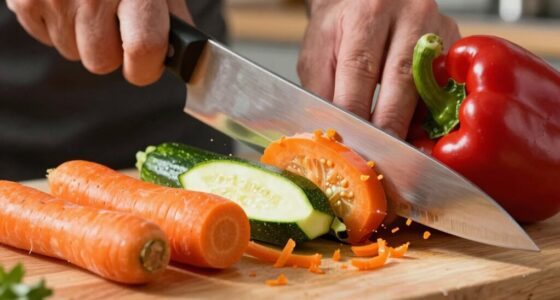
Steel is just part of the story—often the smaller part. The blade geometry—its shape, thickness, and grind—is what actually determines how much force each cut requires. Physics explains why: a thin edge at a low angle (around 15 degrees per side) wedges food apart with minimal resistance, while a thicker blade must displace more material as it descends, compressing and tearing cells rather than parting them cleanly.
The tomato test makes this tangible: an ultra-thin, sharp blade glides through with almost no downward pressure, leaving clean faces that stay fresh longer and plate better. But geometry cuts both ways. That same delicate edge concentrates force onto a tiny area, so striking bone or hacking into frozen food can chip it—repairs are difficult and sometimes impossible on very hard, thin blades. A thicker, more robust blade survives abuse but crushes soft produce and requires more effort, which paradoxically makes it less safe because tired hands and forceful cuts lead to slips.
The practical takeaway is to match geometry to your real habits, not your aspirational ones. If you occasionally hack through squash spines or your knife will share a block with careless family members, choose durability. If your prep is mostly slicing and dicing on a cutting board, prioritize thinness. Key variables to evaluate include blade taper (how quickly it thins toward the edge), edge angle, grind style (flat grinds are predictable and easy to sharpen, hollow grinds slice with less drag but weaken faster, convex grinds are strong and food-release-friendly but harder to maintain), and blade height (taller blades protect knuckles and help with knuckle-guided cuts).
These details shape the cutting experience more than steel type alone—which is exactly why two knives in identical steel can feel like completely different tools.
As an affiliate, we earn on qualifying purchases.
Handle Comfort and Balance: Your Knife’s Best Friends
Even the sharpest blade feels terrible if it’s uncomfortable to hold—and discomfort isn’t just an annoyance, it’s a safety issue. A handle that forces a tight grip fatigues your hand over a long prep session, and a fatigued grip loses control precisely when your attention drifts. A good handle fits your hand size, feels secure when wet, and distributes weight so the knife does the work, not your wrist.
Design philosophy differs meaningfully between traditions. Western handles often use full tangs with wood or synthetic scales, shifting weight toward the handle for a robust, controlled feel that suits heavier cutting. Japanese wa handles tend to be lighter with a smooth, rounded profile, placing balance near the blade for nimble, precise work. Neither is superior—handle-heavy knives feel stable and forgiving for beginners, while blade-heavy knives reward refined technique with speed and agility.
Test a handle the way you’d actually use it: pinch the blade just ahead of the bolster and notice where the knife balances. It should feel neutral at that grip point, not like it’s diving toward the board or tipping backward. Consider texture carefully, too—polished wood looks beautiful but can get slick with wet or oily hands, while textured synthetics grip firmly at the cost of some elegance. If you’re left-handed, be aware that some handles and asymmetrical grinds are shaped for right-handed users, which can mean real discomfort and worse cuts over time.
As an affiliate, we earn on qualifying purchases.
Forged or Stamped? What Really Matters
Forged knives are shaped from heated steel, often giving a heftier feel, a thicker spine, and sometimes a bolster that adds forward balance. Stamped knives are cut from sheet metal, making them lighter and usually less expensive. The marketing world wants you to believe forging equals quality, but the reality is more nuanced.
What forging actually changes is the steel’s internal structure and the knife’s mass distribution—it can produce a denser, more durable feel. What it doesn’t guarantee is a sharp edge, good geometry, or proper heat treatment. Meanwhile, modern stamped manufacturing with laser precision and computer-controlled heat treatment routinely produces knives that outperform poorly forged ones, because edge geometry and heat treatment matter more to your daily experience than how the blank was shaped.
The practical implication: treat construction method as one data point, not a verdict. A well-ground stamped knife with quality steel will serve you better than a mediocre forged knife with a brand-name premium. Judge the knife in your hand—its balance, grind consistency, and steel—and weigh forged knives’ durability advantages against their typically higher cost only if your budget allows.
Japanese vs Western Knives: What’s the Real Difference?
At heart, the Japanese versus Western question is a question about hardness versus toughness—and understanding that tradeoff tells you which knife suits your kitchen. Japanese knives typically run thinner blades, harder steel, and lower edge angles (around 15 degrees per side), which lets them take and hold an extremely keen edge. The physics of hardness explains both sides of the deal: harder steel (say, 60+ HRC) resists deformation so the edge stays sharp longer, but it’s more brittle—mistreat it and it chips rather than bends.
Western knives generally run softer (around 55–58 HRC) and thicker with more curve. Softer steel dulls faster but deforms instead of fracturing, meaning the edge can be realigned with a honing steel and will shrug off contact with bones, dense squash, and the general rough-and-tumble of a busy kitchen. That toughness is why many professionals choose Western blades for heavy prep and reach for Japanese blades for finish work.
Consider a concrete example: a Japanese gyuto slicing paper-thin fish fillets barely disturbs the flesh, preserving texture and presentation; a Western chef’s knife powers through root vegetables and jointed poultry without complaint. Each excels precisely where the other struggles.
Today, many brands deliberately blend these traits—Japanese geometry paired with Western handles, or tough steels ground thin—giving you the finesse of one tradition with the resilience of the other. These hybrids are often the most practical choice for home cooks, because they forgive imperfect technique while still rewarding good habits.
Sharpening and Maintaining Your Knife Like a Pro
A sharp knife isn’t just nicer to use—it’s genuinely safer, because a keen edge bites where you place it instead of skidding off onion skins and toward your fingers. Sharpening with a proper stone, guided system, or professional service removes a tiny amount of steel to create a fresh edge, typically at 15–20 degrees per side depending on your knife: lower angles cut more cleanly but wear faster and chip easier, while higher angles trade sharpness for durability.
Understanding the difference between sharpening and honing saves both money and confusion. A honing steel doesn’t sharpen at all—it realigns the microscopic burrs that fold over during normal use. Doing it regularly delays the need for sharpening, which matters because every sharpening removes metal, and a knife only has so much of it over its lifetime. A waterstone gives the finest, most controllable edge, which is why enthusiasts prefer it; the tradeoff is skill and time, since maintaining a consistent angle freehand takes practice.
Frequency should follow performance, not the calendar. When cutting starts to drag, when tomatoes squish instead of slice, or when the edge catches on your thumbnail—those signals mean it’s time. And resist the temptation of aggressive grinding on coarse stones: removing metal quickly feels productive but overheats thin edges, gouges geometry, and can shorten a knife’s life by years. Slow, patient sharpening preserves your investment and keeps every cut clean, safe, and effortless.
Storage and Hygiene: Keep Your Knives Safe and Sharp
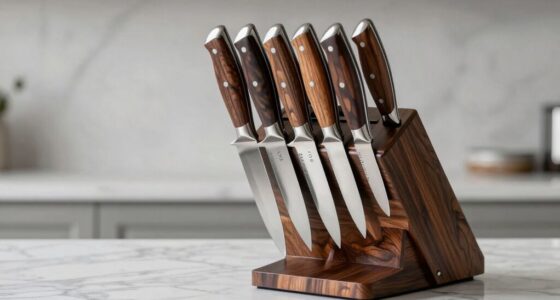
Good storage isn’t an afterthought—it’s edge insurance. Every time a blade rattles against other utensils in a drawer, the edge microscopically rolls or chips, silently undoing your sharpening work. That’s why magnetic strips, knife rolls, or drawer inserts matter: they keep each edge protected from impact and each blade protected from its neighbors. The hidden cost of loose drawer storage isn’t just dullness, either—reaching into a drawer of loose blades is one of the most common kitchen injuries.
Cleaning is simple, and the reasoning matters: hand-wash immediately after use because lingering food acids and moisture attack the edge and, on carbon steel, cause rust within hours. Dry thoroughly before storing—damp blades in enclosed spaces are where corrosion thrives. Dishwashers concentrate every hazard at once: high heat and harsh detergents degrade handle materials and edge temper, while rattling against racks hammers the blade. Even ‘dishwasher-safe’ knives survive; they don’t thrive.
Hygiene deserves real attention, especially if you cook for others. Wood handles can harbor bacteria in their pores if they crack, which is why professional kitchens favor sealed synthetic or micarta handles that can be fully sanitized. Inspect handles periodically—a loose or cracked handle isn’t cosmetic; it’s a failure point that can shift mid-cut. Combine sound handles with regular sharpening and you maintain not just the knife, but a workspace that’s genuinely safe and efficient.
Frequently Asked Questions
What is the best professional chef knife for a home cook?
The best knife depends on your hand size, the foods you prep most, and your maintenance routine. Generally, an 8-inch (20 cm) versatile chef’s or gyuto knife strikes a perfect balance for most tasks.How often should I sharpen my chef knife?
It varies with use. Heavy daily chopping might require every few weeks, while occasional home use can stretch to several months. Watch for dullness—if your cuts drag or squish, it’s time to sharpen.Can I put my chef knife in the dishwasher?
It’s best to hand-wash and dry immediately. Dishwashers expose knives to high heat, harsh detergents, and banging, which dulls edges and damages handles over time.What’s the difference between Japanese and Western chef knives?
Japanese knives tend to be thinner, harder, and sharper at lower angles, ideal for precision work. Western knives are generally thicker, more curved, and tougher, suited for heavier tasks.How do I tell if my knife is high quality?
Look for consistent grind, a well-finished edge, a comfortable handle, and a reputable manufacturer. Price isn’t everything—performance depends on the full system, not just steel or brand.Conclusion
Choosing a professional chef knife isn’t about chasing the priciest model. It’s about understanding how all the pieces—steel, geometry, handle, and your habits—fit together. When you find the right match, every slice, dice, and chop feels like second nature.
Remember, your knife is an extension of your hand. Treat it well, sharpen it often, and it’ll serve you for years to come, turning ordinary ingredients into extraordinary dishes.
Halloween Picks
halloween
As an affiliate, we earn on qualifying purchases.